Best Floor Coating Options: A Room-by-Room Guide
Discover the best floor coating options for every room. Compare epoxy, polyaspartic, and polyurethane systems with real costs and technical specs.

The Chemistry of Floor Coatings: A Quick Reference Matrix
Selecting the right floor coating requires matching the chemical properties of the resin to the specific environmental stressors of a room. A coating that excels in a garage may fail catastrophically in a sunlit living room. Below is a technical matrix comparing the four primary resin families used in residential and light-commercial applications.
| Coating Type | Cure Time | UV Stability | Best Room Application | Avg. Material Cost |
|---|---|---|---|---|
| 100% Solids Epoxy | 12-24 hours | Poor (Ambers) | Garages, Basements, Utility | $1.50 - $2.50 / sq ft |
| Polyaspartic | 1-4 hours | Excellent | Garages, Sunrooms, Patios | $3.00 - $5.00 / sq ft |
| Aliphatic Polyurethane | 8-12 hours | Excellent | Kitchens, Living Areas | $2.00 - $3.50 / sq ft |
| Penetrating Silicate | 2-4 hours | Excellent | Living Areas, Bedrooms | $0.50 - $1.00 / sq ft |
Garage & Utility Spaces: Heavy-Duty Protection
Garages endure thermal shock, impact from dropped tools, and chemical exposure from automotive fluids. The two dominant floor coating options here are 100% solids epoxy and polyaspartic polyurea.
100% Solids Epoxy vs. Water-Based Kits
Avoid big-box store water-based epoxy kits (typically 40-50% solids). These lack the film thickness required to bridge micro-cracks and degrade under hot tire pickup. Professional-grade 100% solids epoxies, such as Sherwin-Williams Macropoxy 646 or Rust-Oleum Professional High Performance Epoxy, build a 10-16 mil thick thermoset plastic shield.
The Polyaspartic Advantage
For homeowners who cannot wait 48 hours to park their cars, polyaspartic coatings (e.g., Citadel Polyaspartic) cure in under four hours, even at temperatures as low as 30°F. They are also entirely UV-stable, meaning they will not yellow if your garage door is left open in direct sunlight.
Kitchens & Laundry Rooms: Chemical and Spill Resistance
Kitchens and laundry rooms demand high chemical resistance against acidic foods, bleach, and enzymatic cleaners, alongside strict indoor air quality considerations.
Water-Based Aliphatic Polyurethanes
Solvent-based coatings off-gas volatile organic compounds (VOCs) that can taint food and degrade indoor air quality. According to the Environmental Protection Agency (EPA), indoor VOC levels can be up to ten times higher than outdoor levels during and immediately after applying conventional coatings.
For these spaces, water-based aliphatic polyurethanes are the optimal choice. Products like Bona Traffic HD (for wood subfloors) or Sherwin-Williams ArmorSeal Water-Based Polyurethane (for concrete) offer exceptional stain resistance with VOC levels well below 100 g/L. They provide a hard, cross-linked finish that resists yellowing from UV light streaming through kitchen windows.
Living Areas & Bedrooms: Aesthetic and Penetrating Sealers
In living spaces, the goal shifts from heavy industrial protection to aesthetics, comfort, and preserving the natural texture of the substrate.
Metallic Epoxies and Polished Concrete
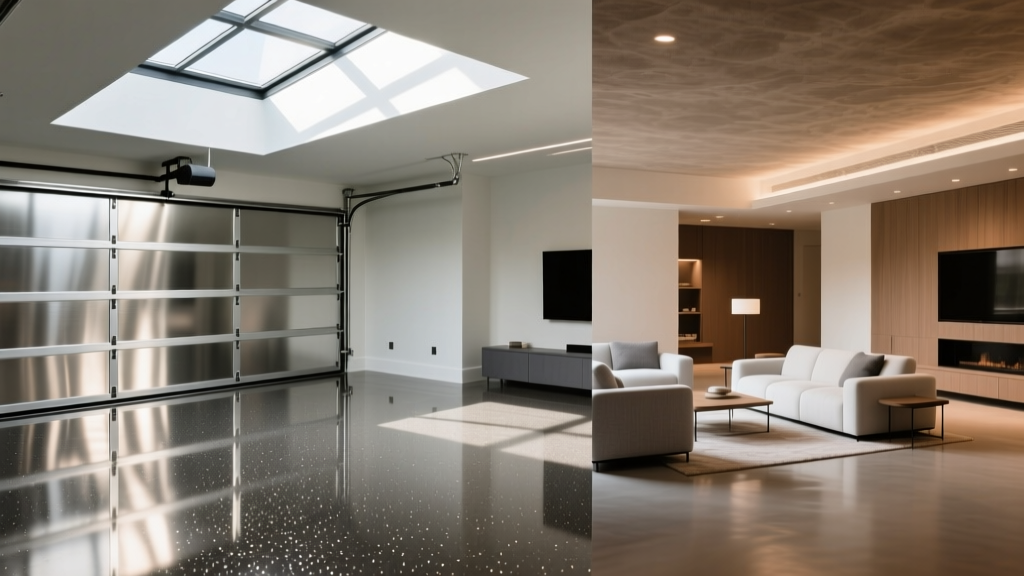
For a high-end, modern aesthetic over concrete slabs, metallic epoxy systems create a three-dimensional, pearlescent effect. However, because standard epoxies scratch easily under furniture legs, they must be top-coated with a sacrificial layer of ceramic-infused polyurethane.
Penetrating Lithium Silicate Densifiers
If you prefer the raw, industrial look of exposed concrete without the plastic-like film of a topical coating, use a penetrating lithium silicate densifier. Products like PROSOCO Consolideck LS react chemically with the free lime in concrete to form calcium silicate hydrate. This permanently hardens the top 1/4 inch of the slab, making it dust-proof and stain-resistant while maintaining the natural traction and matte appearance of the concrete. Because it penetrates rather than sitting on the surface, it will never peel or scratch.
Bathrooms: Waterproofing and Slip Resistance
Bathroom floors face constant water exposure and high slip risks. Standard glossy coatings become hazardous when wet.
Elastomeric Urethanes with Anti-Slip Aggregates
For bathroom tile or concrete, elastomeric urethane coatings provide a flexible, waterproof membrane that bridges grout lines and minor substrate shifts. To ensure safety, the coating must be broadcast with an anti-slip aggregate, such as aluminum oxide or polymer grit.
Slip Resistance Standard: When specifying anti-slip additives for wet areas, ensure the finished floor meets or exceeds a Dynamic Coefficient of Friction (DCOF) of 0.42, the threshold established by ANSI A137.1 for level interior floors expected to be wet.
The #1 Cause of Coating Failure: Subfloor Preparation
Industry data shows that over 75% of floor coating failures are due to improper surface preparation, not defective materials. The substrate must be mechanically profiled to allow the coating to anchor into the microscopic pores of the concrete or wood.
- Concrete Surface Profile (CSP): Most 100% solids epoxies require a CSP-2 or CSP-3 profile. This is achieved using planetary diamond grinders equipped with 30-grit or 40-grit metal-bonded diamond segments.
- The Acid Etching Myth: Muriatic acid etching is an outdated, unreliable preparation method. It leaves behind alkaline salts that neutralize the epoxy's curing agents, leading to soft, tacky spots and eventual delamination. Always mandate mechanical diamond grinding or shot blasting.
- Wood Subfloors: For plywood or OSB, sanding to a 60-grit finish and applying a flexible polyurea base coat is mandatory to accommodate the natural expansion and contraction of the wood without cracking the topcoat.
2026 Cost Breakdown: Materials and Professional Installation
Pricing for floor coatings varies significantly based on the resin chemistry, the condition of the existing substrate, and the level of decorative flake or metallic pigments added. Below is the current national average for professional installation, including diamond grinding, crack repair, and a two-coat system.
| Room / Application | Recommended System | Avg. Installed Cost (per sq ft) | Expected Lifespan |
|---|---|---|---|
| Standard Garage | 100% Solids Epoxy + Polyurethane Topcoat | $5.50 - $7.50 | 10 - 15 years |
| Premium Garage / Sunroom | Polyaspartic Polyurea with Full Flake | $8.00 - $12.00 | 15 - 20+ years |
| Kitchen (Concrete) | Water-Based Polyurethane | $4.00 - $6.00 | 7 - 10 years |
| Living Area (Concrete) | Lithium Silicate Densifier + Burnishing | $3.00 - $5.00 | Lifetime (Re-burnish every 5 yrs) |
| Bathroom (Tile/Concrete) | Elastomeric Urethane + Aluminum Oxide | $6.50 - $9.00 | 8 - 12 years |
Written by
Priya KapoorPriya Kapoor is a real estate market analyst and construction economics researcher with expertise in housing affordability, development feasibility, and infrastructure investment. She holds a Master of Regional Planning from Cornell University and previously worked as a senior analyst at CBRE's Investment Properties group, where she modeled returns for $4B in mixed-use development pipelines. Priya now runs an independent research practice advising developers, municipalities, and REITs on construction cost forecasting and market timing. She publishes the quarterly "BuildMat Market Pulse" report tracking material price indices across 12 commodity categories. Based in Austin, TX, Priya serves on the board of Habitat for Humanity Austin and is a marathon runner.
More from Priya Kapoor
View all
Construction Cost
Cost to Build a 1600 Sq Ft Home in 2026: Full Breakdown
Accurate 2026 cost to build a 1600 sq ft home—material, labor, and regional pricing breakdowns included. Plan your budget with real-time estimates.
Aug 11, 2026

Wood & Lumber
Name the Types of Wood for Pressure Treatment and Preservation
Learn how to name the types of wood best suited for pressure treatment. Compare species treatability, chemical retention levels, and 2026 preservation costs.
Aug 4, 2026

Stone & Masonry
Stone Veneer Suppliers Lindenhurst: 2026 Cost Analysis
Analyze 2026 stone veneer costs in Lindenhurst, NY. Compare local supplier pricing, delivery fees, and Suffolk County installation labor rates.
Aug 4, 2026