Most Affordable Flooring Options for Every Room (2026)
Compare the most affordable flooring options for 2026. Analyze real costs, wear layers, AC ratings, and room-by-room strategies for budget renovations.
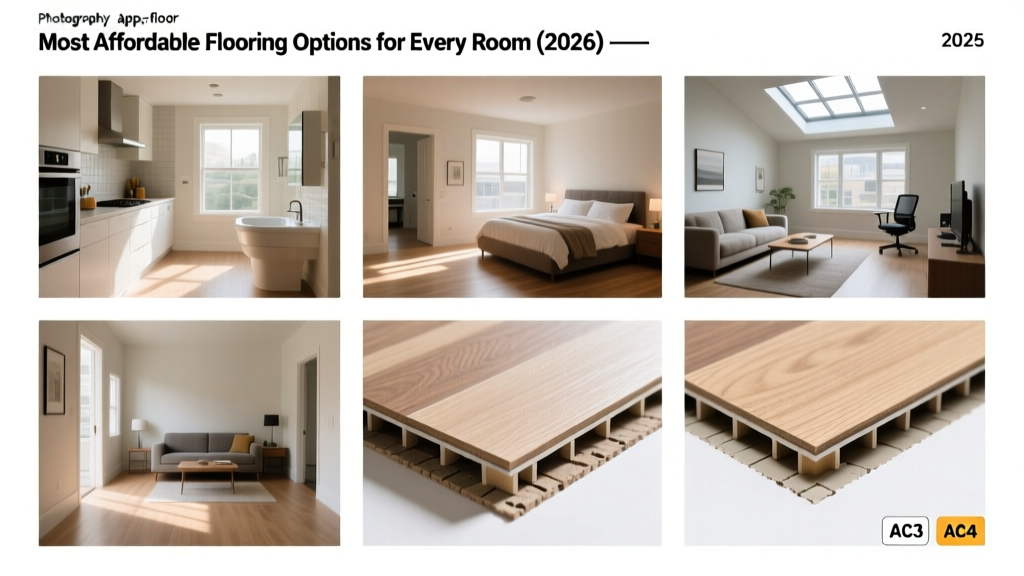
When planning a budget-conscious renovation, evaluating the most affordable flooring options requires looking beyond the sticker price per square foot. The true cost of flooring encompasses material pricing, subfloor preparation, installation labor, and long-term replacement cycles. A material that costs $1.50 per square foot but requires a $2.00 per square foot self-leveling compound and fails in three years is ultimately more expensive than a $3.50 per square foot product that installs directly over minor imperfections and lasts a decade.
This guide breaks down the technical specifications, hidden costs, and optimal applications for the most cost-effective flooring materials available in 2026, providing actionable frameworks for residential and light-commercial projects.
The True Cost Matrix: Material vs. Installed Reality
The table below outlines current national averages for budget-tier flooring. Note that 'Pro Install' costs assume a standard, level subfloor. Any remediation (grinding, leveling, or tear-out) will add $1.00 to $3.50 per square foot to these baselines.
| Material Type | Material Cost (sq. ft.) | Pro Install (sq. ft.) | Expected Lifespan | Best Application |
|---|---|---|---|---|
| Sheet Vinyl (Fiberglass) | $1.25 - $2.50 | $1.50 - $2.50 | 10 - 15 Years | Bathrooms, Laundry, Kitchens |
| Peel-and-Stick Vinyl Tile | $0.50 - $1.50 | $1.00 - $1.50 | 3 - 5 Years | Low-traffic rentals, temporary flips |
| Click-Lock LVP (SPC Core) | $2.50 - $4.50 | $2.00 - $3.50 | 15 - 20 Years | Living areas, basements, kitchens |
| Laminate (8mm - 12mm) | $2.00 - $4.00 | $2.00 - $3.00 | 15 - 25 Years | Dry living areas, bedrooms |
| Acid-Stained Concrete | $3.00 - $5.00 | $4.00 - $7.00 | 50+ Years | Slab-on-grade main floors, garages |
Sheet Vinyl: The Waterproof Budget Champion
Modern sheet vinyl has evolved significantly from the brittle, easily torn materials of the past. For wet areas where luxury vinyl plank (LVP) seams might allow moisture intrusion, fiberglass-backed sheet vinyl remains the most affordable and reliable waterproof option.
Fiberglass vs. Felt Backing: The Installation Difference
When purchasing sheet vinyl, the backing material dictates your installation cost and method:
- Fiberglass-Backed: This material is dimensionally stable and will not curl or shrink. It can be installed using a 'loose-lay' method (secured only at the perimeter with double-sided tape) or with a perimeter glue. This drastically cuts installation time and adhesive costs.
- Felt-Backed: Requires a full-spread adhesive application over the entire subfloor. If installed without full glue, felt will buckle, shrink, and telegraph subfloor imperfections. While the material itself is sometimes $0.30 cheaper per square foot, the adhesive and labor costs negate the savings.
Luxury Vinyl Plank (LVP): Navigating Core Materials
LVP dominates the mid-budget market, but not all planks are engineered equally. The core composition determines the floor's rigidity, acoustic properties, and ability to hide subfloor flaws.
SPC vs. WPC Cores
Stone Plastic Composite (SPC) cores are made from limestone dust and PVC. They are highly rigid, dent-resistant, and generally cost $0.50 to $1.00 less per square foot than Wood Plastic Composite (WPC) cores. WPC cores contain a foaming agent, making them thicker, softer underfoot, and better at sound absorption, but they are more susceptible to heavy point-load denting (like from appliance legs).
For the most affordable flooring options that do not sacrifice structural integrity, target an SPC core with a minimum thickness of 4.0mm and a wear layer of at least 12-mil (0.3mm). According to testing standards highlighted by Consumer Reports flooring evaluations, a 12-mil wear layer is the absolute baseline for residential scratch resistance, while 20-mil is recommended for homes with large dogs or high foot traffic.
Laminate Flooring: Decoding AC Ratings and HDF Density
Laminate flooring offers the most realistic wood-grain photography and embossed-in-register (EIR) textures at a budget price point. However, its Achilles' heel is moisture. When shopping for affordable laminate, ignore the marketing jargon and look strictly at the AC (Abrasion Class) rating and the High-Density Fiberboard (HDF) core density.
- AC3 Rating: Suitable for moderate residential traffic (bedrooms, dining rooms). This is the cheapest tier and will show wear patterns in high-traffic hallways within 5 to 7 years.
- AC4 Rating: Designed for general commercial or heavy residential use. An AC4 laminate from brands like Pergo or TrafficMaster will cost roughly $0.75 more per square foot than AC3 but will double the functional lifespan in a living room or kitchen.
Furthermore, check the HDF core density. Budget laminates use cores with a density of 750 kg/m³, which swell and disintegrate if water sits on the seams for more than an hour. Look for 'water-resistant' laminates that utilize high-density cores (850+ kg/m³) and hydrophobic edge sealants. As noted in Home Depot's comprehensive flooring guides, modern water-resistant laminates can withstand surface moisture for up to 24 hours, bridging the gap between traditional laminate and LVP.
Exposed Concrete: The Slab-on-Grade Advantage
If you are renovating a basement, garage, or slab-on-grade main floor, the most affordable flooring option might be the subfloor itself. Removing existing glued-down carpet or vinyl and refinishing the concrete slab eliminates material costs entirely.
Grinding, Staining, and Sealing
The process involves diamond-grinding the slab to expose the aggregate, applying an acid stain or concrete dye, and sealing it with a polyurethane or epoxy topcoat. While DIY acid staining kits cost around $0.50 per square foot, professional concrete polishing and sealing typically range from $4.00 to $7.00 per square foot. This is highly competitive with mid-tier LVP when you factor in the zero-maintenance lifespan and the elimination of underlayment and transition moldings.
Budget Red Flags: What to Avoid in 2026
When hunting for the most affordable flooring options, certain products will cost you exponentially more in remediation and replacement. Avoid these specific red flags:
- No-Name LVP with 4-Mil Wear Layers: Often sold in bulk at liquidation centers, these planks lack UV stabilizers (causing them to yellow near windows) and have wear layers so thin that the printed design rubs off within two years.
- Laminate Without an Attached Pad: If you buy $1.50/sq. ft. laminate without an attached underlayment, you must purchase a separate foam pad ($0.40/sq. ft.) to meet basic acoustic standards (IIC/STC ratings) required by most HOAs and multi-family building codes. The combined cost pushes it out of the 'ultra-budget' tier.
- Ceramic Tile on Wood Subfloors: While the tile itself can be cheap ($1.00/sq. ft.), installing it over a wood-framed subfloor requires cement backer board, thin-set mortar, and grout. The labor and prep materials will easily push the installed cost past $12.00 per square foot, destroying any material savings.
Room-by-Room Allocation Strategy
To maximize a tight budget, allocate your spending based on the environmental stressors of each specific room rather than installing a single, uniform floor throughout the house.
- Bathrooms & Laundry: Use fiberglass-backed sheet vinyl. The seamless nature prevents water from reaching the subfloor, and the material cost remains under $2.50 per square foot.
- Living Rooms & Bedrooms: Use 8mm or 10mm AC3 laminate. These are dry areas where laminate's acoustic warmth and scratch resistance outperform cheap LVP, and you avoid the premium cost of thick WPC cores.
- Kitchens & Entryways: Invest in 5.0mm SPC LVP with a 20-mil wear layer. These areas endure dropped utensils, wet shoes, and heavy appliance traffic. SPC's rigidity prevents denting from refrigerators, and the click-lock seams handle minor moisture spills.
- Basements: If the slab is dry, acid-stained concrete is the most durable and cost-effective choice. If moisture is a concern, use a floating SPC LVP with a built-in vapor barrier underlayment to prevent mold growth trapped beneath the floor.
By matching the technical specifications of the material to the exact demands of the room, you can achieve a high-end, durable result while strictly adhering to a budget-conscious bottom line. Always request manufacturer specification sheets to verify wear layer thickness and core density before purchasing any discounted or liquidation flooring.
Written by
James ThorntonJames Thornton is a construction industry veteran with 25 years of hands-on experience in wood framing, lumber grading, and residential building codes. He started as a framing carpenter in rural Oregon, earned his ICC Residential Building Inspector certification, and eventually became a senior plan reviewer for the City of Portland Bureau of Development Services. James holds a B.S. in Wood Science & Technology from Oregon State University and is a certified lumber grader through the West Coast Lumber Inspection Bureau (WCLIB). He has inspected over 3,000 residential construction sites and authored the city's internal guide on advanced framing techniques (2x6 at 24" O.C.). James lives in Bend, OR, where he builds custom timber-frame cabins and competes in lumberjack sports.
More from James Thornton
View all
Insulation
Best Home Insulation Materials: Complete 2026 Guide
Compare top home insulation materials for 2026. Find R-values, installed costs per square foot, and best uses for fiberglass, spray foam, and mineral wool.
Aug 4, 2026

Sustainable Building
Certify Your Green Building Material for LEED and WELL
Step-by-step guide to certifying a green building material for LEED v5 and WELL v2. Master EPDs, HPDs, and VOC limits for 2026 project specifications.
Aug 4, 2026

Stone & Masonry
Veneer Stacked Stone Panels: Interior Design & Style Showcase
Discover how veneer stacked stone panels transform interiors. Explore modern design profiles, material pairings, and technical installation specs.
Aug 4, 2026