Industrial Ride On Floor Scrubber Janesville: Prep & Coating Guide
Master surface prep and coating application for Janesville industrial floors using ride-on scrubbers. Includes hard water tips and CSP pad matrices.
Janesville’s Unique Industrial Flooring Environment
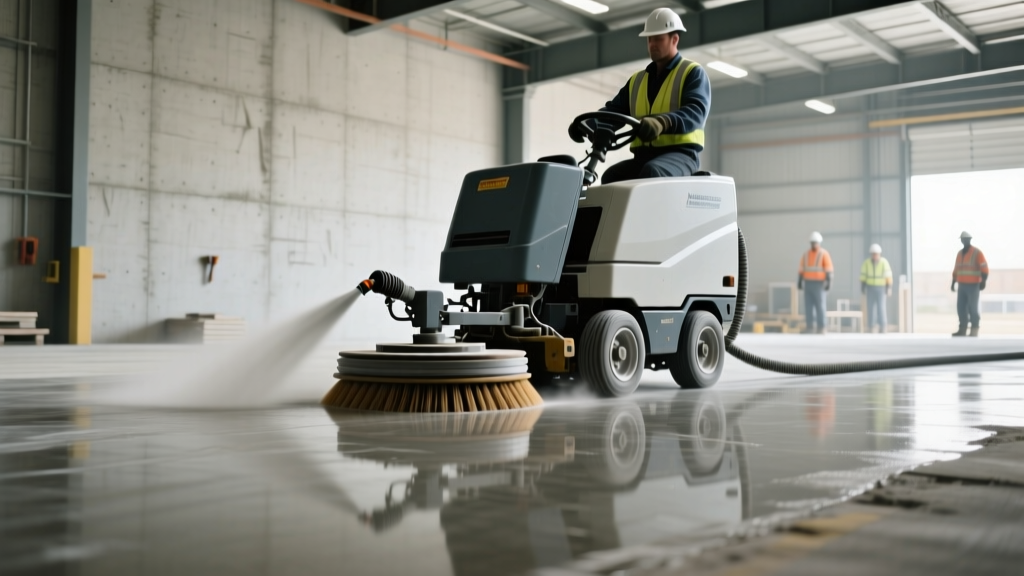
Facilities along the I-39/I-90 corridor in Janesville, Wisconsin, endure extreme operational stress. Logistics hubs and manufacturing plants rely on heavy-duty floor coatings—specifically 100% solids epoxy, polyaspartic topcoats, and urethane cement—to withstand forklift traffic and chemical spills. However, the success of any industrial flooring installation hinges entirely on surface preparation. An industrial ride on floor scrubber in Janesville is not merely a cleaning tool; it is the primary mechanical engine for achieving the necessary Concrete Surface Profile (CSP) and removing contaminants before coating application.
Contractors and facility managers in Rock County face two distinct environmental challenges that dictate scrubber operation:
- Hard Water Scaling: According to the USGS Water Science School, groundwater in the Rock River valley typically exhibits moderate to high hardness (12–18 grains per gallon). When mixed with alkaline floor prep chemicals in a scrubber’s solution tank, this calcium and magnesium content rapidly precipitates, clogging solenoid valves and reducing chemical efficacy.
- Winter Salt Tracking: Janesville’s freezing winters necessitate the heavy use of magnesium chloride (MgCl2) and rock salt. These hygroscopic salts embed into concrete pores. If not aggressively extracted via ride-on scrubbing prior to epoxy installation, they cause osmotic blistering and catastrophic coating delamination.
Selecting the Ride-On Scrubber for Surface Prep
Not all ride-on scrubbers are engineered for the down-pressure required in coating prep. Standard daily-cleaning models (like the Tennant T5) lack the head weight to drive diamond-impregnated pads into the concrete matrix. For industrial coating prep in Janesville facilities, you must deploy heavy-duty models such as the Tennant T16 or Nilfisk SC6500.
Critical Machine Specifications
| Specification | Requirement for Coating Prep | Why It Matters |
|---|---|---|
| Head Weight / Down-Pressure | 150 lbs – 300 lbs (adjustable) | Forces diamond abrasives into the concrete to open pores and achieve CSP 2-3. |
| Squeegee Blade Durometer | 85A Polyurethane | Stiffer blades prevent water bypass during high-speed extraction, leaving the slab dry. |
| Vacuum Motor Lift | Minimum 80 inches of water lift | Ensures complete recovery of suspended silica dust and salt residues. |
| Solution Tank Capacity | 40 – 60 Gallons | Reduces refill downtime during the alkaline degreasing phase. |
Step-by-Step Surface Preparation Protocol
Before a single drop of primer is applied, the concrete must be profiled and chemically neutralized. Follow this exact sequence using your ride-on scrubber to guarantee adhesion testing meets International Concrete Repair Institute (ICRI) standards.
- Dry Pre-Sweep & Edge Work: Use an automated walk-behind sweeper to remove macro-debris. Hand-scrape pallet rack leg pads and tire marks using a carbide scraper. The ride-on scrubber cannot reach within 14 inches of walls; edge work must be done with a hand-held planetary grinder.
- Alkaline Degreasing Pass: Fill the scrubber with hot water (120°F) and a heavy-duty alkaline degreaser (pH 11-12) diluted at 1:64. Mount black stripping pads (400 RPM). Drive at 2.5 mph with 4-inch overlaps. This emulsifies hydraulic fluid and winter salt residues.
- Extraction & Rinse: Engage the vacuum squeegee. Immediately follow with a clean-water rinse pass using red buffing pads to agitate and extract the suspended chemical slurry.
- Mechanical Profiling (Diamond Scrubbing): Swap pads for 50-grit or 100-grit diamond-impregnated maintenance pads (e.g., HTC Twister or 3M Trizact). Increase machine down-pressure to 200 lbs. Run the scrubber dry or with a neutral pH lubricant. This cuts the laitance and opens the concrete pores to achieve a CSP 2 or CSP 3.
- Final Vacuum Extraction: Perform a final pass with clean water and a stiff polyurethane squeegee blade to pull all micro-silica out of the pores. The slab should be visibly dry within 15 minutes of the scrubber passing.
Concrete Surface Profile (CSP) & Pad Matrix
Matching the diamond pad grit to your target coating is critical. Epoxies require deeper profiles than polyurethanes. Use this matrix to configure your scrubber:
| Coating System | Target CSP | Scrubber Pad Grit | Machine Down-Pressure | Passes Required |
|---|---|---|---|---|
| 100% Solids Epoxy Mortar | CSP 3 - 4 | 30 / 50 Grit Diamond | 250 - 300 lbs | 2 (Cross-hatch pattern) |
| Standard Epoxy Flood Coat | CSP 2 - 3 | 100 Grit Diamond | 150 - 200 lbs | 1 - 2 (Linear overlap) |
| Polyaspartic / Urethane | CSP 1 - 2 | 200 / 400 Grit Resin | 100 - 150 lbs | 1 (Linear overlap) |
Transitioning from Prep to Coating Application
Once the ride-on scrubber has completed the mechanical profiling, the slab must be tested for moisture. Even with aggressive extraction, Janesville’s high water table can cause hydrostatic pressure issues. Perform in-situ Relative Humidity (RH) testing per ASTM F2170. If RH levels exceed 75%, a moisture-mitigating epoxy primer must be applied before the main coating system.
Ensure all scrubber maintenance is completed off-site or in a designated wash bay. Cleaning the scrubber’s recovery tank near the prepped slab risks splashing contaminated, high-pH water onto the open concrete pores, which will ruin the upcoming pull-off adhesion tests (ASTM D7234).
Chemical Handling and Safety
Operators handling the concentrated alkaline and acidic neutralizers required for this prep process must comply with the OSHA Hazard Communication Standard. Safety Data Sheets (SDS) for all scrubber chemicals must be kept in the machine’s cab, and operators must wear chemical-resistant gloves and splash goggles during the tank-mixing phase.
Post-Application Maintenance & Curing Protocols
The role of the industrial ride on floor scrubber does not end at installation. Improper post-installation cleaning is the leading cause of premature coating failure in logistics facilities.
- The 7-Day Cure Rule: Do not introduce water or scrubbers to a newly installed 100% solids epoxy or urethane floor for a minimum of 7 days. Early exposure to water can cause amine blush (a waxy, sticky surface film) that ruins the aesthetic and slip resistance.
- Neutral pH Maintenance: Once cured, switch the scrubber’s chemistry to a neutral pH cleaner (7.0 - 8.0). High-alkaline cleaners will eventually degrade the cross-link density of polyaspartic topcoats, causing them to chalk and lose gloss.
- Squeegee Maintenance: Inspect the scrubber’s squeegee blade weekly. A worn blade leaves a 1mm film of dirty water behind the machine. In a warehouse, this film dries into abrasive silica dust that acts like sandpaper under forklift tires, scratching the new floor.
Troubleshooting Common Application Failures
When coating installations fail in Rock County facilities, the root cause is almost always traceable to the scrubber prep phase. Diagnose issues using this framework:
Cause: Incomplete extraction of magnesium chloride winter salts. The salts attracted ambient moisture through the semi-permeable epoxy membrane.
Fix: Strip the coating via shot blasting. Re-scrub with hot water and an ion-chelating detergent to bind and extract the salts before repriming.
Cause: Insufficient down-pressure during the diamond scrubbing phase, resulting in a CSP 1 instead of the required CSP 3. The epoxy lacked mechanical teeth to grip the concrete.
Fix: Increase machine head weight to 250+ lbs and switch to a 50-grit diamond pad for future prep cycles.
Mastering the intersection of heavy machinery operation, concrete chemistry, and coating specifications is what separates temporary floor patches from decade-long industrial flooring solutions. By adapting your ride-on scrubber protocols to Janesville’s specific water and climate conditions, you ensure maximum adhesion, durability, and return on investment for your facility's flooring assets.