Minneapolis Metro Budget-Friendly Flooring Installation Options (2026)
Compare 2026 costs for budget-friendly flooring installation options in the Minneapolis metro, including SPC vinyl, laminate, and local labor rates.

The Twin Cities Climate Penalty: Why Upfront Costs Can Be Deceiving
Minneapolis winters demand flooring that withstands heavy snowmelt, corrosive ice-melting chlorides, and drastic indoor humidity shifts. When evaluating budget-friendly flooring installation options in the Minneapolis metro, the lowest upfront price often leads to premature failure if the material cannot handle local conditions. Solid hardwood, for example, is highly susceptible to winter gapping due to dry indoor air and summer cupping from humidity spikes. Therefore, a true cost analysis must factor in the 'climate penalty'—the hidden cost of replacing water-damaged or warped floors within five years.
This 2026 cost breakdown isolates the most resilient, cost-effective flooring materials for Hennepin and Ramsey County homes, providing exact material pricing, local labor rates, and the specific technical grades required to survive Minnesota winters.
2026 Cost Matrix: Budget Flooring Materials vs. Minneapolis Durability
The following matrix reflects average 2026 pricing for the Twin Cities market, combining material costs with professional installation. Prices assume a standard 500-square-foot project on a wood subfloor.
| Material Type | Material Cost (per sq. ft.) | Installation Cost (per sq. ft.) | Total Project Cost (500 sq. ft.) | Best Local Application |
|---|---|---|---|---|
| SPC Rigid Core Vinyl Plank | $3.50 - $5.50 | $2.50 - $4.00 | $3,000 - $4,750 | Mudrooms, entryways, basements |
| AC4 Water-Resistant Laminate | $2.50 - $4.50 | $3.00 - $4.50 | $2,750 - $4,500 | Living rooms, main-level bedrooms |
| Fiberglass-Backed Sheet Vinyl | $1.50 - $3.00 | $2.50 - $4.00 | $2,000 - $3,500 | Kitchens, utility rooms, laundry |
| Engineered Hardwood (Thin Veneer) | $4.50 - $7.00 | $4.00 - $6.50 | $4,250 - $6,750 | Formal dining rooms, upper-level living |
Material Deep-Dive: The Best Budget Contenders for Cold Climates
Stone Plastic Composite (SPC) Luxury Vinyl Plank
SPC has become the undisputed leader for budget-friendly flooring installation options in the Minneapolis metro, primarily due to its limestone-dust core. Unlike traditional flexible vinyl or wood-plastic composite (WPC), SPC does not expand or contract significantly with temperature fluctuations. This is critical for Minneapolis homes that experience wide temperature swings between seasons or in rooms with inconsistent heating.
- Required Spec: Demand a minimum 20-mil wear layer. A 12-mil layer will scratch easily from embedded gravel and sand tracked in from winter boots.
- Installation Advantage: SPC utilizes a click-lock floating system, allowing it to be installed directly over existing tile or hardwood without costly tear-out, saving roughly $2.00 to $3.50 per square foot in demolition labor.
- Subfloor Tolerance: Because the core is rigid, SPC requires a flatter subfloor (typically 3/16-inch variance over 10 feet). Older South Minneapolis bungalows often require self-leveling compound, adding $1.50 to $2.50 per square foot to the prep budget.
AC4-Rated Water-Resistant Laminate
Modern laminate has evolved past the swelling issues of the 2010s, provided you select the correct abrasion class (AC) and moisture rating. For the Twin Cities, an AC4 rating (moderate commercial) is the minimum threshold to withstand the grit and debris brought in during winter months.
- Moisture Protection: Look for 'hydro-seal' or wax-treated bevels. Standard laminate will absorb snowmelt from boots and swell at the seams within hours. Water-resistant models buy you a 24-to-72-hour window to wipe up moisture.
- Acoustic Underlayment: Laminate is inherently loud. Budget an additional $0.45 to $0.85 per square foot for a high-density foam underlayment with an IIC (Impact Insulation Class) rating of 50 or higher, especially for second-story installations in multi-family duplexes common in St. Paul.
Fiberglass-Backed Sheet Vinyl
For pure cost-efficiency in wet zones, sheet vinyl remains unbeatable. Modern fiberglass-backed sheet vinyl offers dimensional stability that older felt-backed versions lacked. Because it can be installed with minimal seams (or entirely seamless in rooms under 12 feet wide), it prevents snowmelt and salt water from penetrating the subfloor.
Warning: Radiant Heat Compatibility
Many Minneapolis homes built or renovated in the last decade feature hydronic or electric radiant floor heating. According to the U.S. Department of Energy guidelines on radiant heating, flooring materials must have a low thermal resistance (R-value) to allow heat transfer. SPC vinyl and thin engineered hardwood are generally safe, but always verify the manufacturer's maximum surface temperature limit (usually 85°F). Thick laminates and cork-backed vinyls will insulate the heat, driving up your winter utility bills and potentially overheating the system.
Minneapolis Labor Rates and Hidden Installation Costs
According to HomeGuide's regional flooring installation cost data, labor rates fluctuate based on local demand and union prevalence. In the Minneapolis-St. Paul metro, professional flooring installers typically charge between $45 and $85 per hour, translating to the per-square-foot installation costs listed in the matrix above. However, local contractors frequently encounter specific hidden costs that inflate the final invoice.
Common Local Cost Adders
- Asbestos Abatement in Older Homes: Homes built before 1980 (abundant in neighborhoods like Longfellow, Powderhorn, and Highland Park) often have 9x9 inch vinyl asbestos tiles (VAT) glued to the subfloor. If you choose to remove this rather than float a new floor over it, expect to pay $4.00 to $8.00 per square foot for certified abatement.
- Subfloor Leveling: Decades of freeze-thaw cycles cause foundation settling in Twin Cities homes, leading to sloped or uneven joists. Pouring self-leveling underlayment costs roughly $1.20 to $2.50 per square foot but is mandatory for rigid click-lock floors.
- Baseboard and Quarter-Round Replacement: Installing a floating floor requires an expansion gap around the perimeter. If your existing baseboards are too thin to cover the gap, you must install quarter-round molding. Labor and materials for this add $1.50 to $3.00 per linear foot.
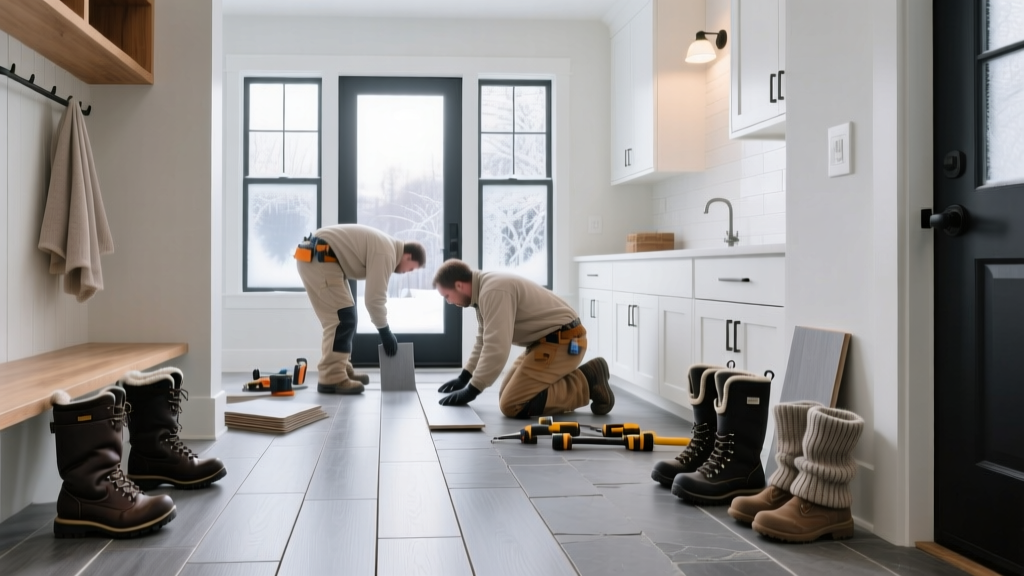
Strategic Sourcing in the Metro Area
Where you buy your materials significantly impacts your bottom line. While big-box stores offer convenience, local liquidators and specialized warehouses often provide commercial-grade materials at residential budget prices.
- Big Box Stores (Home Depot, Lowe's, Menards): Best for DIYers buying small quantities. Menards, heavily concentrated in the Midwest, frequently runs 11% rebate promotions on flooring materials, which can offset the cost of premium underlayment or transition strips.
- Specialty Warehouses (Floor & Decor in Bloomington): Ideal for mid-to-large projects. They carry a massive inventory of SPC and laminate, often priced 15% to 20% lower than traditional showrooms because they eliminate the middleman. The trade-off is that you must arrange your own delivery or rent a truck.
- Local Liquidators and Habitat for Humanity ReStores: For ultra-budget projects, landlords, or flip properties, the Twin Cities Habitat ReStores (located in Minneapolis, St. Paul, and New Brighton) occasionally receive surplus contractor-grade flooring. You can find name-brand engineered hardwood or laminate for $1.00 to $2.00 per square foot, though matching dye lots across multiple boxes is nearly impossible.
Decision Framework: Matching Floor to Room and Budget
To maximize your budget without sacrificing durability against Minnesota's harsh elements, apply this decision matrix to your floor plan:
Quick Selection Guide
Zone 1: The Drop Zone (Mudrooms, Foyers, Garage Entries)
Requirement: 100% waterproof, salt-resistant, heavy abrasion tolerance.
Choice: SPC Rigid Core Vinyl with a textured, low-gloss finish to hide winter grit.
Zone 2: High-Traffic Living (Kitchens, Main Hallways)
Requirement: Spill resistance, comfortable underfoot, easy maintenance.
Choice: Fiberglass-backed sheet vinyl (for tightest budgets) or AC4 water-resistant laminate (for better aesthetics).
Zone 3: Dry Comfort Zones (Bedrooms, Formal Living)
Requirement: Warmth, acoustic dampening, visual appeal.
Choice: Thin-veneer engineered hardwood with a high-quality acoustic underlayment, or premium WPC vinyl if radiant heat is not present.
For further verification on contractor pricing and regional labor variations, reviewing Angi's comprehensive guide to flooring installation costs can help you benchmark quotes from local Twin Cities installers. By prioritizing climate-appropriate materials like SPC and AC4 laminate, and accurately budgeting for the unique subfloor conditions of older Minneapolis homes, you can achieve a durable, high-end look without exceeding a strict budget.
Written by
James ThorntonJames Thornton is a construction industry veteran with 25 years of hands-on experience in wood framing, lumber grading, and residential building codes. He started as a framing carpenter in rural Oregon, earned his ICC Residential Building Inspector certification, and eventually became a senior plan reviewer for the City of Portland Bureau of Development Services. James holds a B.S. in Wood Science & Technology from Oregon State University and is a certified lumber grader through the West Coast Lumber Inspection Bureau (WCLIB). He has inspected over 3,000 residential construction sites and authored the city's internal guide on advanced framing techniques (2x6 at 24" O.C.). James lives in Bend, OR, where he builds custom timber-frame cabins and competes in lumberjack sports.
More from James Thornton
View all
Insulation
Best Home Insulation Materials: Complete 2026 Guide
Compare top home insulation materials for 2026. Find R-values, installed costs per square foot, and best uses for fiberglass, spray foam, and mineral wool.
Aug 4, 2026

Sustainable Building
Certify Your Green Building Material for LEED and WELL
Step-by-step guide to certifying a green building material for LEED v5 and WELL v2. Master EPDs, HPDs, and VOC limits for 2026 project specifications.
Aug 4, 2026

Stone & Masonry
Veneer Stacked Stone Panels: Interior Design & Style Showcase
Discover how veneer stacked stone panels transform interiors. Explore modern design profiles, material pairings, and technical installation specs.
Aug 4, 2026