Best Commercial Kitchen Flooring Options for Safety and Durability
Compare the best commercial kitchen flooring options. Expert analysis on urethane, quarry tile, slip resistance, and FDA coving codes.
The True Cost of Commercial Kitchen Flooring Failures
Specifying the wrong floor in a high-volume culinary environment is a multi-million dollar liability. Beyond the immediate cost of replacement, failed flooring leads to health department shutdowns due to bacterial harborage in cracked grout, and massive worker's compensation claims from slip-and-fall incidents. According to OSHA guidelines on slip and fall prevention, wet and greasy floors are the primary culprit in restaurant workplace injuries. When evaluating commercial kitchen flooring options, facility managers must look past initial square-foot pricing and prioritize thermal shock resistance, chemical tolerance, and long-term coefficient of friction (COF) retention.
Decoding Slip Resistance: DCOF vs. Greasy Realities
The ANSI A137.1 standard mandates a Dynamic Coefficient of Friction (DCOF) of 0.42 or greater for level interior spaces. However, this metric is tested using a specific soapy water solution. It does not account for animal fats, vegetable oils, or flour dust. For commercial kitchens, a DCOF of 0.42 is dangerously insufficient. You must specify flooring with a wet/greasy COF exceeding 0.60. This is achieved not through the base material alone, but through engineered surface profiles—such as aluminum oxide broadcasts in resinous floors or the natural micro-porosity of extruded clay tiles.
Material Matrix: What Actually Survives the Line?
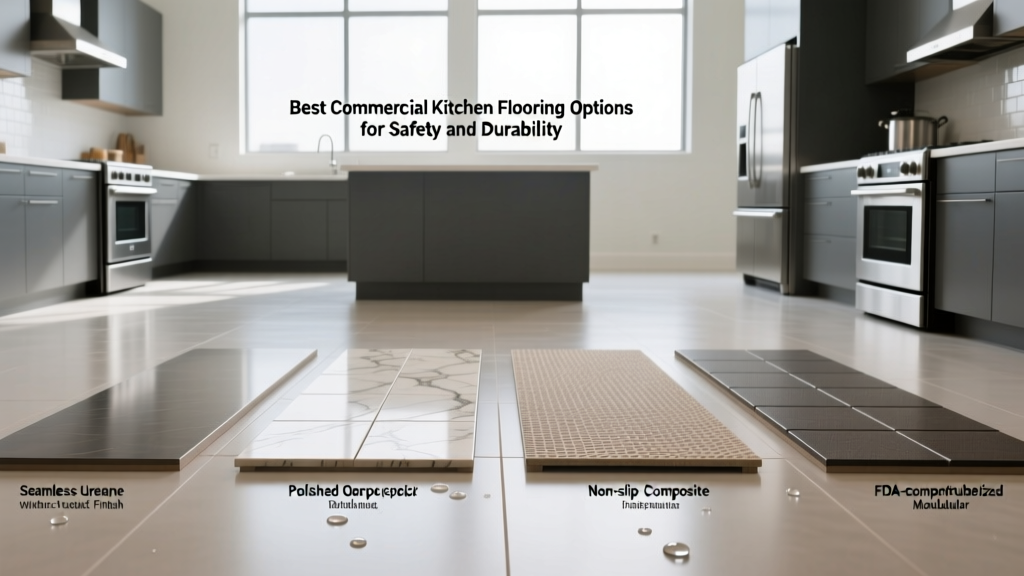
Below is a technical comparison of the top commercial kitchen flooring options, evaluating their performance against the extreme conditions of a working kitchen line.
| Material Type | Installed Cost (per sq. ft.) | Thermal Shock Limit | Expected Lifespan | Best Application |
|---|---|---|---|---|
| Urethane Mortar | $14.00 - $22.00 | Up to 250°F+ | 15 - 20+ Years | Hot line, fryers, dish pits |
| Unglazed Quarry Tile | $9.00 - $16.00 | High (Clay body) | 20 - 30 Years | Prep areas, main kitchen floors |
| Commercial Sheet Vinyl | $6.00 - $10.00 | Low (Softens >140°F) | 7 - 10 Years | Dry storage, server stations |
| Standard Epoxy | $5.00 - $9.00 | Low (Softens >120°F) | 3 - 5 Years | Not recommended for hot zones |
Urethane Mortar Systems (The Heavy-Duty Standard)
Urethane mortar (often referred to by the legacy brand name Ucrete) is the undisputed champion for heavy-duty culinary environments. Applied at a thickness of 1/4-inch to 3/8-inch, this system features a coefficient of thermal expansion that closely matches concrete. When a cook drops a pot of boiling water or hot oil, standard epoxy will undergo a glass transition, soften, and delaminate. Urethane mortar remains stable at temperatures exceeding 250°F. Furthermore, it is inherently antimicrobial and can be installed with an integral quartz sand broadcast to guarantee a >0.60 COF even when coated in grease.
Unglazed Quarry Tile (The Traditional Workhorse)
Extruded, unglazed quarry tile remains a highly viable option, provided it is installed correctly. The critical failure point in tile systems is the grout. Standard cementitious grout is porous, absorbs fats, and harbors Listeria and Salmonella. To meet modern health codes, quarry tile must be set with a 100% solids epoxy grout. Additionally, specify 1/2-inch thick tiles with a 1/8-inch maximum grout joint width to minimize the surface area of the grout lines. The Tile Council of North America (TCNA) provides specific handbook details for heavy-duty commercial tile installations that contractors must follow to prevent lippage and cracking under point-loads from heavy equipment.
Commercial Sheet Vinyl (The Budget Alternative)
For budget-constrained projects or low-moisture zones like server alleys and dry storage, commercial-grade heterogeneous sheet vinyl is a practical choice. The mandatory requirement here is heat-welded seams. Unlike residential vinyl that relies on adhesive butting, commercial sheet vinyl seams are routed and filled with a matching PVC weld rod, creating a monolithic, waterproof surface. However, vinyl is highly susceptible to thermal shock and point-load indentation from heavy fryer batteries, restricting its use in the actual cooking line.
The Epoxy Delamination Trap
Many contractors bid standard 100% solids epoxy for kitchens to save costs. Standard epoxy has a Glass Transition Temperature (Tg) of roughly 120°F to 140°F. When exposed to hot water from a pasta cooker or steam from a dish pit, the epoxy softens, loses its bond to the concrete, and bubbles. Once moisture gets beneath the coating, catastrophic delamination follows within months. Always upgrade to urethane or polyaspartic systems in wet, hot zones.
FDA Compliance: Coving, Slopes, and Drainage
The flooring material is only half the battle; the transitions and drainage dictate whether you pass your health inspection. The FDA Food Code explicitly requires that floor and wall junctures be coved and closed. A minimum 4-inch integral cove base is mandatory in commercial kitchens.
- Resinous Floors: The cove is troweled by hand up the wall, creating a seamless, radiused transition that prevents water from pooling at the baseboard.
- Tile Floors: Requires pre-formed radiused cove base tiles. Standard square-edge tiles cut and glued to the wall will fail inspection.
- Vinyl Floors: Requires "flash coving," where the sheet vinyl is run up the wall and capped with a top-set rubber or metal termination strip.
Additionally, the floor must be sloped at a minimum of 1/4-inch per foot toward trench drains or point drains to prevent standing water, which is a direct violation of health and safety codes.
Pre-Installation Subfloor Diagnostics
The most expensive commercial kitchen floor will fail if the concrete substrate is ignored. Before any flooring contractor pours a resin or lays a tile, they must perform quantitative moisture testing. Relying on the "plastic sheet test" is obsolete and inaccurate.
- Relative Humidity (RH) Testing: Perform in-situ probe testing per ASTM F2170. Drills holes into the concrete slab to 40% of its depth (or 20% if drying from both sides). For urethane mortars and epoxies, the RH must typically be below 75%, though some advanced urethane systems can tolerate up to 100% RH.
- Calcium Chloride Testing: Per ASTM F1869, measures moisture vapor emission rate (MVER). The general limit for resinous coatings is 3 lbs per 1,000 square feet per 24 hours.
- Surface Profiling: The concrete must be mechanically shot-blasted to a CSP-3 (Concrete Surface Profile) or higher to ensure mechanical adhesion. Acid etching is strictly prohibited in commercial environments due to the risk of residual salts causing osmotic blistering.

Strategic Specifying for Long-Term ROI
Choosing the right commercial kitchen flooring options requires aligning the material science with the specific operational realities of the space. While urethane mortar commands a premium upfront cost of up to $22 per square foot, its ability to withstand aggressive steam cleaning, thermal shock, and heavy impact without delaminating yields a vastly superior lifecycle ROI compared to replacing failed epoxy or re-grouting porous tile every three years. Specify materials based on the thermal and chemical realities of the cooking line, mandate epoxy grouts for tile, and enforce strict ASTM subfloor testing to guarantee a floor that performs as hard as the kitchen staff.
Written by
Priya KapoorPriya Kapoor is a real estate market analyst and construction economics researcher with expertise in housing affordability, development feasibility, and infrastructure investment. She holds a Master of Regional Planning from Cornell University and previously worked as a senior analyst at CBRE's Investment Properties group, where she modeled returns for $4B in mixed-use development pipelines. Priya now runs an independent research practice advising developers, municipalities, and REITs on construction cost forecasting and market timing. She publishes the quarterly "BuildMat Market Pulse" report tracking material price indices across 12 commodity categories. Based in Austin, TX, Priya serves on the board of Habitat for Humanity Austin and is a marathon runner.
More from Priya Kapoor
View all
Construction Cost
Cost to Build a 1600 Sq Ft Home in 2026: Full Breakdown
Accurate 2026 cost to build a 1600 sq ft home—material, labor, and regional pricing breakdowns included. Plan your budget with real-time estimates.
Aug 11, 2026

Wood & Lumber
Name the Types of Wood for Pressure Treatment and Preservation
Learn how to name the types of wood best suited for pressure treatment. Compare species treatability, chemical retention levels, and 2026 preservation costs.
Aug 4, 2026

Stone & Masonry
Stone Veneer Suppliers Lindenhurst: 2026 Cost Analysis
Analyze 2026 stone veneer costs in Lindenhurst, NY. Compare local supplier pricing, delivery fees, and Suffolk County installation labor rates.
Aug 4, 2026