LifeProof Vinyl Plank Flooring: 2026 Product Line Deep Dive
Expert deep dive into LifeProof vinyl plank flooring for 2026. Analyze ISOCORE tech, wear layers, pricing, and real-world installation failure modes.
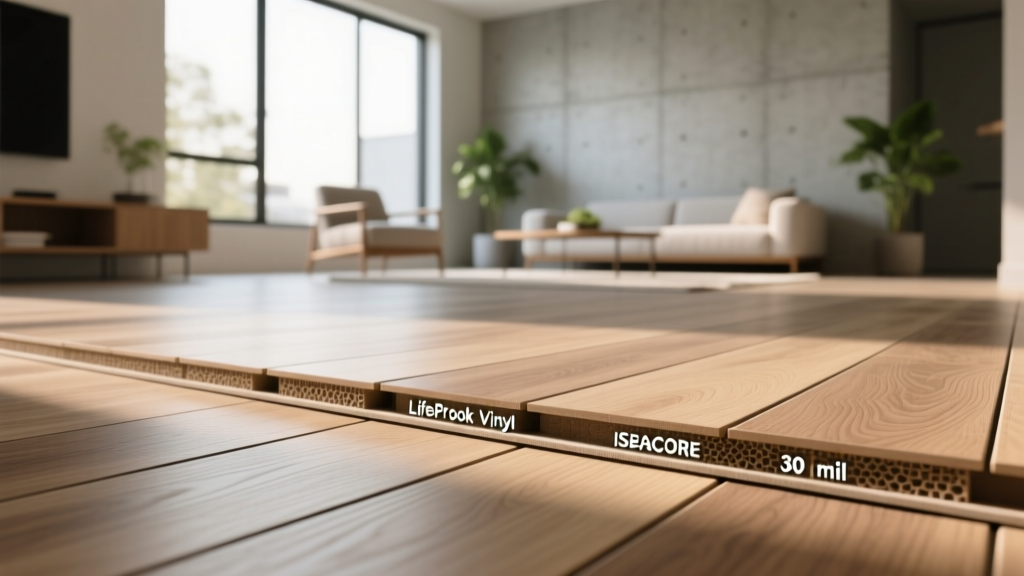
The Anatomy of ISOCORE: Beyond the Marketing Hype
When evaluating luxury vinyl plank (LVP) options, the core layer dictates the floor's structural integrity, acoustic profile, and dent resistance. LifeProof vinyl plank flooring utilizes a proprietary closed-cell PVC foam core branded as ISOCORE. Unlike traditional Wood Plastic Composite (WPC) which incorporates wood flour and foaming agents, or Stone Plastic Composite (SPC) which relies on a dense limestone dust matrix, ISOCORE is an extruded, highly engineered foamed PVC. This unique composition allows it to achieve a middle-ground density that offers the indentation resistance of SPC while retaining the underfoot warmth and sound-dampening qualities of WPC.
According to industry analysis from Forbes Home Improvement, rigid core LVP has completely dominated the residential flooring market due to its waterproof claims and dimensional stability. However, the waterproof nature of LifeProof applies strictly to the plank itself. The ISOCORE will not swell or degrade when submerged, but it does not protect your subfloor from trapped moisture, a critical distinction many DIYers overlook during basement installations.
Wear Layer Realities: 6.5 mil vs. 12 mil vs. 20 mil
The wear layer is the transparent top coat that protects the printed vinyl design film from abrasion. LifeProof infuses this urethane layer with Ceramic Bead Technology, which significantly increases scratch resistance compared to standard aluminum oxide finishes. For 2026, the product line is segmented by wear layer thickness:
- 6.5 mil (Standard): Adequate for low-to-medium traffic residential areas (bedrooms, home offices). Prone to micro-scratching from pet claws over time.
- 12 mil (Enhanced): The sweet spot for active households with large dogs or heavy foot traffic. Provides a robust barrier against daily abrasion.
- 20+ mil (Commercial/Luxury): Designed for light commercial applications or high-end residential zones. Offers maximum longevity but can sometimes exhibit a slightly higher sheen that highlights dust.
2026 LifeProof Product Matrix: Standard vs. Luxury vs. Rigid
Navigating the shelves at The Home Depot can be overwhelming. Below is a technical breakdown of the primary LifeProof tiers available in 2026 to help you match the exact specification to your project requirements.
| Product Line | Total Thickness | Wear Layer | Attached Pad | Best Use Case | Avg. Price/Sq Ft |
|---|---|---|---|---|---|
| LifeProof Standard | 8.7 mm | 6.5 mil | Yes (IXPE) | Budget-friendly residential flips | $3.50 - $4.00 |
| LifeProof Luxury | 9.5 mm | 12 mil | Yes (IXPE) | Primary residences, active families | $4.50 - $5.20 |
| LifeProof Rigid Core | 10.0 mm | 20 mil | Yes (Cork/IXPE) | Light commercial, heavy furniture | $5.50 - $6.50 |
Real-World Installation Failure Modes & Edge Cases
While LifeProof is marketed as a beginner-friendly, floating floor system, professional installers frequently encounter specific failure modes that are rarely discussed in the manufacturer's glossy brochures. Understanding these edge cases is vital for ensuring a 15-year lifespan.
The Drop-Lock Mechanism: A Double-Edged Sword
LifeProof utilizes a modified drop-and-lock mechanism on the short ends of the plank. While this allows for rapid installation in open areas, it becomes highly problematic in tight spaces, such as under door jambs or against the final wall row. The short-end locking lip is notoriously fragile; if you force a plank down at an incorrect angle, the milled PVC lip will snap off, creating a permanent seam gap that cannot be glued back together effectively.
UV Degradation and Thermal Expansion
ISOCORE is highly dimensionally stable, but it is not immune to extreme thermal fluctuations. In rooms with expansive, south-facing floor-to-ceiling windows, direct UV exposure can cause surface temperatures of the LVP to exceed 110°F (43°C). This localized heat causes the planks to expand asymmetrically. If the mandatory 1/4-inch expansion gap around the perimeter is compromised by baseboards or heavy cabinetry, the floor will 'peak' or buckle in the center of the sunlit zone. Always use UV-blocking window films in these specific environments.
Point Loads from Heavy Appliances
Despite the dent-resistance claims of the ISOCORE, static point loads exceeding 1,000 PSI will eventually cause permanent compression. A fully loaded French-door refrigerator resting on two small front leveling legs concentrates massive weight. Always place load-distributing pucks or a sheet of 1/4-inch plywood beneath heavy appliances before sliding them into place.
Cost Breakdown & ROI Analysis for 2026
Budgeting for LifeProof requires looking beyond the per-square-foot sticker price of the planks. The ancillary materials and floor preparation often account for 30% to 40% of the total project cost.
- Base Material: $3.50 to $6.50 per sq. ft. depending on the tier.
- Vapor Barrier: While the attached pad provides sound absorption, a 6-mil polyethylene vapor barrier ($0.15/sq. ft.) is strictly required for below-grade concrete slabs to prevent hydrostatic pressure issues.
- Moldings and Transitions: This is where budgets break. LifeProof coordinating stair noses retail for $45 to $65 per 78-inch piece. T-moldings and reducer strips average $35 each. For a multi-level home with a staircase, expect to add $300 to $500 just for transition pieces.
- Subfloor Prep: Self-leveling compound and primer ($60 per 50lb bag) to meet the 3/16-inch flatness tolerance.
- Professional Labor: $2.50 to $4.50 per sq. ft. for certified installation, excluding demolition of existing flooring.
"LifeProof is an excellent product for the price point, but DIYers always underestimate the cost of the trim and transitions. You aren't just buying planks; you're buying a complete ecosystem of moldings that are priced at a premium because they are exclusive to a single retailer." — Mark T., Certified Flooring Installer (CFI)
Final Verdict: Decision Framework
Should you install LifeProof vinyl plank flooring in your 2026 renovation? Use this framework to decide:
Choose LifeProof if: You need a highly water-resistant, floating floor for a kitchen, bathroom, or basement; you want the convenience of an attached underlayment pad to reduce material sourcing; and you are willing to strictly adhere to subfloor flatness tolerances.
Look elsewhere (Consider SPC or Sheet Vinyl) if: You are installing over a severely uneven subfloor and do not want to pay for leveling compound; you are covering a massive, open-concept commercial space that requires a glue-down application to prevent thermal expansion issues; or you need highly specialized, custom-matched architectural moldings that the big-box ecosystem does not provide.
By understanding the exact mechanics of the ISOCORE, selecting the correct wear layer for your traffic profile, and budgeting accurately for the transition ecosystem, LifeProof remains one of the most formidable rigid-core LVP options on the market today.