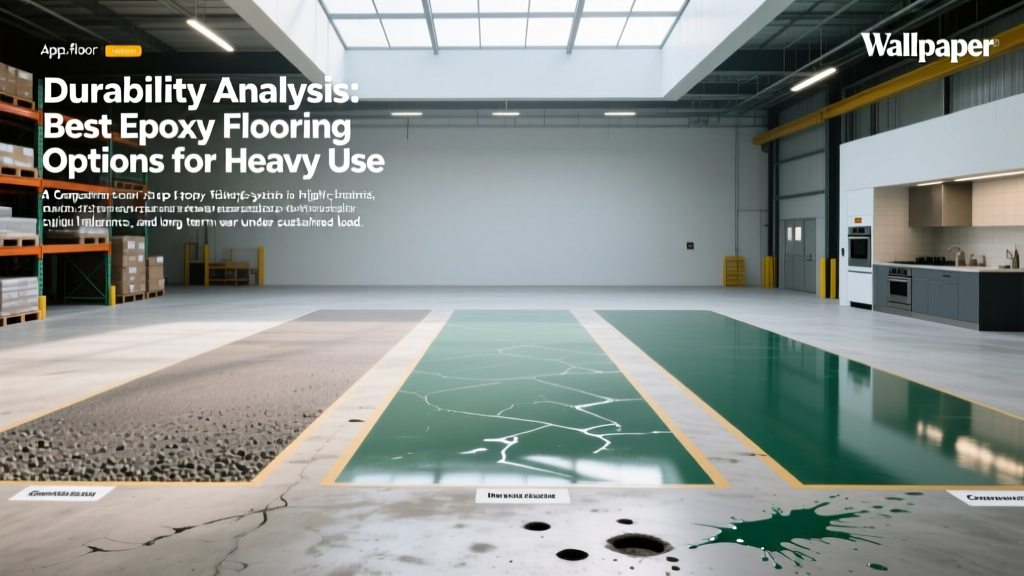
Durability Analysis: Best Epoxy Flooring Options for Heavy Use
Compare the durability of top epoxy flooring options. Analyze abrasion resistance, chemical tolerance, and lifespan for residential and commercial use.
The Chemistry of Durability: Decoding Epoxy Formulations
When evaluating epoxy flooring options for high-traffic garages, commercial warehouses, or industrial facilities, the term 'epoxy' is often mistakenly used as a catch-all for any resinous floor coating. In reality, the durability, chemical resistance, and ultimate lifespan of the floor are dictated entirely by the chemical formulation and the percentage of solids in the resin. Understanding these distinctions is the first step in preventing premature coating failure.
Water-Based Epoxies
Water-based epoxies contain 40% to 60% solids, with the remainder being water and volatile organic compounds (VOCs). As the water evaporates, the coating cures to a thin film, typically 3 to 5 mils thick. While they are low-odor and easy to apply, their thin profile makes them highly susceptible to abrasion and hot tire pickup. They are strictly decorative and unsuitable for heavy mechanical stress.
Solvent-Based Epoxies
Formulated with 60% to 80% solids, solvent-based options penetrate concrete pores more effectively than water-based variants. They build a thicker film (4 to 8 mils) and offer moderate chemical resistance. However, the high VOC content requires rigorous ventilation during application, and the long-term UV stability remains poor without an aliphatic topcoat.
100% Solids Epoxies
The gold standard for heavy-duty applications. As the name implies, these contain zero solvents or water; 100% of the applied material remains on the floor after curing. They are typically applied at 10 to 20+ mils thick and can be broadcast with quartz sand or aluminum oxide to create a highly durable, slip-resistant mortar system. According to the U.S. Environmental Protection Agency, 100% solids systems also eliminate the indoor air quality hazards associated with off-gassing solvents.
Always read the Technical Data Sheet (TDS) for the exact 'Volume Solids' percentage. Some commercial products market themselves as 'commercial grade epoxy' but contain only 70% solids, requiring multiple coats to achieve the mil thickness of a single coat of true 100% solids epoxy.
Quantifying Wear: Abrasion and Impact Resistance Metrics
Durability in epoxy flooring is not subjective; it is measured using standardized testing protocols. The most critical metric for surface wear is the ASTM D4060 Taber Abraser test, which measures the milligram loss of the coating after 1,000 cycles with abrasive wheels. Lower numbers indicate superior abrasion resistance.
| Epoxy Type | Typical Mil Thickness | Taber Abrasion Loss (mg) | Impact Resistance | 2026 Est. Cost / Sq Ft |
|---|---|---|---|---|
| Water-Based | 3 - 5 mils | 80 - 120 mg | Low (Chips easily) | $1.50 - $2.50 |
| Solvent-Based | 4 - 8 mils | 40 - 60 mg | Moderate | $3.00 - $5.00 |
| 100% Solids (Neat) | 10 - 15 mils | 15 - 25 mg | High | $5.50 - $8.00 |
| 100% Solids + Quartz | 18 - 30+ mils | < 10 mg | Very High (Mortar) | $8.00 - $14.00 |
For environments subject to steel-wheeled forklift traffic or heavy dropped tools, a 100% solids epoxy broadcast with graded quartz aggregate is mandatory. The quartz acts as a structural skeleton within the resin, distributing point-load impacts and reducing the Taber abrasion loss to single digits.
Chemical Tolerance and Environmental Stressors
Epoxy resins are inherently thermosetting polymers, meaning they form rigid, cross-linked molecular chains upon curing. This structure provides excellent resistance to a wide array of chemicals, including motor oil, brake fluid, and diluted acids. However, specific environmental stressors require targeted epoxy flooring options.
Hot Tire Pickup
In residential garages and auto shops, 'hot tire pickup' is a primary failure mode. As tires heat up from driving, the plasticizers in the rubber become active. When parked on a thin or poorly cured epoxy coating, these plasticizers chemically bond with the resin. Upon cooling and driving away, the tire literally rips the epoxy off the concrete. True 100% solids epoxies, particularly those formulated with cycloaliphatic amines, possess a higher cross-link density that resists plasticizer migration.
UV Degradation and Yellowing
Standard epoxies are aromatic, meaning their chemical structure contains benzene rings that absorb ultraviolet light. When exposed to direct sunlight (e.g., near garage doors or skylights), aromatic epoxies will chalk and yellow within 6 to 12 months. To maintain color stability and gloss retention in UV-exposed areas, an aliphatic polyurethane or polyaspartic topcoat must be applied over the epoxy base. Polyaspartic topcoats offer superior UV stability and can be applied at thicknesses of 6 to 12 mils without yellowing.
The Hidden Killer: Moisture Vapor Transmission (MVT)
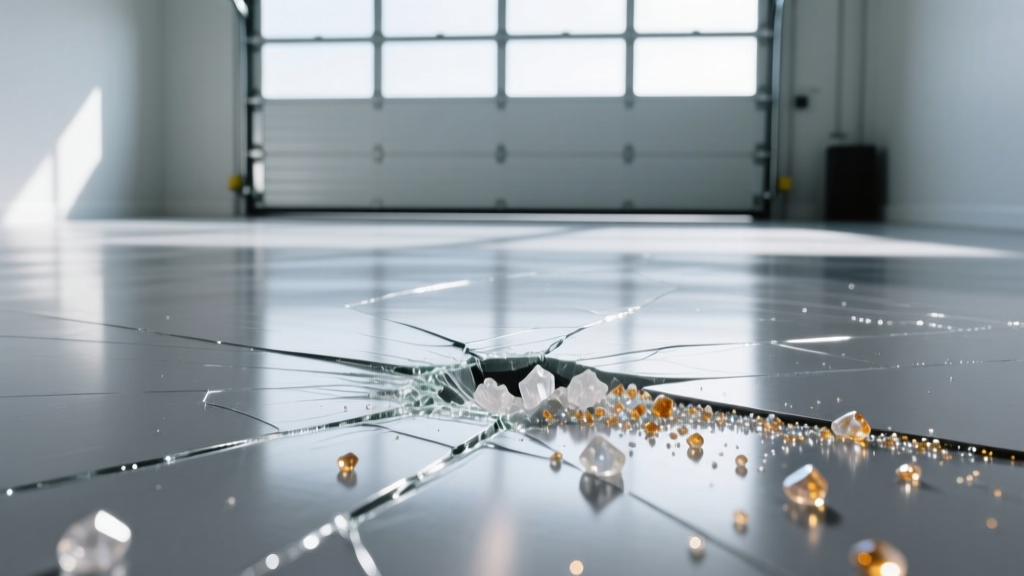
The most common cause of catastrophic epoxy floor failure is not surface wear, but sub-surface moisture. Concrete is a porous, capillary-rich material that constantly wicks moisture from the soil below. When an impermeable epoxy coating is applied over a slab with high Moisture Vapor Transmission (MVT), the vapor becomes trapped. As temperature fluctuations occur, hydrostatic pressure builds until it exceeds the tensile bond strength of the epoxy, resulting in osmotic blistering and delamination.
Standard epoxy systems will fail if MVT exceeds 3 to 5 lbs per 1,000 sq ft per 24 hours (measured via ASTM F1869 calcium chloride test) or if internal relative humidity exceeds 75% (ASTM F2170). If your slab tests above these limits, you must use a specialized moisture-mitigating epoxy primer before applying the main coating system.
Surface Preparation: The True Anchor of Epoxy Lifespan
No epoxy flooring option, regardless of its chemical superiority, will survive if the concrete substrate is improperly prepared. The coating does not adhere to the surface of the concrete; it mechanically locks into the microscopic pores and valleys of the substrate. The International Concrete Repair Institute (ICRI) standardizes these profiles using Concrete Surface Profiles (CSP).
- CSP 1 (Acid Etching): Yields a very light profile. Unacceptable for 100% solids epoxies or heavy-duty use. Acid etching also leaves residual salts that can cause adhesion failure.
- CSP 2 (Light Shot Blasting / Grinding): The minimum acceptable profile for standard residential garage epoxies (10-15 mils).
- CSP 3 to CSP 4 (Aggressive Shot Blasting): Required for heavy commercial systems, quartz broadcasts, and thick mortar builds (20+ mils). This opens the concrete pores deeply, allowing the 100% solids primer to penetrate up to 1/16th of an inch, creating an unbreakable mechanical bond.
Decision Matrix: Matching Epoxy Options to Use Cases
Selecting the correct system requires matching the physical demands of the space to the chemical capabilities of the coating. Use this framework to finalize your specification:
- Residential Garage (Light/Moderate Use): Diamond grind to CSP-2. Apply a 100% solids epoxy primer (10 mils), followed by a pigmented 100% solids epoxy topcoat with a light vinyl flake broadcast for slip resistance. Finish with a clear aliphatic polyurethane topcoat for UV and chemical protection.
- Commercial Auto Shop (Heavy Chemical/Impact): Shot blast to CSP-3. Apply a moisture-mitigating primer if MVT is a concern. Apply a 100% solids epoxy mortar coat broadcast heavily with graded quartz sand (20 mils). Seal with a polyaspartic topcoat to withstand harsh solvents and hot tire pickup.
- Warehouse / Forklift Traffic (Extreme Abrasion): Shot blast to CSP-4. Apply a 100% solids high-build epoxy slurry (30+ mils) incorporating aluminum oxide aggregate. Aluminum oxide provides a significantly harder surface than quartz, drastically reducing the wear patterns caused by steel-wheeled or hard-poly forklifts.
By prioritizing solids content, enforcing strict surface preparation profiles, and mitigating sub-slab moisture, you ensure the selected epoxy system performs to its maximum engineered lifespan, often exceeding 15 to 20 years in demanding environments.
Written by
David NakamuraDavid Nakamura is a licensed architect (AIA) and construction technology writer focused on sustainable building methods, mass timber engineering, and high-performance building envelopes. He holds a Master of Architecture from the University of Washington and is a certified Passive House Consultant (CPHC). David spent eight years at the Seattle firm Mithun, where he led the design of three LEED Platinum projects, before founding his own practice specializing in net-zero residential design. He serves on the editorial advisory board of GreenBuilder Magazine and has authored peer-reviewed papers on cross-laminated timber (CLT) connections for the Journal of Structural Engineering. In his spare time, David teaches woodworking at Pratt Fine Arts Center and kayaks the Puget Sound.
More from David Nakamura
View all
Construction Cost
Labor Cost to Build a Deck Per Sq Ft: 2026 Installation Guide
Discover the exact labor cost to build a deck per sq ft in 2026. This installation guide breaks down contractor rates, complexity factors, and hidden fees.
Aug 4, 2026

Construction Cost
How Much Does It Cost to Build a 3 Bedroom House? Financing Guide
Learn exactly how much it costs to build a 3 bedroom house and explore 2026 financing options, construction loan types, and budget frameworks for your build.
Aug 4, 2026

Construction Cost
Cost to Build a Tennis Court: 2026 Guide
How much does it cost to build a tennis court in 2026? Breakdowns for asphalt, concrete, and synthetic surfaces plus fencing and lighting.
Jul 30, 2026