Evaluating Commercial Flooring Options for Maximum Durability
Compare top commercial flooring options for high-traffic durability. Analyze wear layers, ASTM standards, lifecycle costs, and heavy-duty material specs.
The True Cost of Commercial Floor Failure
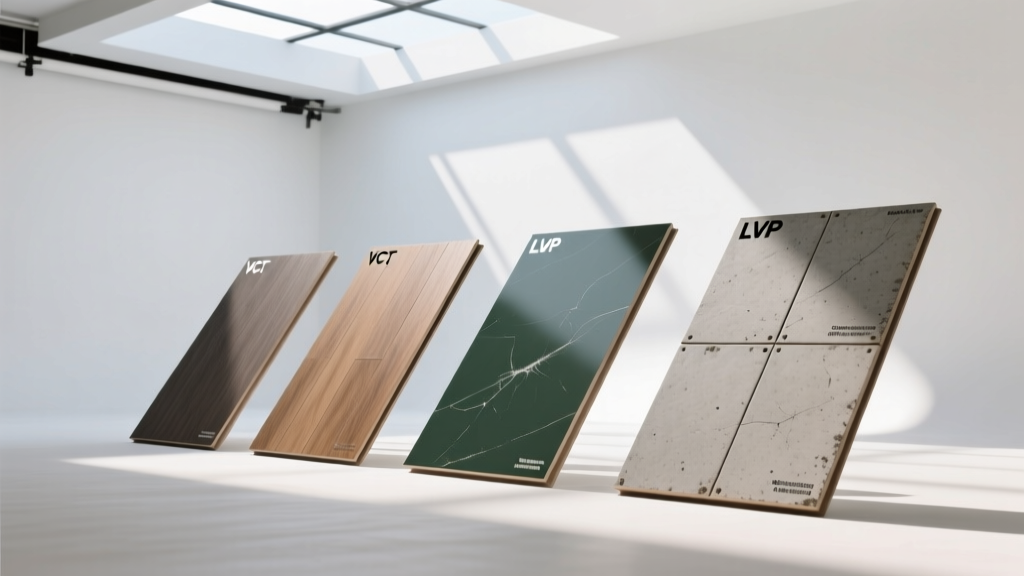
When specifying commercial flooring options, facility managers and architects frequently fall into the trap of optimizing for initial material cost rather than total lifecycle cost (LCC). A budget-friendly Vinyl Composition Tile (VCT) might cost $2.00 to $3.00 per square foot installed, but it demands aggressive maintenance. Between daily damp mopping, periodic scrubbing, and 4 to 6 strip-and-wax cycles annually, the maintenance cost for VCT averages $1.50 to $2.50 per square foot per year. Over a 15-year lifecycle, the maintenance eclipses the initial installation by a factor of ten.
Conversely, premium commercial flooring options like polished concrete or homogeneous vinyl demand higher upfront capital ($6.00 to $12.00 per square foot) but reduce annual maintenance to pennies. Evaluating durability requires moving beyond surface-level aesthetics and analyzing material science, subfloor dependencies, and standardized abrasion metrics. This analysis breaks down the structural realities of heavy-duty commercial floors in 2026, providing a data-driven framework for high-traffic environments.
Decoding Durability Standards: ASTM and ISO Metrics
Marketing terms like 'commercial grade' or 'heavy duty' are largely unregulated. To accurately compare commercial flooring options, specifiers must rely on standardized testing protocols established by organizations like ASTM International and the International Organization for Standardization (ISO).
Critical Testing Standards for Specifiers
- ASTM F1914 (Residual Indentation): Measures how well resilient flooring recovers from static point loads (e.g., heavy shelving, hospital beds). A lower score indicates better recovery.
- ISO 24343 (EN 660-2): Determines the volume loss of resilient floor coverings under abrasion. Group T ratings represent the highest abrasion resistance for commercial vinyl.
- PEI (Porcelain Enamel Institute) Rating: Crucial for ceramic and porcelain tile. Commercial corridors and lobbies mandate a minimum PEI IV (heavy traffic) or PEI V (extra heavy traffic) rating.
For Luxury Vinyl Tile (LVT) and Stone Plastic Composite (SPC) rigid core flooring, the wear layer thickness is the primary indicator of longevity. While a 12-mil wear layer is sufficient for residential use, high-traffic commercial corridors require a minimum 20-mil wear layer, with 40-mil being the standard for airports, hospitals, and large retail hubs. However, a thick wear layer is useless if the underlying photographic film delaminates under hydrostatic pressure.
Material Deep-Dive: Performance Under Rolling and Point Loads
Homogeneous Vinyl vs. Heterogeneous LVT
Heterogeneous LVT features a layered construction: a backing, a printed design film, a clear polyurethane wear layer, and a topcoat. If a heavy rolling load breaches the wear layer, the printed design is destroyed, and the floor must be replaced. Homogeneous vinyl, such as Tarkett's iQ Granit line, features a single-ply, through-pattern construction. Because the color and pattern extend through the entire 2mm thickness of the material, deep scratches and scuffs can be dry-buffed or diamond-polished out, restoring the floor to a like-new state. For healthcare and education sectors, homogeneous vinyl remains the undisputed champion of resilient commercial flooring options.
Large-Format Porcelain Tile
Porcelain tile offers near-indestructible surface hardness, but its vulnerability lies in the installation. According to the Tile Council of North America (TCNA), large-format tiles (any edge longer than 15 inches) require a perfectly flat subfloor (maximum variance of 1/8 inch in 10 feet). If installed over an uneven substrate with standard thinset, point loads from heavy carts or pallet jacks will cause the tile to crack or 'lip' at the edges. Furthermore, specifiers must mandate rectified edges to allow for tight 1/16-inch grout joints, minimizing the porous grout lines that trap dirt and harbor bacteria in food service or healthcare environments.
Polished Concrete and Epoxy Terrazzo
Polished concrete eliminates the concept of a 'wear layer' entirely by densifying the slab itself. Using lithium silicate densifiers and grinding up to a 3000-grit resin finish, the concrete surface achieves a Mohs hardness of 7 or higher. However, polished concrete is highly susceptible to acidic spills (citrus, vinegar, battery acid) which can etch the surface. Epoxy terrazzo—a 3/8-inch thick matrix of epoxy resin and marble/glass aggregates—solves the chemical vulnerability issue. It is non-porous, seamless, and impervious to harsh commercial cleaning chemicals, making it the premier choice for airport concourses and hospital lobbies despite its $15 to $25 per square foot installed cost.
Commercial Flooring Options Comparison Matrix
The following matrix compares the top commercial flooring options based on 2026 market pricing, lifecycle expectations, and heavy-load performance.
| Material Type | Wear Spec / Thickness | Rolling Load Tolerance | Installed Cost (per sq ft) | Expected Lifecycle |
|---|---|---|---|---|
| Homogeneous Vinyl | 2.0mm solid / Group T | Excellent (Buffable) | $6.50 - $9.00 | 15 - 20 Years |
| Commercial LVT (Glue-Down) | 40-mil wear layer | Good (Permanent dent if breached) | $5.00 - $8.00 | 10 - 15 Years |
| SPC Rigid Core | 22-mil wear / 5mm core | Superior (High dent resistance) | $5.50 - $8.50 | 10 - 15 Years |
| Large-Format Porcelain | PEI V / 10mm thickness | Excellent (Brittle under point impact) | $9.00 - $14.00 | 30+ Years |
| Epoxy Terrazzo | 3/8-inch matrix | Unmatched (Seamless structural) | $18.00 - $28.00 | 40+ Years |
Edge Cases: Where Standard Commercial Options Fail
Even the most durable commercial flooring options will fail catastrophically if subfloor conditions are ignored. The most common cause of resilient floor failure in commercial spaces is Moisture Vapor Emission Rate (MVER) exceeding the adhesive's tolerance.
Warning: The Calcium Chloride Trap
Historically, specifiers relied on the ASTM F1869 Calcium Chloride test, which measures moisture at the top 1/2 inch of the concrete slab. However, a slab can be dry at the surface but hold massive hydrostatic pressure deep within. Modern best practices mandate the ASTM F2170 Relative Humidity (RH) probe test, which measures moisture at 40% of the slab's depth. If RH exceeds 75-80%, standard water-based adhesives will re-emulsify, leading to adhesive degradation, floor bubbling, and total system failure. In high-RH scenarios, a two-part epoxy moisture mitigation barrier (such as Mapei Primer EP) must be applied before flooring installation.
Another critical failure mode is Alkali-Silica Reaction (ASR) in concrete subfloors. High alkalinity (pH > 10) can chemically break down the ester bonds in acrylic adhesives used for LVT and VCT. Always mandate a pH test alongside MVER testing before approving adhesive application.
Actionable Specification Framework for Facility Managers
To ensure you select the correct commercial flooring options for your specific environment, follow this four-step specification framework:
- Audit the Load Profile: Map the facility. Use SPC rigid core or homogeneous vinyl for corridors with heavy rolling carts (hospitals, warehouses). Use large-format porcelain for static high-traffic pedestrian zones (lobbies, retail).
- Test the Subfloor Early: Conduct ASTM F2170 (RH), ASTM F1869 (MVER), and pH tests a minimum of 60 days before installation. Budget $1.50 to $3.00 per square foot for moisture mitigation if RH exceeds 75%.
- Specify the Adhesive, Not Just the Floor: The floor is only as strong as its bond. For high-traffic commercial zones, specify pressure-sensitive, hard-set acrylic adhesives or two-part polyurethane adhesives rather than standard wet-set acrylics to prevent lateral shifting under heavy foot traffic.
- Calculate the 15-Year LCC: Request Environmental Product Declarations (EPDs) and maintenance schedules from manufacturers. Cross-reference the Resilient Floor Covering Institute (RFCI) maintenance guidelines to calculate the true cost of ownership, factoring in daily labor rates for janitorial staff.
By shifting the focus from initial material costs to standardized durability metrics and subfloor science, facility managers can deploy commercial flooring systems that withstand decades of punishing use while minimizing operational disruption and maintenance overhead.
Written by
Marcus ChenMarcus Chen is a licensed structural engineer (PE) and building materials analyst with over 12 years of experience across residential, commercial, and industrial construction. He holds a Master of Science in Civil Engineering from UC Berkeley and spent six years at Thornton Tomasetti before transitioning to independent consulting and technical writing. Marcus specializes in material selection for seismic-prone regions, concrete reinforcement strategies, and lifecycle cost analysis. His work has been cited by the American Concrete Institute (ACI) and the Structural Engineers Association of California (SEAOC). When he is not on a job site or at his desk, you will find him hiking the Sierra Nevada or restoring a 1920s craftsman bungalow in Oakland, CA.
More from Marcus Chen
View all
Construction Cost
How Much Did the Eiffel Tower Cost to Build?
How much did the Eiffel Tower cost to build in 1889? We adjust for inflation and compare its budget to modern skyscraper construction.
Aug 4, 2026

Fire Resistance
What Is a Fire Resistant Material? Testing & Certification Guide
Discover what is a fire resistant material through ASTM and UL testing. Learn how fire ratings, certifications, and assemblies work in construction.
Aug 4, 2026

Construction Cost
How Much Did the Burj Khalifa Cost to Build?
How much did the Burj Khalifa cost to build? We break down the $1.5B project and extract 5 money-saving strategies for your next build.
Jul 30, 2026