Industrial Flooring Options: A Facility Selection Framework
Evaluate industrial flooring options using our facility selection framework. Compare epoxy, polyurethane, and concrete by load, chemical, and thermal needs.
The Cost of Getting It Wrong: Why a Framework Matters
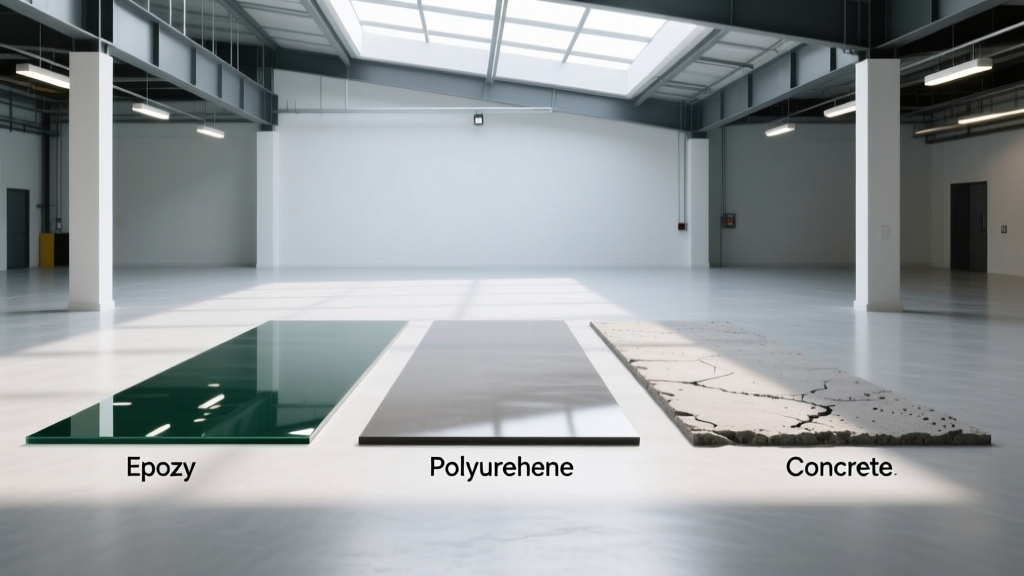
Selecting industrial flooring options requires moving beyond basic square-footage pricing to evaluate mechanical, thermal, and chemical stressors. A failed floor in a manufacturing, warehouse, or food processing facility halts production, costing upwards of $10,000 to $50,000 per hour in downtime, not including the expense of emergency remediation. Standard epoxy coatings that perform well in dry assembly plants will catastrophically delaminate in a wet food processing environment subjected to thermal shock. This framework isolates the exact material specifications, testing protocols, and installation parameters required to match specific operational environments with the correct flooring chemistry.
Core Stressors: Profiling Your Facility's Demands
Before reviewing material options, facility managers must quantify the three primary stressors that dictate industrial floor failure:
- Mechanical & Impact Loads: Evaluate point loads from heavy machinery and the type of forklift traffic. Hard plastic polyurethane wheels cause significantly more abrasive wear and micro-fracturing on brittle coatings than softer rubber tires. Drop zones for steel parts require high-compressive-strength mortar systems, not thin-film coatings.
- Thermal Shock & Cycling: Facilities with hot water washdowns (180°F to 250°F) followed by rapid cooling to ambient temperatures (40°F to 60°F) create severe thermal gradients. This delta-T causes standard coatings to expand and contract at different rates than the concrete substrate, leading to shear failure and delamination.
- Chemical Exposure: Identify the exact pH and concentration of spills. While standard epoxies handle mild alkalis, they break down rapidly when exposed to organic acids (lactic, citric) or strong oxidizers, requiring specialized novolac or polyurethane chemistries.
Industrial Flooring Options: Material Breakdown & Specs
Epoxy Systems (Bisphenol-A vs. Novolac)
Standard Bisphenol-A epoxy amines are the workhorses for dry manufacturing and general assembly areas. They provide excellent adhesion and high compressive strength (10,000+ PSI). However, for secondary containment areas, battery rooms, or chemical processing zones exposed to >20% sulfuric acid or aggressive solvents, Novolac epoxies are mandatory. Novolacs feature a higher cross-link density, providing near-impermeability to harsh chemicals. For heavy impact zones, specify a 1/8-inch to 3/16-inch troweled epoxy mortar rather than a 10-mil to 20-mil roller-applied coating.
Polyurethane & Ucrete (Thermal Shock Resistance)
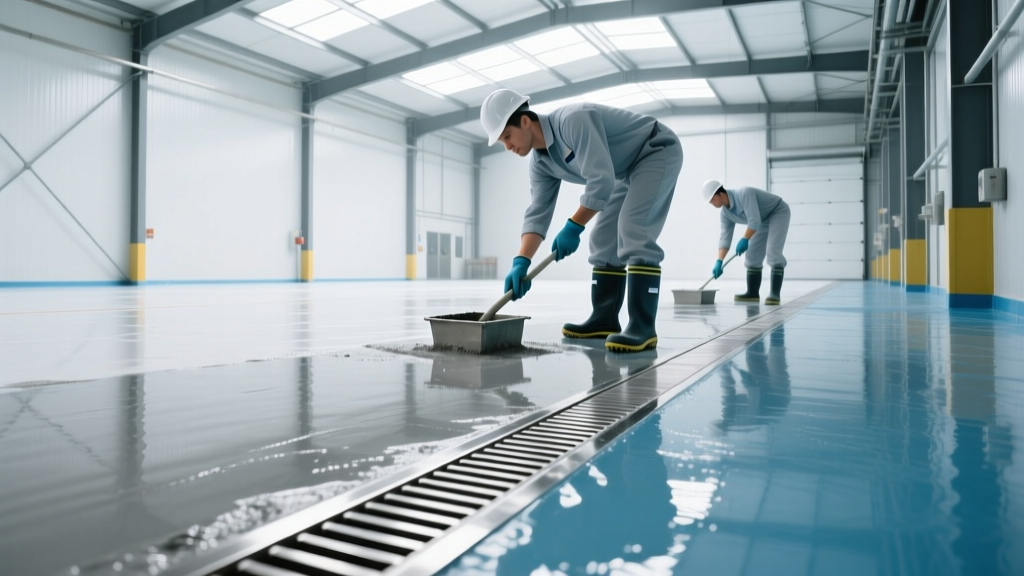
Polyurethane (PU) systems, particularly heavy-duty urethane concretes like BASF Ucrete, are the undisputed standard for food and beverage processing. Unlike rigid epoxies, PU systems possess a degree of elastomeric flexibility and a coefficient of thermal expansion that closely matches concrete. This allows them to withstand thermal shock from 250°F washdowns without cracking. They also resist lactic and citric acids inherent in dairy and meat processing, which typically degrade standard epoxies within months.
Methyl Methacrylate (MMA) (Rapid Cure & Cold Application)
MMA resins are specified when time or temperature is the primary constraint. MMAs can cure to full chemical and mechanical resistance in 1 to 2 hours, even at temperatures as low as -20°F. This makes them ideal for cold storage freezers or facilities that can only afford a single weekend shift for installation. The trade-off is extremely high VOC emissions and a pungent odor during installation, requiring aggressive ventilation and strict adherence to EPA guidelines on VOC emissions and worker safety protocols.
Densified & Polished Concrete (Dry Warehousing)
For dry distribution centers and high-rack warehouses, polished concrete utilizing lithium silicate densifiers is the most cost-effective option. The densifier reacts with free lime in the concrete to form calcium silicate hydrate (CSH), hardening the surface. Specifying an 800-grit to 1,500-grit finish provides sufficient reflectivity and abrasion resistance for forklift traffic. However, polished concrete offers virtually zero chemical resistance and becomes highly slippery when wet; it must never be used in food processing or chemical handling areas.
The Selection Matrix: Matching System to Stressor
| Material System | Best Application | Thermal Shock Limit | Chemical Resistance | Return to Service |
|---|---|---|---|---|
| Standard Epoxy | Dry assembly, light manufacturing | Low (Max 140°F) | Moderate (Alkalis, mild acids) | 12–24 Hours |
| Novolac Epoxy | Chemical containment, battery rooms | Moderate (Max 180°F) | Extreme (Strong acids, solvents) | 24–48 Hours |
| Urethane Concrete | Food/bev processing, wet washdowns | Extreme (-40°F to 250°F) | High (Organic acids, sugars) | 8–12 Hours |
| MMA Resin | Cold storage, rapid turnaround | High (-20°F to 200°F) | Moderate to High | 1–2 Hours |
| Polished Concrete | Dry warehousing, distribution | N/A (Substrate dependent) | None (Stains easily) | Immediate |
Hidden Failure Modes: Moisture Vapor and Surface Profiling
The vast majority of industrial resinous floor failures are not caused by the coating itself, but by improper substrate preparation and ignored moisture vapor transmission (MVT). Concrete slabs on grade act as sponges, wicking groundwater upward.
Never specify a standard epoxy or polyurethane system without conducting relative humidity (RH) testing per ASTM F2170. If in-situ probe readings exceed 75% RH, or if calcium chloride tests (ASTM F1869) show MVT greater than 3 lbs/1,000 sq ft/24 hours, standard coatings will blister and delaminate within months. You must specify a specialized moisture-mitigating epoxy primer (100% solids, high-build) rated to block up to 100% RH and 10 lbs MVT before applying the topcoat.
Equally critical is surface profiling. Acid etching is entirely unacceptable for industrial resinous coatings due to its inconsistency and the risk of residual salts. Contractors must utilize shot blasting or scarification to achieve an International Concrete Repair Institute (ICRI) Concrete Surface Profile (CSP) of CSP 3 to CSP 5. This aggressive profile increases the surface area by up to 300%, providing the mechanical tooth necessary for high-build epoxies and urethane concretes to achieve permanent adhesion. For deeper insights into surface prep standards, refer to the International Concrete Repair Institute (ICRI) guidelines.
2026 Pricing Benchmarks & Lifecycle Costs
When budgeting for industrial flooring options, evaluate the lifecycle cost rather than just the initial installation price. A cheaper coating that requires replacement every three years is vastly more expensive than a premium system that lasts a decade. The following benchmarks reflect 2026 national averages for material and professional installation, assuming proper CSP 3-5 shot-blasting preparation.
| Flooring System | Installed Cost (Per Sq. Ft.) | Expected Lifespan | Maintenance Requirements |
|---|---|---|---|
| Epoxy Coating (10-20 mils) | $3.50 – $6.00 | 2 – 4 Years | High (Frequent touch-ups) |
| Epoxy Mortar (1/8" - 1/4") | $8.00 – $14.00 | 7 – 10 Years | Low |
| Urethane Concrete (PU/Ucrete) | $13.00 – $24.00 | 10 – 15+ Years | Very Low |
| MMA Resin Systems | $11.00 – $19.00 | 8 – 12 Years | Low |
| Polished/Densified Concrete | $4.50 – $9.00 | 10+ Years (Dry only) | Moderate (Burnishing) |
Compliance and Safety Standards
Industrial floors must comply with stringent safety regulations to prevent workplace accidents. Under OSHA's Walking-Working Surfaces standards, facility owners are responsible for maintaining slip-resistant surfaces. In wet processing areas, specifying a smooth, glossy epoxy is a severe liability risk.
"For areas subject to continuous moisture or grease, specify a broadcast aggregate system. Broadcasting aluminum oxide or graded quartz sand into the wet topcoat and sealing it with a clear polyaspartic or polyurethane wear course achieves a Dynamic Coefficient of Friction (DCOF) greater than 0.60, vastly exceeding minimum safety thresholds for ramp and wet-floor environments."
Furthermore, in food and pharmaceutical facilities, the flooring system must meet USDA and FDA criteria for seamless, non-porous, and coving-capable installations. Resinous systems allow for the creation of integral cove bases (curving the floor up the wall by 4 to 6 inches), eliminating the 90-degree corners where bacteria and moisture accumulate, thereby ensuring compliance with strict sanitary design principles.
Written by
Marcus ChenMarcus Chen is a licensed structural engineer (PE) and building materials analyst with over 12 years of experience across residential, commercial, and industrial construction. He holds a Master of Science in Civil Engineering from UC Berkeley and spent six years at Thornton Tomasetti before transitioning to independent consulting and technical writing. Marcus specializes in material selection for seismic-prone regions, concrete reinforcement strategies, and lifecycle cost analysis. His work has been cited by the American Concrete Institute (ACI) and the Structural Engineers Association of California (SEAOC). When he is not on a job site or at his desk, you will find him hiking the Sierra Nevada or restoring a 1920s craftsman bungalow in Oakland, CA.
More from Marcus Chen
View all
Construction Cost
How Much Did the Eiffel Tower Cost to Build?
How much did the Eiffel Tower cost to build in 1889? We adjust for inflation and compare its budget to modern skyscraper construction.
Aug 4, 2026

Fire Resistance
What Is a Fire Resistant Material? Testing & Certification Guide
Discover what is a fire resistant material through ASTM and UL testing. Learn how fire ratings, certifications, and assemblies work in construction.
Aug 4, 2026

Construction Cost
How Much Did the Burj Khalifa Cost to Build?
How much did the Burj Khalifa cost to build? We break down the $1.5B project and extract 5 money-saving strategies for your next build.
Jul 30, 2026