Cost Calculator for Modern Kitchen Backsplash Ideas: 2026 Guide
Calculate exact costs for modern kitchen backsplash ideas. Get 2026 pricing, waste factors, and hidden installation fees for large-format tile and stone.
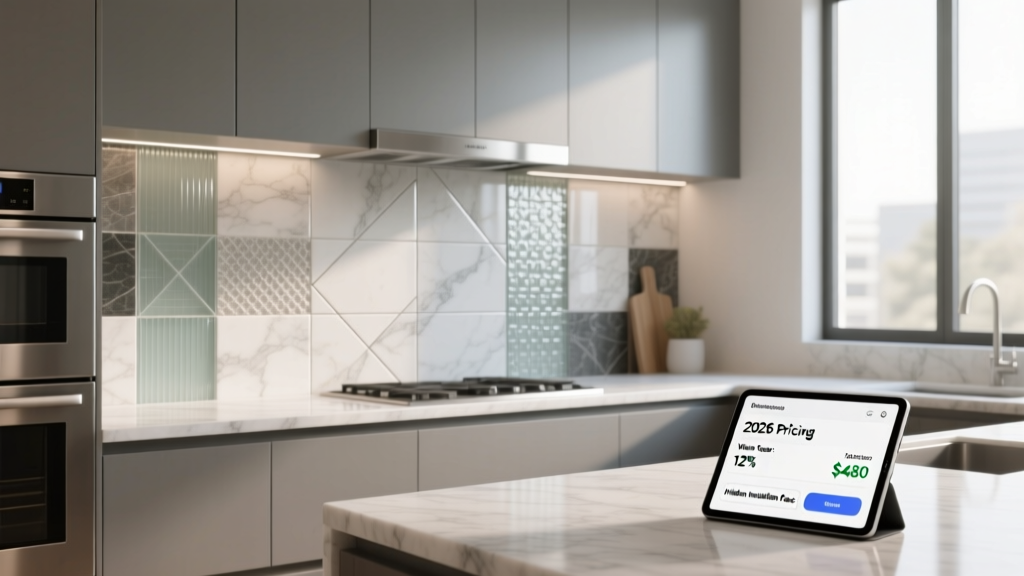
The Flooring-to-Wall Crossover: Why Modern Backsplashes Use Floor Tiles
When exploring modern kitchen backsplash ideas, the most prominent design trend in 2026 is the migration of heavy-duty flooring materials onto vertical surfaces. Homeowners and designers are increasingly utilizing 24x48-inch large-format porcelain, sintered stone (like Dekton), and polished concrete overlays to create seamless, minimal-grout aesthetics. While these materials are technically rated for floors, their application on walls introduces unique structural, adhesive, and calculation challenges that standard backsplash guides often ignore.
According to the National Kitchen & Bath Association (NKBA), material selection and specialized labor now account for over 60% of total kitchen renovation budgets. Because large-format tiles and handmade architectural materials behave differently than standard 3x6 subway tiles, using a generic square-footage calculator will result in severe material shortages and budget overruns. This guide provides a precise, material-specific cost estimation and quantity calculator framework tailored for modern, high-end backsplash installations.
The Modern Backsplash Quantity Calculator Formula
To accurately estimate material requirements, you must first determine the vertical coverage area and then apply a material-specific waste factor. Modern kitchens typically fall into two coverage categories: the standard 18-inch backsplash (from countertop to the bottom of wall cabinets) or the full-height backsplash (extending from the countertop to the ceiling or hood vent).
Step 1: Calculate Base Square Footage
- Standard 18-Inch Height: Measure the total linear feet of countertop space that requires a backsplash. Multiply this number by 1.5 (the decimal equivalent of 18 inches). Example: 12 linear feet × 1.5 = 18 square feet.
- Full-Height (48 to 54 inches): Multiply the linear feet by 4 or 4.5, depending on your ceiling height. Example: 12 linear feet × 4.5 = 54 square feet.
Step 2: Apply the Material-Specific Waste Factor
Unlike standard ceramic tiles where a flat 10% waste factor suffices, modern materials require advanced calculus due to pattern matching, lippage control cuts, and manufacturing defects. The Tile Council of North America (TCNA) mandates specific handling protocols for large-format and handmade tiles that directly impact yield.
- Large-Format Porcelain (24x48 or larger): 15% to 20% waste. (Requires extensive cutting for outlets and corners; a single bad cut ruins a $30 tile).
- Handmade Zellige or Architectural Clay: 15% waste. (Up to 5% of tiles in a box may have excessive glaze pooling or chipped edges that disrupt a clean modern line).
- Sintered Stone Slabs (Dekton/Neolith): 10% to 30% waste. (Highly dependent on the fabricator's templating and the complexity of the hood vent cutout).
- Standard Glass or Ceramic Mosaics (Sheet-mounted): 10% waste.
2026 Material & Labor Cost Matrix
The cost of modern kitchen backsplash ideas varies wildly based on the substrate requirements and the skill level of the installer. Large-format tiles require a perfectly plumb wall; if your drywall bows by even 1/8th of an inch over four feet, the installer must float the wall with a patching compound before setting the tile, adding $3 to $5 per square foot in prep labor.
| Material Type | Material Cost / Sq Ft | Labor Cost / Sq Ft | Required Mortar Type |
|---|---|---|---|
| 24x48 Matte Porcelain | $6.00 - $14.00 | $18.00 - $25.00 | Medium-Bed / Non-Sag |
| Handmade Zellige (2x6) | $18.00 - $32.00 | $15.00 - $22.00 | Standard Polymer-Modified |
| Sintered Stone (Slab) | $45.00 - $90.00 | $35.00 - $60.00 | Epoxy / Fabricator Grade |
| Polished Concrete Overlay | $12.00 - $18.00 | $20.00 - $30.00 | Microcement Base Coat |
Hidden Installation Costs & Edge Cases
When budgeting modern kitchen backsplash ideas, the tile itself is only half the equation. Modern design relies on precise edge detailing and specialized chemistry that rarely appears on initial contractor estimates.
1. Edge Trims and Profiles
Modern backsplashes rarely use bullnose tiles. Instead, they terminate at exposed edges using anodized aluminum or brushed brass metal profiles. The Schluter QUADEC (square edge) or RONDEC (rounded edge) profiles are the industry standard. Expect to pay $18 to $35 per 8-foot stick for premium finishes like brushed brass or matte black. If your kitchen island has a raised bar or exposed peninsula ends, you will need additional linear footage for these trims.
2. Non-Sag Mortar for Vertical Large-Format
You cannot use standard thinset to install 24x48-inch porcelain tiles on a wall. Gravity will pull the heavy tiles down before the mortar cures, resulting in severe lippage. Installers must use a specialized non-sag, medium-bed mortar like LATICRETE 4-XLT or Custom ProLite. This mortar costs roughly $65 to $85 per 50lb bag (compared to $20 for standard thinset) and requires a specialized 1/2-inch x 1/2-inch square-notch trowel, plus back-buttering of every single tile.
3. Outlet and Switch Cutouts
Kitchen backsplashes are notoriously interrupted by electrical outlets, under-cabinet lighting pucks, and pot-filler valves. Cutting a precise, clean rectangular hole in a piece of sintered stone or large-format porcelain requires a specialized diamond blade, a wet saw, and an angle grinder for plunge cuts. Most premium tile contractors charge an explicit 'cutout fee' of $25 to $50 per outlet. A standard kitchen with 6 to 8 outlets can see an unexpected $200 to $400 added to the labor invoice purely for electrical penetrations.
Execution Strategy: Ordering and Staging
To execute modern kitchen backsplash ideas without costly delays, follow this procurement protocol:
- Batch Dye-Lot Verification: When ordering porcelain or Zellige, ensure the supplier guarantees a single dye-lot and production run. Modern minimalist designs highlight color variations that might look charming in a rustic setting but appear as installation errors in a sleek, contemporary kitchen.
- Sealer Pre-Application: If using unglazed architectural clay or natural stone, the material must be sealed before grouting. If grout haze gets trapped in the porous surface of unsealed Zellige, it is nearly impossible to remove without destroying the tile's finish. Factor in $40 per quart for a high-quality penetrating sealer like Miracle Sealants 511.
- Grout Chemistry: For large-format tiles with tight 1/16-inch joints, standard sanded grout will scratch the surface and fail to pack into the narrow space. You must specify an unsanded, high-performance cementitious grout (like Mapei Ultracolor Plus FA) or a premium epoxy grout (like LATICRETE SpectraLOCK PRO). Epoxy grout costs upwards of $90 per gallon kit but provides absolute stain resistance, a non-negotiable feature behind a kitchen stove.