Evaluating Kitchen Floor Material Options: A Selection Framework
Use our data-driven selection framework to evaluate kitchen floor material options based on moisture resistance, PEI ratings, and lifecycle costs.

The Hard Metrics Matrix: Comparing Kitchen Floor Material Options
Kitchens are high-stress environments that subject flooring to thermal cycling from ovens, hydrostatic pressure from appliance leaks, and severe point-load impacts from dropped cast-iron cookware. Selecting from the available kitchen floor material options requires moving beyond aesthetic preferences into structural and chemical performance metrics. The following matrix establishes the baseline physical properties required for a successful kitchen installation.
| Material | Critical Rating Standard | Moisture Tolerance | Impact Resistance | Avg. Material Cost (2026) |
|---|---|---|---|---|
| Glazed Porcelain | PEI IV or V / DCOF > 0.42 | Impervious (<0.5% absorption) | High (but brittle) | $4.00 - $12.00 / sq.ft. |
| Rigid Core LVP (SPC) | AC4 / 20-mil wear layer | 100% Waterproof core | Moderate (dent resistant) | $3.50 - $7.50 / sq.ft. |
| Engineered Hardwood | Janka > 1200 / Aluminum Oxide | Susceptible to standing water | Moderate (scratches) | $7.00 - $14.00 / sq.ft. |
| Polished Concrete | FCI (Floor Condition Index) | Requires penetrating sealer | Extreme | $5.00 - $12.00 / sq.ft. |
Material Deep-Dives: Exact Specifications for Kitchens
Porcelain Tile: Decoding DCOF and Rectification
When specifying porcelain for a kitchen, the primary safety and maintenance metrics are the Dynamic Coefficient of Friction (DCOF) and edge rectification. According to the Tile Council of North America (TCNA), wet areas require a DCOF of 0.42 or higher to meet ANSI A137.1 slip-resistance standards. Furthermore, always specify rectified tiles. Rectification mechanically grinds the edges to exact 90-degree angles, allowing for narrow 1/16-inch grout joints. Narrow joints minimize the surface area of porous cementitious grout, drastically reducing staining from spilled oils and acidic foods like tomato sauce.
Rigid Core LVP: SPC vs. WPC in Thermal Zones
While both Stone Plastic Composite (SPC) and Wood Plastic Composite (WPC) cores are waterproof, SPC is the mandatory choice for kitchens. Kitchens experience extreme localized thermal fluctuations near dishwashers, ranges, and refrigerators with ice-makers. WPC cores contain foaming agents that can expand and contract under thermal stress, leading to joint peaking. SPC cores, composed of limestone dust and PVC, remain dimensionally stable. Specify a minimum 20-mil commercial-grade urethane wear layer; residential 12-mil layers will scratch rapidly from dragged barstools and pet claws.
Engineered Hardwood: Mitigating Hydrostatic Shock
Solid hardwood is fundamentally incompatible with modern kitchens due to its tendency to cup when exposed to micro-leaks from supply lines. Engineered hardwood, however, utilizes a cross-ply Baltic birch core that neutralizes dimensional expansion. When evaluating engineered options, demand a minimum 4mm sawn veneer top layer and a UV-cured aluminum oxide finish. The National Wood Flooring Association (NWFA) explicitly warns against installing any wood flooring beneath dishwashers or ice-makers without a secondary waterproof catch-pan and leak-detection shutoff valve.
The Subfloor & Installation Decision Tree
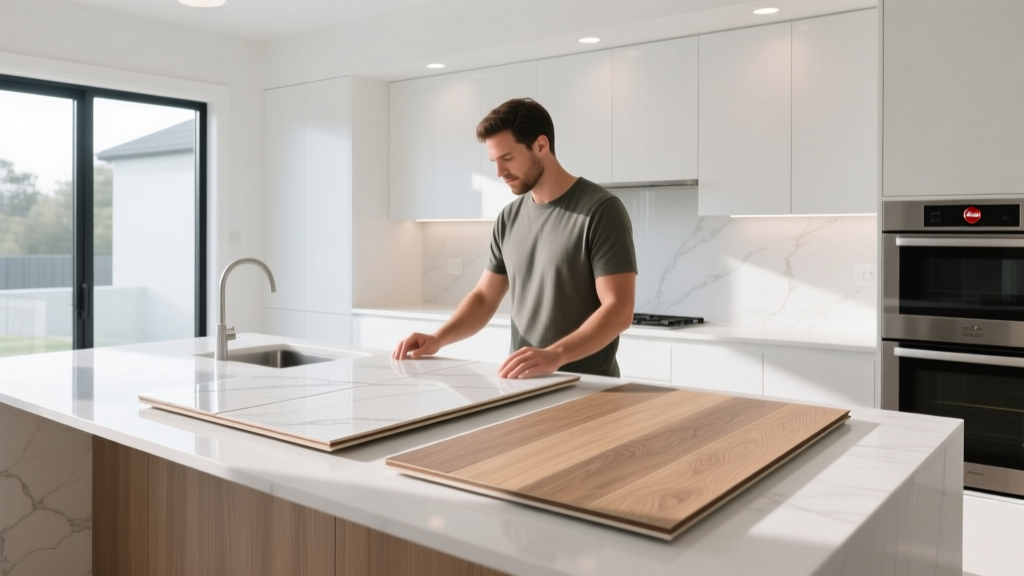
Choosing the right material is only half the framework; the installation methodology must adapt to your specific subfloor and lifestyle. Use this decision tree to finalize your selection:
- Node 1: Evaluate the Subfloor.
- Concrete Slab (Below/Above Grade): You can install porcelain, polished concrete, or floating SPC. Do not glue down wood without a vapor mitigation system (calcium chloride test < 3 lbs/1000 sq ft/24 hrs).
- Wood Joist System: Verify joist spacing. If joists are 24 inches on-center, you must add a second layer of 1/2-inch plywood or an uncoupling membrane (like Schluter-DITRA) before installing tile to prevent deflection cracking.
- Node 2: Assess Acoustic Requirements.
- Open-Concept / High Ceilings: Porcelain and concrete will create severe acoustic reverberation. Choose floating SPC with an attached IXPE acoustic pad (minimum 1.5mm) or engineered wood to dampen sound.
- Node 3: Appliance Clearance.
- Existing Cabinets & Toe-Kicks: If you are not removing cabinets, floating floors (LVP) are superior. Tile requires cutting perfectly around cabinet bases and reinstalling shoe molding, which increases labor costs by 20-30%.
Total Cost of Ownership (TCO) Over 15 Years
Initial material costs often mislead homeowners. A proper selection framework for kitchen floor material options must calculate the 15-year Total Cost of Ownership, factoring in installation, required maintenance, and expected replacement cycles. Data synthesized from National Kitchen & Bath Association (NKBA) industry reports and contractor averages reveal the following financial realities.
| Material | Initial Install Cost (Material + Labor) | 15-Year Maintenance Cost | Expected Lifespan | 15-Year TCO (per 150 sq.ft. kitchen) |
|---|---|---|---|---|
| Porcelain Tile | $1,800 - $3,500 | $300 (Grout sealing/cleaning) | 50+ Years | $2,100 - $3,800 |
| Rigid Core SPC | $1,200 - $2,200 | $50 (Basic cleaning) | 15 - 20 Years | $1,250 - $2,250 |
| Engineered Hardwood | $2,500 - $4,500 | $600 (Refinishing/Scratch repair) | 30 - 50 Years | $3,100 - $5,100 |
Common Failure Modes and How to Prevent Them
Even premium materials fail when installation protocols are ignored. Recognizing these edge cases separates professional frameworks from amateur guesswork.
LVP Telegraphing and Joint Separation
SPC and WPC planks are highly rigid, meaning they will not conform to subfloor imperfections; they will bridge them. If the subfloor has dips exceeding 3/16-inch over 10 feet, the locking mechanisms will bear the structural load instead of the subfloor. Within six months of foot traffic, the click-locks will sheer, resulting in joint separation and moisture infiltration. Always use a Portland cement-based floor patch, not gypsum-based compounds, to level dips in kitchen environments.
Grout Efflorescence and Haze
When installing porcelain tile, using standard cementitious grout in a kitchen prone to heavy mopping can lead to efflorescence—a white, powdery residue caused by water-soluble salts migrating to the surface. To bypass this entirely, specify single-component, stain-proof grouts (such as urethane or epoxy-based formulations). While urethane grout costs roughly $40 more per gallon and requires slower installation times to prevent haze, it eliminates the need for annual penetrating sealers and resists kitchen grease penetration permanently.
By applying this selection framework, you move past subjective design trends and base your kitchen flooring decision on verifiable structural metrics, precise material specifications, and long-term financial modeling.
Written by
Marcus ChenMarcus Chen is a licensed structural engineer (PE) and building materials analyst with over 12 years of experience across residential, commercial, and industrial construction. He holds a Master of Science in Civil Engineering from UC Berkeley and spent six years at Thornton Tomasetti before transitioning to independent consulting and technical writing. Marcus specializes in material selection for seismic-prone regions, concrete reinforcement strategies, and lifecycle cost analysis. His work has been cited by the American Concrete Institute (ACI) and the Structural Engineers Association of California (SEAOC). When he is not on a job site or at his desk, you will find him hiking the Sierra Nevada or restoring a 1920s craftsman bungalow in Oakland, CA.
More from Marcus Chen
View all
Construction Cost
How Much Did the Eiffel Tower Cost to Build?
How much did the Eiffel Tower cost to build in 1889? We adjust for inflation and compare its budget to modern skyscraper construction.
Aug 4, 2026

Fire Resistance
What Is a Fire Resistant Material? Testing & Certification Guide
Discover what is a fire resistant material through ASTM and UL testing. Learn how fire ratings, certifications, and assemblies work in construction.
Aug 4, 2026

Construction Cost
How Much Did the Burj Khalifa Cost to Build?
How much did the Burj Khalifa cost to build? We break down the $1.5B project and extract 5 money-saving strategies for your next build.
Jul 30, 2026