Selection Framework: Best Patio Floor Options by Climate and Budget
Discover the best patio floor options for your specific climate and budget. Use our expert selection framework to compare materials, costs, and durability.
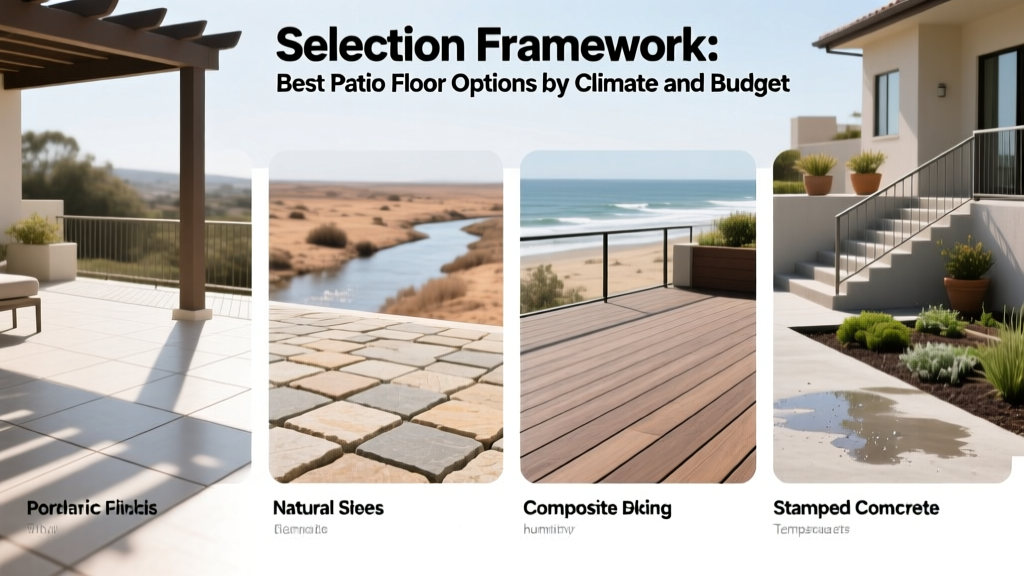
The 4-Point Patio Material Evaluation Matrix
Selecting the right patio floor options requires moving beyond aesthetic preferences to evaluate structural performance under environmental stress. A material that thrives in an arid, high-UV environment will often catastrophically fail in a freeze-thaw climate due to moisture ingress and thermal expansion. To make an informed decision, evaluate every material against four critical metrics: water absorption rate (ASTM C373), thermal movement coefficient, load-bearing capacity, and 20-year lifecycle cost.
The Natural Stone Institute and the Interlocking Concrete Pavement Institute (ICPI) provide baseline testing standards that dictate how materials behave when exposed to moisture and temperature fluctuations. Use the matrix below as your foundational comparison tool before narrowing down your choices.
| Material Type | Water Absorption | Frost/Freeze Rating | Heat Retention | Installed Cost (per sq. ft.) |
|---|---|---|---|---|
| 20mm Porcelain Pavers | < 0.5% | Excellent | High (Dark) / Low (Light) | $14.00 - $22.00 |
| Stamped Concrete (Sealed) | 3% - 5% | Moderate (Requires Sealer) | Moderate | $12.00 - $18.00 |
| Natural Bluestone (Thermal) | 1% - 2% | Good (High Density) | Moderate | $18.00 - $28.00 |
| Permeable Concrete Pavers | N/A (Voids) | Excellent (ASTM C1781) | Moderate | $10.00 - $15.00 |
| Travertine (Tumbled) | 3% - 6% | Poor (Porous) | Very Low (Stays Cool) | $16.00 - $24.00 |
Climate-Specific Patio Floor Options
The most common cause of patio failure is material-climate mismatch. Below is a targeted framework for selecting patio floor options based on your specific regional environmental stressors.
Freeze-Thaw Zones (USDA Hardiness Zones 3-6)
In regions where temperatures frequently cross the 32°F (0°C) threshold, water absorption is the primary enemy. When water penetrates a porous material and freezes, it expands by 9%, generating internal pressures exceeding 30,000 psi that cause spalling and micro-fractures.
- Best Choice: 20mm extruded porcelain pavers. With a water absorption rate of less than 0.5%, they are virtually impervious to freeze-thaw damage. Install them on a compacted aggregate base using polymeric sand (ASTM C144) to lock joints and prevent water infiltration.
- Alternative: High-density natural bluestone. Ensure the supplier provides a thermal-pattern finish with a minimum density of 165 lbs/cu ft. Avoid sandstone and limestone entirely, as their high porosity guarantees winter degradation.
- Avoid: Stamped concrete without a rigorous maintenance schedule. Even with a high-solids acrylic sealer, micro-cracks will allow water ingress, leading to surface flaking within 3 to 5 years.
Coastal and High-Salt Environments
Salt crystallization and chloride attack severely degrade standard concrete and porous stones. As saltwater evaporates, salt crystals form inside the material's pores, exerting pressure similar to freezing water.
- Best Choice: Porcelain pavers or sealed granite. Porcelain's vitrified surface prevents salt penetration entirely. If using natural stone, select granite with a resin-treated finish to fill micro-fissures.
- Avoid: Standard poured concrete and travertine. The Portland Cement Association notes that chloride ions from sea spray accelerate the corrosion of any underlying steel reinforcement and cause rapid surface scaling in standard concrete mixes.
Arid and High-UV Exposure Zones
In desert climates, the primary threats are UV degradation of sealers, thermal shock from extreme day-to-night temperature swings, and soil subsidence due to expansive clays.
- Best Choice: Integral-color concrete pavers or tumbled travertine. Travertine is highly reflective and remains remarkably cool to the touch, making it ideal for barefoot traffic around pool decks. Integral-color pavers do not rely on surface coatings that will peel or yellow under intense UV radiation.
- Avoid: Stamped concrete with topical sealers. The UV radiation will break down the acrylic or polyurethane sealers within 18 months, leading to a chalky, faded appearance that requires expensive chemical stripping and reapplication.
Regardless of the patio floor options you select, 80% of structural failures originate below the surface. Never install pavers or stone directly on native soil or rounded gravel. You must use a 4-to-6-inch base of crushed angular aggregate (ASTM D2940) compacted to 95% Standard Proctor density. The angular edges mechanically lock together, preventing lateral shifting, while a non-woven geotextile fabric (such as Mirafi 500X) placed beneath the base prevents capillary moisture wicking and subgrade soil migration.
Cost vs. Longevity Decision Tree
Initial installation cost is a poor indicator of long-term value. Use this decision framework to evaluate the true 20-year lifecycle cost of your patio floor options.
- Is your budget under $12 per square foot installed?
- Yes: Opt for standard 4-inch thick poured concrete with a broom finish or exposed aggregate. Stamped concrete is out of budget when factoring in the mandatory $2.50/sq. ft. resealing cost every three years.
- No: Proceed to the next step.
- Do you require permeable surfaces for local stormwater compliance?
- Yes: Select permeable interlocking concrete pavers (PICP). Factor in the cost of an open-graded crushed stone reservoir base (typically 8-12 inches deep), which increases excavation and material costs by 15-20%.
- No: Proceed to the next step.
- Is the patio adjacent to a pool or high-moisture area?
- Yes: Choose tumbled travertine or light-colored porcelain pavers on a pedestal system. The pedestal system allows for rapid drainage and easy access to underlying plumbing or waterproofing membranes.
- No: Choose based on aesthetic preference between natural bluestone and standard porcelain pavers.
Execution and Edge Cases
Even with the perfect material selected, installation nuances dictate the final performance. Pay strict attention to these frequently overlooked edge cases:
Jointing Material Selection
For sand-set pavers, standard masonry sand will wash out during heavy rain and harbor weed growth. Always specify polymeric sand. However, polymeric sand requires a completely dry substrate during installation. If installed over damp sand, the polymers will activate prematurely, creating a hazy, unremovable film on the paver surface. For porcelain pavers with tight 1/8-inch joints, use an epoxy-based grout (such as LATICRETE Spectralock) rather than polymeric sand to ensure a rigid, waterproof seal.
Edge Restraint Engineering
Flexible plastic edging secured with 10-inch spikes is insufficient for large-format pavers or areas subject to vehicular traffic. For patios abutting driveways or retaining walls, install a rigid concrete curb (minimum 6 inches wide by 8 inches deep) troweled directly against the perimeter pavers. This prevents the lateral creep that causes joint widening and edge collapse over time.
Summary Action Plan
- Step 1: Test your native soil percolation rate. Dig a 12-inch hole, fill it with water, and measure the drain time. If it drains slower than 1 inch per hour, mandate a permeable paver system or install French drains beneath the subgrade.
- Step 2: Match the material's water absorption rate to your climate's freeze-thaw cycles. Demand the ASTM C373 test certificate from your stone or paver supplier.
- Step 3: Allocate 25% of your total budget to subgrade preparation. A $20,000 porcelain patio will fail in three years if built on a $1,000 uncompacted dirt base.
- Step 4: Specify ASTM D2940 angular aggregate and non-woven geotextile fabric in your contractor's scope of work to eliminate base migration.
Written by
Priya KapoorPriya Kapoor is a real estate market analyst and construction economics researcher with expertise in housing affordability, development feasibility, and infrastructure investment. She holds a Master of Regional Planning from Cornell University and previously worked as a senior analyst at CBRE's Investment Properties group, where she modeled returns for $4B in mixed-use development pipelines. Priya now runs an independent research practice advising developers, municipalities, and REITs on construction cost forecasting and market timing. She publishes the quarterly "BuildMat Market Pulse" report tracking material price indices across 12 commodity categories. Based in Austin, TX, Priya serves on the board of Habitat for Humanity Austin and is a marathon runner.
More from Priya Kapoor
View all
Construction Cost
Cost to Build a 1600 Sq Ft Home in 2026: Full Breakdown
Accurate 2026 cost to build a 1600 sq ft home—material, labor, and regional pricing breakdowns included. Plan your budget with real-time estimates.
Aug 11, 2026

Wood & Lumber
Name the Types of Wood for Pressure Treatment and Preservation
Learn how to name the types of wood best suited for pressure treatment. Compare species treatability, chemical retention levels, and 2026 preservation costs.
Aug 4, 2026

Stone & Masonry
Stone Veneer Suppliers Lindenhurst: 2026 Cost Analysis
Analyze 2026 stone veneer costs in Lindenhurst, NY. Compare local supplier pricing, delivery fees, and Suffolk County installation labor rates.
Aug 4, 2026