Durability Analysis of Top Natural Flooring Options for High Traffic
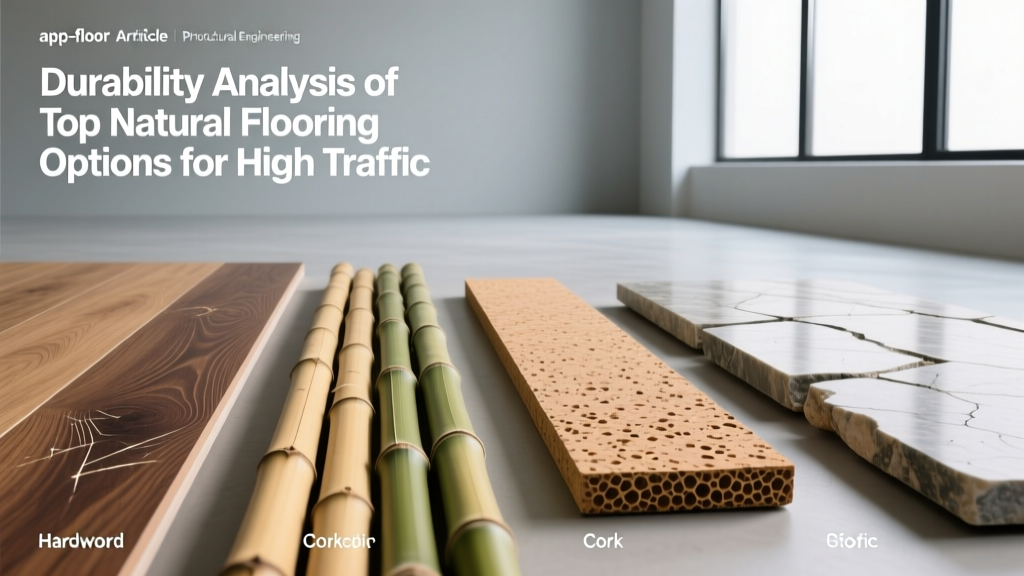
Compare the durability of top natural flooring options including hardwood, bamboo, cork, and stone. Discover Janka ratings, costs, and best use cases.
The Science of Flooring Durability: Beyond Surface Scratches
When evaluating natural flooring options for high-traffic residential or commercial environments, surface hardness is only one metric of longevity. True durability encompasses dimensional stability, abrasion resistance, moisture tolerance, and structural recovery. A material that resists scratching but cups under minor humidity fluctuations will fail faster than a softer material that maintains its structural integrity. This analysis breaks down the mechanical properties of leading natural materials, providing specific data points to guide specification and purchasing decisions.
Hardwood: The Janka Scale and Species Selection
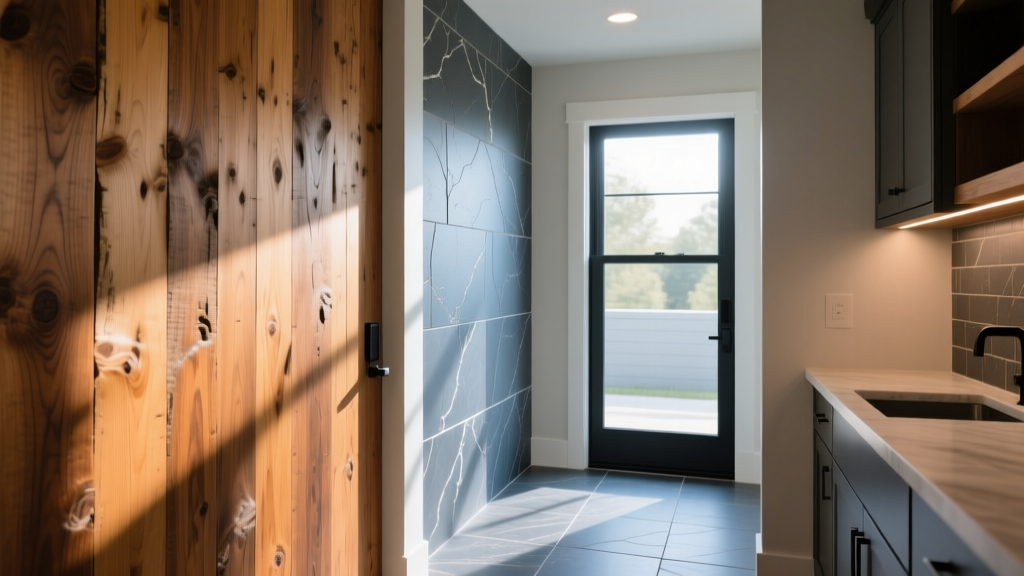
The Janka hardness test measures the force required to embed a 0.444-inch (11.28 mm) steel ball halfway into a wood sample. While it is the industry standard for comparing scratch and dent resistance, it must be contextualized with the wood's modulus of elasticity (stiffness) and dimensional stability.
High-Traffic Species Breakdown
- Hickory (Janka: 1,820 lbf): The hardest commercially available domestic hardwood. Its high density makes it highly resistant to denting from dropped objects, though its pronounced grain can visually mask minor scratches. Average cost: $6 to $12 per square foot.
- Hard Maple (Janka: 1,450 lbf): Features a tight, closed grain that resists dirt infiltration but shows surface scratches more readily than open-grained woods. Average cost: $7 to $11 per square foot.
- White Oak (Janka: 1,360 lbf): Contains tyloses (cellular structures) that block water penetration, making it significantly more rot- and moisture-resistant than Red Oak (1,290 lbf). Average cost: $8 to $14 per square foot.
- Ipe / Brazilian Walnut (Janka: 3,510 lbf): An exotic species so dense it sinks in water. It requires pre-drilling for installation and specialized carbide-tipped saw blades. Average cost: $14 to $22 per square foot.
Natural Stone: Mohs Hardness vs. Chemical Etching
Natural stone flooring options are evaluated on the Mohs scale of mineral hardness, but in practical application, chemical resistance is often the primary failure point. Stone durability is bifurcated into silicate stones (granite, slate) and calcareous stones (marble, limestone, travertine).
Silicate vs. Calcareous Performance
Granite ranks between 6 and 7 on the Mohs scale, making it virtually impervious to scratching from everyday foot traffic or pet claws. More importantly, its silicate composition means it will not etch when exposed to acidic spills (pH < 7). Conversely, marble ranks at 3 to 4 on the Mohs scale and is highly susceptible to chemical etching. A spilled glass of lemon juice or wine will permanently dull the polished surface of marble within minutes, regardless of the topical sealer applied. For high-traffic kitchens or entryways, honed or leathered slate (Mohs 5.5-6) provides superior traction and hides abrasion marks far better than polished marble.
'Sealers do not make natural stone stain-proof; they make it stain-resistant by buying time to wipe up spills. Impregnating sealers must be reapplied every 1 to 3 years depending on foot traffic and cleaning chemical alkalinity.' — Natural Stone Institute
Bamboo and Cork: The Resilience Factor
Often categorized alongside hardwoods, bamboo and cork offer distinct mechanical advantages for specific high-traffic scenarios.
Strand-Woven Bamboo
Traditional horizontal or vertical bamboo flooring yields a Janka rating of roughly 1,300 to 1,400 lbf. However, strand-woven bamboo is manufactured by shredding bamboo fibers, mixing them with a phenolic resin, and compressing them under extreme heat and pressure. This process results in a Janka rating exceeding 3,000 lbf, making it harder than most exotic hardwoods. It is highly resistant to denting, though it can be prone to UV discoloration if not treated with a UV-inhibitor topcoat. Expect to pay $5 to $9 per square foot.
Cork Flooring
Cork scores very low on traditional hardness scales, but its durability stems from its cellular structure and compressive recovery. Cork contains suberin, a naturally occurring waxy substance that makes it impervious to water and rot. When subjected to heavy static loads (like kitchen islands or heavy furniture), high-density cork (minimum 280 kg/m³) will compress but will recover up to 95% of its original shape once the load is removed. It is highly recommended for commercial spaces or kitchens where dropped glassware is common, as the material's shock absorption prevents breakage. Cost ranges from $6 to $12 per square foot.
Durability Comparison Matrix
| Material | Hardness Rating | Scratch Resistance | Moisture Tolerance | Avg. Installed Cost |
|---|---|---|---|---|
| Hickory Hardwood | 1,820 Janka | High | Low (Solid) / Med (Engineered) | $10 - $18 / sq ft |
| Strand-Woven Bamboo | 3,000+ Janka | Very High | Medium | $8 - $14 / sq ft |
| Honed Slate | 5.5 - 6 Mohs | High | Very High | $12 - $25 / sq ft |
| High-Density Cork | Low Janka / High Recovery | Low (Dents, doesn't scratch) | High (Suberin protected) | $9 - $16 / sq ft |
| Polished Marble | 3 - 4 Mohs | Low (Prone to etching) | Low | $15 - $30 / sq ft |
Real-World Failure Modes and Edge Cases
Selecting a durable material is insufficient if the installation environment compromises its structural integrity. The most common catastrophic failures in natural flooring options stem from subfloor moisture and environmental humidity.
Moisture Vapor Emission Rates (MVER)
Before installing any solid hardwood, bamboo, or cork over a concrete slab, a calcium chloride test must be performed to measure the MVER. If the emission rate exceeds 3 lbs per 1,000 square feet per 24 hours, moisture will migrate through the concrete and cause the natural flooring to cup, crown, or delaminate. In these scenarios, you must either apply a two-part epoxy moisture mitigation system to the concrete or switch to an engineered wood product with a cross-ply core that resists dimensional expansion.
Micro-Bevel Dirt Traps
Many pre-finished hardwood and bamboo planks feature micro-beveled edges to hide minor height variations between boards during installation. In high-traffic entryways, these micro-bevels act as channels that trap abrasive grit and sand. Over time, the friction from foot traffic grinds this grit into the bevel, wearing through the finish prematurely. For maximum longevity in high-traffic zones, specify square-edge (micro-bevel free) site-finished flooring.
Maintenance Frameworks for Maximum Lifespan
Durability is a partnership between material properties and maintenance protocols. The Environmental Protection Agency (EPA) emphasizes that controlling indoor relative humidity (RH) is critical for natural materials.
- Humidity Control: Maintain indoor RH between 30% and 50%. Solid hardwood installed in environments that regularly drop below 25% RH in winter will experience gapping and face-checking (structural cracking along the grain), regardless of the wood's Janka hardness.
- pH-Neutral Cleaning: Never use vinegar, ammonia, or alkaline-heavy commercial degreasers on natural stone or polyurethane-finished wood. These strip topical sealers and degrade the finish matrix. Use a pH-neutral cleaner (pH 7.0) specifically formulated for the material.
- Entryway Matting: Place a minimum of 15 feet of commercial-grade walk-off matting at exterior entrances. Up to 80% of the abrasive soil that destroys natural flooring finishes is tracked in on shoes within the first six steps of entering a building.
Written by
David NakamuraDavid Nakamura is a licensed architect (AIA) and construction technology writer focused on sustainable building methods, mass timber engineering, and high-performance building envelopes. He holds a Master of Architecture from the University of Washington and is a certified Passive House Consultant (CPHC). David spent eight years at the Seattle firm Mithun, where he led the design of three LEED Platinum projects, before founding his own practice specializing in net-zero residential design. He serves on the editorial advisory board of GreenBuilder Magazine and has authored peer-reviewed papers on cross-laminated timber (CLT) connections for the Journal of Structural Engineering. In his spare time, David teaches woodworking at Pratt Fine Arts Center and kayaks the Puget Sound.
More from David Nakamura
View all
Construction Cost
Labor Cost to Build a Deck Per Sq Ft: 2026 Installation Guide
Discover the exact labor cost to build a deck per sq ft in 2026. This installation guide breaks down contractor rates, complexity factors, and hidden fees.
Aug 4, 2026

Construction Cost
How Much Does It Cost to Build a 3 Bedroom House? Financing Guide
Learn exactly how much it costs to build a 3 bedroom house and explore 2026 financing options, construction loan types, and budget frameworks for your build.
Aug 4, 2026

Construction Cost
Cost to Build a Tennis Court: 2026 Guide
How much does it cost to build a tennis court in 2026? Breakdowns for asphalt, concrete, and synthetic surfaces plus fencing and lighting.
Jul 30, 2026