Heavy Duty Floor Jack Loads: Garage Flooring Durability & Lifespan
Analyze how heavy duty floor jack point loads impact garage floors. Compare epoxy, polyaspartic, and PVC tiles for maximum durability and lifespan.
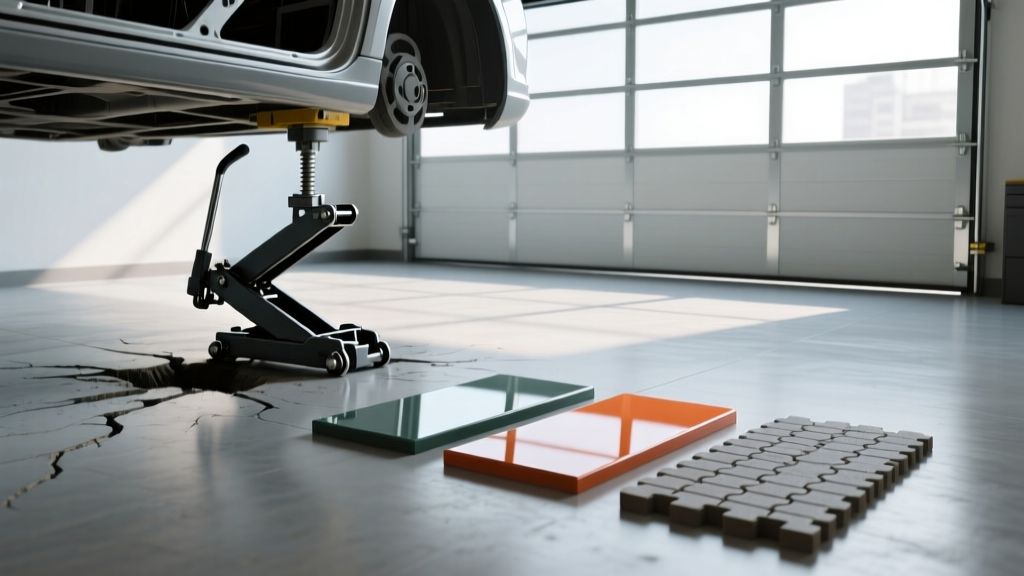
Standard residential garage floors are engineered to handle the distributed static weight of a parked vehicle. They are not engineered to withstand the extreme, concentrated point loads generated by automotive maintenance equipment. When you position a heavy duty floor jack beneath a 6,500-pound truck and begin pumping the hydraulic cylinder, the physics of your garage floor change dramatically. The weight of the vehicle transfers through the jack's lifting saddle and steel casters, creating localized pressure spikes that routinely crack concrete, delaminate epoxy, and shatter cheap interlocking tiles.
Understanding the exact mechanical stress a heavy duty floor jack exerts on your flooring is the first step toward selecting a surface that will actually survive a decade of weekend wrenching. This analysis breaks down the compressive thresholds, failure modes, and realistic lifespans of the top garage flooring systems when subjected to professional-grade jacking equipment.
The Physics of Point Loads: Why Jacks Destroy Floors
To evaluate flooring durability, we must first quantify the abuse. A typical 3-ton heavy duty floor jack features a lifting saddle measuring roughly 3 inches by 3 inches (9 square inches). If you are lifting the front axle of a 6,000-pound SUV, approximately 3,000 pounds of force is concentrated onto that 9-square-inch saddle.
Static Point Load: 3,000 lbs / 9 sq in = 333 PSI.
Dynamic Impact Load: When rolling the jack over an expansion joint or dropping the saddle onto the concrete, momentary impact spikes can exceed 1,500 PSI. Furthermore, the steel casters on the jack act as narrow blades, digging into coatings and soft concrete with immense lateral shear force.
Standard builder-grade concrete is poured at 3,000 PSI. While 333 PSI seems well within that limit, concrete's tensile strength is only about 10% of its compressive strength. The dynamic shearing and micro-fracturing caused by rolling steel casters and shifting jack stands will quickly cause 3,000 PSI concrete to spall, dust, and crack at the joints.
Material Comparison Matrix: Lifespan Under Jack Stress
Not all garage flooring is created equal. The table below maps the expected lifespan and primary failure modes of common flooring systems when subjected to regular heavy duty floor jack use.
| Flooring System | Compressive/Impact Strength | Point Load Tolerance | Est. Lifespan (Under Jack Use) | Primary Failure Mode |
|---|---|---|---|---|
| Standard 3000 PSI Bare Concrete | 3,000 PSI | Low | 2-4 Years | Surface spalling, joint crumbling, dusting |
| 100% Solids Epoxy Coating | High Tensile, Brittle | Moderate | 3-5 Years | Delamination, micro-fracturing under saddle |
| Polyaspartic / Polyurea | High Tensile, Flexible | High | 10-15+ Years | Substrate failure (if concrete is weak) |
| Rigid PVC Interlocking Tiles | 80,000+ PSI | Very High | 15-20 Years | Seam separation under lateral drag |
Deep Dive: Top Flooring Systems for Heavy-Duty Jacking
1. Polyaspartic / Aliphatic Polyurea Coatings (The Flexible Shield)
As of 2026, polyaspartic polyurea has largely replaced epoxy as the gold standard for high-abuse garage environments. Unlike epoxy, which cures into a rigid, glass-like shell that shatters under impact, polyaspartic coatings retain a degree of elastomeric flexibility. When the heavy duty floor jack saddle makes contact, or when a jack stand settles into the floor, the coating flexes microscopically rather than cracking.
Installation Specifics: The lifespan of this coating is entirely dependent on the substrate prep. Acid etching is entirely insufficient for heavy point loads. The concrete must be diamond-ground or shot-blasted to a CSP-2 or CSP-3 (Concrete Surface Profile) standard. This opens the pores, allowing the polyurea primer to penetrate deeply and create a mechanical bond that resists the upward shear forces of jack casters.
2. Interlocking Rigid PVC Tiles (The Load Distributors)
If your existing concrete slab is already heavily spalled or cracked, applying a liquid coating will only telegraph those defects. Interlocking rigid PVC tiles, such as those engineered by RaceDeck or SwissTrax, offer a structural workaround. High-end PVC tiles boast compressive strength ratings exceeding 80,000 PSI.
The secret to their durability under a heavy duty floor jack lies in the underside grid structure. When the jack's caster rolls over the tile, the grid distributes the localized point load outward across a 12-inch radius, effectively neutralizing the shearing force. According to flooring experts at Family Handyman, the interlocking teeth on premium tiles are designed to withstand the lateral drag of rolling tool chests and jacks without unzipping.
3. 4000+ PSI Steel-Troweled Concrete (The Bare Minimum)
If you are pouring a new slab and prefer bare concrete, you must specify a minimum 4,000 PSI mix with a low water-to-cement ratio (0.45 or lower) and a steel-troweled finish. The steel troweling process pushes the aggregate down and brings a dense layer of cement paste to the surface, creating a natural wear layer that resists the digging action of steel jack casters. However, bare concrete will eventually absorb oil and transmission fluid, requiring annual applications of a penetrating silane-siloxane sealer to prevent freeze-thaw spalling.
Critical Edge Cases and Failure Modes
Even the best flooring systems will fail prematurely if specific edge cases associated with hydraulic jacks are ignored.
- The Steel Caster Problem: Most heavy duty floor jacks come equipped with cast-iron or steel casters. These act like pizza cutters on polyaspartic coatings and PVC tiles. Solution: Swap the steel casters for heavy-duty polyurethane wheels, which provide a softer durometer footprint without sacrificing load capacity.
- Jack Stand Slippage: When a vehicle is resting on jack stands, the floor is bearing dead weight for hours or days. If the floor has a high-gloss polyaspartic topcoat, the steel base of the jack stand can slowly micro-slip, gouging the clear coat. Solution: Always place a 1/4-inch thick neoprene or urethane pad beneath jack stands to increase the friction coefficient and distribute the load.
- Moisture Vapor Transmission (MVT): If your garage slab lacks a proper vapor barrier beneath it, hydrostatic pressure will push moisture vapor upward. When trapped under an impermeable epoxy or polyurea coating, this pressure builds until it blistered the floor. A heavy duty floor jack rolling over a moisture blister will instantly pop it, destroying the coating. Always perform a calcium chloride MVT test before applying any liquid flooring system.
Decision Framework: Matching Your Floor to Your Workflow
Use this framework to finalize your flooring investment based on your specific maintenance habits.
THEN install interlocking rigid PVC tiles (Diamond or Coin pattern). They forgive substrate imperfections and distribute point loads flawlessly.
IF you want a seamless, chemical-resistant surface for detailing and light-to-medium jacking...
THEN invest in a multi-coat polyaspartic/polyurea system applied over diamond-ground concrete. Ensure you use urethane slotted jack pads on your lifting saddle to protect the clear coat.
IF you are on a strict budget and only jack up passenger cars twice a year...
THEN a high-quality 100% solids epoxy with a heavy quartz broadcast will suffice, provided you never drop the jack saddle directly onto the surface.
For comprehensive safety standards regarding vehicle lifting and load distribution, always consult the guidelines published by the Automotive Lift Institute (ALI). Proper flooring is only half the equation; ensuring your heavy duty floor jack is rated for the specific gross vehicle weight (GVW) you are lifting prevents catastrophic mechanical failures that no garage floor can survive. Ultimately, treating your garage floor as a structural workspace rather than a simple parking pad ensures your investment withstands the brutal physics of automotive repair for decades.