Polyaspartic Flooring Brands & Cost Guide for 2026
Compare top polyaspartic flooring brands like VersaFlex and Penntek. Get 2026 pricing, technical specs, and failure modes for concrete coatings.
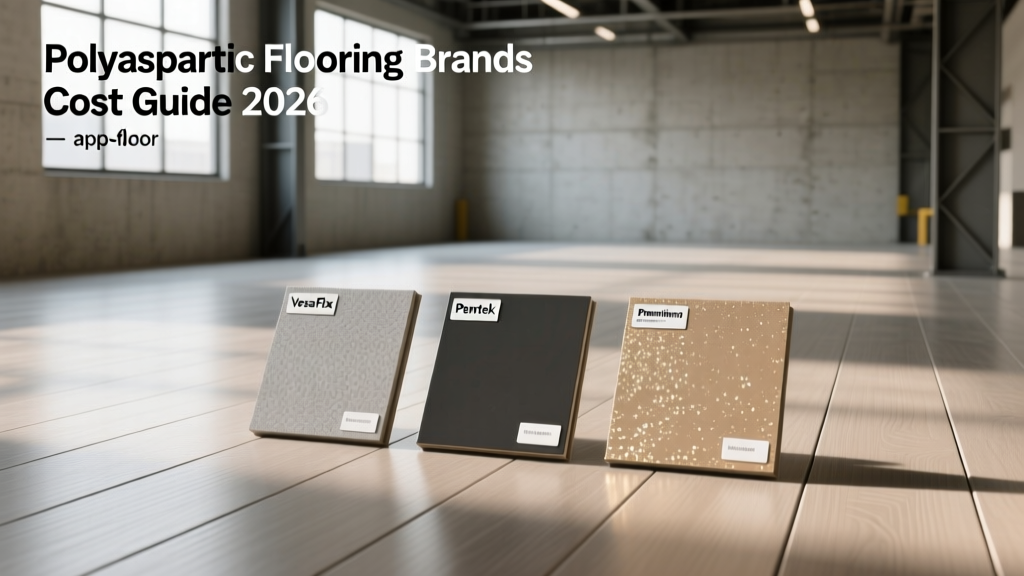
The Aliphatic Advantage: Polyaspartic vs. Traditional Epoxy
Polyaspartic flooring is technically an aliphatic polyurea. Unlike aromatic epoxies, which contain benzene rings that break down and yellow (chalk) when exposed to ultraviolet light, aliphatic polyaspartics maintain their molecular stability under direct sunlight. This makes them the undisputed standard for sunrooms, outdoor patios, and garages with large windows. According to the American Chemistry Council, the aliphatic structure also provides superior abrasion resistance and flexibility, allowing the coating to expand and contract with the concrete substrate without micro-cracking.
Cure Time & Temperature Matrix
Traditional 100% Solids Epoxy: Requires ambient temperatures above 50°F (10°C). Walkable in 12-24 hours; driveable in 7 days.
Polyaspartic (Standard): Can be applied down to 30°F (-1°C). Walkable in 2-4 hours; driveable in 24 hours.
The ROI Impact: A commercial auto dealership can close its service bays for a single weekend to install polyaspartic, whereas epoxy would require a phased 2-week shutdown to accommodate cure times and temperature restrictions.
2026 Brand Matrix: VersaFlex, Penntek, and Spartacote
Not all polyaspartics are formulated equally. The market is segmented by solids content, which dictates shrinkage, VOC levels, and build thickness per coat. Here is a technical breakdown of the three dominant product lines specifying contractors rely on in 2026.
| Brand / Product Line | Solids Content | Pot Life (at 70°F) | Primary Application |
|---|---|---|---|
| VersaFlex F90 (PPG) | 90% Solids | 15 - 20 Minutes | Fast-track flake systems, high-traffic commercial |
| VersaFlex F100 | 100% Solids | 20 - 30 Minutes | Zero-VOC environments, thick-build topcoats |
| Penntek PT-2500 | High-Build | 25 - 35 Minutes | Metallic systems, seamless residential garages |
| Spartacote Flex | 100% Solids | 30 - 45 Minutes | Premium residential, custom decorative overlays |
Formulation Insight: The 10% variance in 90% solids products (like the F90) typically consists of reactive diluents or solvents that lower viscosity, making the product easier to roll out in colder temperatures. However, 100% solids products (F100, Spartacote Flex) yield zero shrinkage and strictly adhere to the most stringent EPA VOC guidelines, making them mandatory for healthcare or food processing facilities.
The True Cost of Installation (And Where Contractors Cut Corners)
A legitimate polyaspartic floor system is an investment in chemical engineering, not just paint. In 2026, homeowners and facility managers should expect to pay between $7.50 and $11.50 per square foot for a professionally installed, full-flake or metallic system. If a contractor quotes $3.00 to $4.00 per square foot, they are almost certainly using a water-based polyaspartic hybrid or skipping critical surface preparation.
- Surface Preparation (Shot Blasting / Diamond Grinding): $1.50 - $2.50 / sq ft. The concrete must be opened to a CSP 2 or CSP 3 (Concrete Surface Profile) standard as defined by the International Concrete Repair Institute (ICRI). Acid etching is obsolete and will cause delamination.
- Primer Coat (Epoxy or Polyaspartic): $1.20 - $1.80 / sq ft. Applied at 5-7 mils thickness to penetrate the concrete pores and create a mechanical bond.
- Base Coat & Flake Broadcast: $2.50 - $3.50 / sq ft. Applied at 10-12 mils. Full flake broadcast requires roughly 12-15 lbs of vinyl chips per 100 sq ft to ensure zero grout lines show through.
- Topcoat (Aliphatic Polyaspartic): $2.00 - $3.00 / sq ft. Applied at 12-15 mils. High-end installations will scrape and vacuum the flake, then apply two topcoats to prevent 'fiber pop' (sharp flake edges protruding through a single thin topcoat).
Edge Cases & Failure Modes: Avoiding the 'Peel and Blister'
Polyaspartic is highly resilient, but it is unforgiving of poor substrate conditions. Because it cures rapidly, contractors cannot rely on the material to 'self-level' or 'self-seal' over problematic concrete.
CRITICAL WARNING: Moisture Vapor Transmission (MVT)
If your concrete slab emits moisture vapor at a rate exceeding 3 lbs per 1,000 sq ft per 24 hours (measured via ASTM F1869 calcium chloride test), a standard polyaspartic primer will fail. The vapor pressure will blister the coating from underneath within 6 to 12 months. The Fix: You must specify a moisture-mitigating epoxy primer (such as VersaFlex V-11) as the first coat. This adds roughly $1.50/sq ft to the project but acts as an impermeable vapor barrier.
Pinholing and Concrete Outgassing
Concrete is porous and contains trapped air. When the sun hits a garage floor or the ambient temperature rises, the concrete 'exhales' (outgasses). If a fast-curing polyaspartic topcoat is applied during this phase, the escaping air gets trapped, creating thousands of tiny pinholes in the finish. Professional contractors mitigate this by applying a thin, porous 'scratch coat' of polyaspartic in the early morning when the slab is cooling and inhaling, followed by the final topcoat once the slab temperature stabilizes.
Specification Checklist for 2026 Projects
When writing the scope of work or reviewing a contractor's proposal, ensure these exact technical parameters are documented to guarantee a commercial-grade result:
- Prep Standard: Mechanical preparation via shot blasting to achieve ICRI CSP-2 to CSP-3 profile. No acid etching.
- Moisture Testing: Mandatory ASTM F1869 Calcium Chloride testing prior to primer application. If >3 lbs, specify moisture mitigation primer.
- Crack Repair: All structural cracks must be routed out and filled with a polyurea joint filler or fast-setting polyaspartic patching compound, not standard cementitious fillers which will crack again.
- Flake Density: Specify '100% full broadcast' (approx. 15 lbs/100 sq ft) if hiding substrate imperfections is the goal.
- Topcoat Mil Thickness: Minimum 12 mils wet film thickness (WFT) for the final clear coat, applied with a notched squeegee and back-rolled, not just a standard nap roller.
- Anti-Slip Aggregate: Specify the addition of aluminum oxide or polymer grit (e.g., 40-60 mesh) broadcast into the final topcoat at a rate of 1 lb per 100 sq ft for wet-area traction.
By mandating these specifications, you eliminate the variables that lead to premature coating failure and ensure the aliphatic polyurea chemistry performs to its engineered 15-to-20-year lifespan.