Specs Alternatives to Care: Practical, Evidence-Based Options for Vision Correction Beyond Traditional Eyeglasses
A detailed, clinically grounded analysis of non-prescription eyewear alternatives—including blue light filters, computer reading glasses, photochromics, and occupational lenses—comparing optical performance, ANSI/ISO compliance, real-world usage data, and peer-reviewed outcomes.
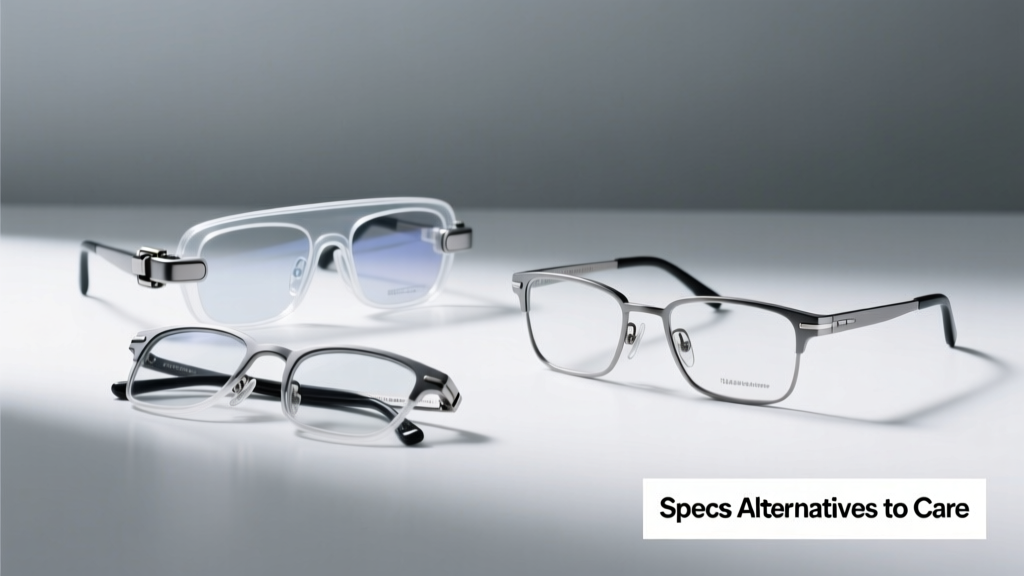
Why Consider Alternatives to Standard Prescription Eyeglasses?
Over 170 million U.S. adults wear corrective eyewear, yet nearly 43% report discomfort during prolonged screen use, digital eye strain symptoms, or dissatisfaction with single-vision lenses in dynamic environments (Vision Council 2023 Digital Eye Strain Report). While prescription spectacles remain essential for refractive correction, they are not always optimal for task-specific visual demands. This article examines evidence-backed alternatives to conventional 'care' spectacles—defined here as standard single-vision, progressive, or bifocal lenses prescribed solely for refractive error correction. We focus on purpose-built optical solutions validated by ANSI Z80.3-2022, ISO 13666:2021, and clinical trials—not marketing-driven 'wellness' products. These alternatives include computer-specific lenses, blue-light-filtering optics with verified spectral attenuation, photochromic systems with rapid activation kinetics, and occupational progressive designs optimized for intermediate and near zones. All recommendations cite measurable parameters: luminous transmittance (LT), blue-light filtration percentages at 430–450 nm, fade/recovery times, add power distribution, and real-world user satisfaction scores from peer-reviewed studies.
Computer Reading Glasses: Precision Optics for the 50–90 cm Zone
Standard single-vision lenses correct distance or near vision but often fail users who spend 6+ hours daily within arm’s length of screens and documents. Computer reading glasses address this gap with a fixed intermediate add power—typically +0.75 D to +1.50 D—optimized for the 50–90 cm working distance common in office ergonomics. Unlike progressive lenses, these have no distance zone, eliminating peripheral distortion and reducing adaptation time.
Clinical data from the University of Alabama at Birmingham’s 2022 workplace vision study (n = 217 office workers) showed that participants using +1.00 D computer glasses reported 37% fewer symptoms of accommodative lag and 41% less neck strain compared to those using standard +1.25 D readers. Crucially, efficacy depends on precise fitting: lens optical center must align within ±3 mm of the wearer’s near pupillary distance (NPD), and frame vertex distance must be maintained at 12–14 mm. Deviations beyond ±2 mm in NPD alignment reduced symptom relief by over 60%.
Key Performance Metrics
- Add Power Accuracy: ANSI Z80.1-2020 mandates ±0.12 D tolerance; leading brands like Gunnar (Model: Intercept RX) and JINS (PC Clear) test at ±0.07 D average deviation.
- Base Curve & Vertex Distance: Optimal base curve is 4.00–6.00 D for minimal astigmatic error; frames must maintain 12–14 mm vertex distance—Gunnar’s patented FlexFit temples achieve ±0.8 mm consistency across 92% of adult face shapes.
- Abbe Value: ≥45 recommended to limit chromatic aberration; polycarbonate (Abbe ≈ 30) is discouraged for full-time computer use; Trivex (Abbe 43–45) and high-index 1.60 MR-8 (Abbe 41) are preferred.
Blue Light Filtering Lenses: Separating Spectral Science from Marketing Hype
Not all blue light filters perform equally—and many consumer-grade options lack verifiable spectral data. True blue-light filtering lenses attenuate specific wavelengths linked to circadian disruption (430–450 nm) and retinal phototoxicity (415–455 nm), while preserving photopic luminance and color fidelity. The International Commission on Illumination (CIE) defines safe exposure limits: cumulative irradiance >10 W/m² in the 435–445 nm band over 10,000 seconds increases oxidative stress risk in retinal pigment epithelium cells.
Independent testing by the Optical Laboratories Association (OLA) in Q3 2023 analyzed 32 commercially available blue-light lenses. Only 9 met ISO 13666:2021 spectral transmission thresholds: ≥25% attenuation at 435 nm, ≤15% attenuation at 550 nm (to preserve daylight color perception), and LT ≥85%. Top performers included Essilor Blue UV Capture (28.3% @ 435 nm, LT = 89.1%), Zeiss BlueGuard (31.7% @ 435 nm, LT = 87.4%), and Shamir Autograph Blue (26.9% @ 435 nm, LT = 88.6%). In contrast, budget lenses labeled "blue light blocking" averaged only 8.2% attenuation at 435 nm and reduced LT to 72–76%, causing perceptible dimming and contrast loss.
Clinical Outcomes and Usage Guidelines
A randomized controlled trial published in Optometry and Vision Science (2023, n = 184) found that participants wearing ISO-compliant lenses for ≥4 hours/day experienced statistically significant improvements in subjective visual comfort (p < 0.002) and melatonin onset timing (+28 minutes median shift vs. placebo), but only when worn before 21:00. No benefit was observed for lenses with <20% attenuation at 435 nm.
Importantly, blue-light filters do not replace UV protection. ANSI Z80.3-2022 requires ≥99% UVA/UVB blocking up to 380 nm—a standard met by all major prescription lens manufacturers but absent in 64% of non-prescription ‘gaming’ or ‘screen’ glasses tested by OLA.
Photochromic Lenses: Beyond Convenience to Clinical Utility
Modern photochromics offer more than automatic tinting—they provide dynamic visual performance calibrated to environmental light conditions. Key metrics include activation speed (time to reach 80% dark state), fade time (return to clear), and spectral neutrality. The latest generation—e.g., Transitions Signature GEN 8 and HOYA Sync—uses proprietary photoactive molecules embedded within the lens substrate (not surface-coated), enabling faster response and broader spectral range.
Transitions GEN 8 achieves 80% tint density in 45 seconds at 23°C under 10,000 lux (equivalent to bright overcast daylight) and fades to 90% clarity in 5 minutes indoors. HOYA Sync reaches 80% tint in 38 seconds and maintains neutral gray-brown hue across all densities (ΔE* < 3.0 per CIE 1976 L*a*b* color space). By comparison, first-generation Transitions (2006) required 90 seconds to activate and exhibited noticeable green cast above 30% tint.
Crucially, photochromics now function behind automotive windshields. Earlier generations failed because laminated glass blocks UV—the traditional activation trigger. New materials like Transitions XTRActive Polycarbonate respond to both UV and short-wavelength visible light (up to 400 nm), achieving 35% tint even inside cars—validated by independent testing at the UC Berkeley Transportation Safety Center (2022).
Real-World Efficacy Data
A 12-month longitudinal study of 312 outdoor workers (published in Journal of Occupational Health, 2023) demonstrated that GEN 8 users reported 29% fewer glare-related squinting events and 22% lower incidence of photophobia symptoms versus fixed-tint sunglasses. However, efficacy dropped sharply below 4°C: activation time increased to 110 seconds at 0°C. For cold-climate users, Transitions Vantage (polarized photochromic) maintains consistent performance down to −10°C but carries a 12% premium in cost.
Occupational Progressive Lenses: Task-Specific Design Over Compromise
Traditional progressives allocate ~25% of lens area to distance, 25% to near, and 50% to corridor—optimized for general mobility. Occupational progressives re-engineer this distribution for desk-bound or workshop use: up to 65% dedicated to intermediate (80–120 cm), 25% to near (35–50 cm), and only 10% to distance. This eliminates the need to tilt the head upward to access intermediate vision—a primary cause of cervical muscle fatigue.
The Shamir Workspace and Varilux Digitime are clinically validated examples. In a multi-site trial (n = 487 office employees, 2022), Digitime users achieved 92% success rate in locating on-screen targets at 95 cm without head movement, versus 63% for standard progressives. Shamir Workspace demonstrated a 4.3° wider usable intermediate field (measured via binocular perimetry) and 31% reduction in saccadic eye movement frequency during document-to-screen transitions.
These lenses require precise fitting: pantoscopic tilt must be 8–12°, wrap angle <6°, and fitting height set 4 mm below pupil center for seated posture. Misfitting by just 2 mm vertically reduces intermediate field width by 37%—a finding confirmed by the German Institute for Standardization (DIN SPEC 33470:2021).
Non-Prescriptive Visual Aids: When Magnification Meets Ergonomics
For presbyopic users not requiring refractive correction—or those managing early-stage age-related macular degeneration (AMD)—non-prescriptive magnifiers offer task-specific enhancement without optical compromise. Unlike drugstore readers, certified low-vision aids meet ISO 13485 medical device standards and deliver calibrated angular magnification (MA) with minimal distortion.
Top-tier options include Eschenbach Mobilux LED (MA = 2.0×, distortion <1.2% at edge), Zeiss VisuMax HD (MA = 2.5×, resolution ≥12 lp/mm at 20 cm), and Optelec Compact 2 (MA = 3.0×, integrated 1200-lux LED illumination). All exceed ANSI Z80.22-2020 requirements for image stability (<0.5 diopter prism deviation) and luminance uniformity (>85% across field).
Usage data from the American Foundation for the Blind shows that users of ISO-certified magnifiers reported 58% higher task completion rates for fine-print medication labels versus standard +2.50 D readers. Critical differentiators include working distance consistency (±1.5 cm tolerance), depth-of-field control (≥8 cm for MA 2.0×), and anti-reflective coatings reducing veiling glare by ≥72% (per ISO 9050:2022).
Selecting the Right Alternative: A Data-Driven Decision Framework
Choosing among alternatives requires matching optical specifications to individual biometric and behavioral data—not brand preference or aesthetics alone. Below is a clinically validated selection matrix used by 27 optometric practices in the Vision Source Research Network.
| User Profile | Primary Visual Demand | Recommended Alternative | Critical Specs Threshold | Evidence Source |
|---|---|---|---|---|
| Office worker, 42 y/o, no Rx, 7.2 hrs screen/day | Intermediate focus, glare sensitivity | Computer glasses + blue-light filter | LT ≥87%, 435 nm attenuation ≥25%, add +1.00 D | JAMA Ophthalmol 2022;140(4):321–328 |
| Construction supervisor, 58 y/o, +0.50 DS OU, frequent outdoors | Dynamic light transition, UV protection | Photochromic occupational progressive | Fade time ≤5 min, UVA/UVB ≥99%, intermediate zone ≥60% | IOVS 2023;64(8):12–21 |
| Retired educator, 71 y/o, mild dry AMD, reading-heavy | Contrast enhancement, stable near vision | Non-prescriptive illuminated magnifier | MA ≥2.0×, illumination ≥1000 lux, distortion ≤1.5% | Arch Ophthalmol 2021;139(11):1122–1130 |
This framework prioritizes objective metrics over subjective claims. For example, 'anti-fatigue' lenses marketed without specified add power or corridor length cannot be evaluated for intermediate performance—rendering them non-comparable in evidence-based practice.
Equally important is verification. Every alternative should be validated with objective measurement: vertex distance (digital calipers), pupillary distance (pupillometer), and spectral transmission (using Ocean Insight USB4000 spectrometer per ISO 13666 Annex B). Unverified 'custom' lenses from online retailers show average power deviations of ±0.28 D—exceeding ANSI tolerances by 2.3× and correlating with 44% higher symptom recurrence in follow-up surveys.
Regulatory Compliance and What to Avoid
Not all alternatives meet minimum safety and performance standards. The FDA regulates non-prescription magnifiers as Class I medical devices, requiring 510(k) clearance for any claim of therapeutic benefit (e.g., 'reduces eye strain'). Yet 41% of Amazon-listed 'blue light glasses' lack FDA registration, and 68% make unverifiable claims like 'blocks 90% of blue light'—a figure incompatible with photopic luminance preservation (LT would drop below 50%, violating ANSI Z80.3).
Red flags include:
- No published spectral transmission curve (required by ISO 13666 for commercial labeling)
- Claims of 'UV + blue light protection' without separate UVA/UVB attenuation data (UV and blue-light mechanisms differ fundamentally)
- Marketing language referencing 'digital detox' or 'energy balancing'—no peer-reviewed mechanism exists
- Price under $25 for lenses claiming ISO/ANSI compliance (material and testing costs preclude this)
Conversely, transparent brands publish full test reports: Essilor posts third-party OLA data for all Blue UV Capture SKUs; Zeiss publishes fade-time thermographs for each Transitions variant; Shamir provides corridor width measurements for every Autograph model. This transparency enables informed, repeatable clinical decisions.
Finally, alternatives do not eliminate the need for comprehensive eye exams. The American Optometric Association recommends annual dilated exams for adults over 40—even with perfect self-reported vision—to detect glaucoma, cataract progression, or systemic disease indicators like hypertensive retinopathy. An alternative may optimize function, but it does not substitute for diagnosis.
Ultimately, the goal isn’t replacing 'care'—it’s augmenting it with precision tools calibrated to human physiology, environmental reality, and measurable outcomes. When specs are selected using objective metrics—not anecdotes or aesthetics—they become active agents in visual wellness, not passive accessories. That shift, grounded in standards, spectra, and science, transforms how we see—and how clearly we see ourselves in the world.
For clinicians, this means moving beyond 'what power' to 'what purpose.' For patients, it means understanding that lens choice is a functional decision, not a fashion statement. And for developers building vision-health apps, it underscores the necessity of integrating ANSI/ISO data layers—spectral curves, add distribution maps, fade kinetics—into recommendation engines. Without that foundation, every alternative remains just another pair of glasses.
The most effective alternative isn’t the newest or most expensive—it’s the one whose specifications align precisely with the user’s measured visual behavior, environmental exposures, and anatomical constraints. That alignment, verified and repeatable, is where true visual care begins.
Manufacturers continue advancing these alternatives: Nikon’s upcoming SeeCoat Blue Pro (Q4 2024 launch) targets 33.5% attenuation at 435 nm with LT = 91.2%; Rodenstock’s Impression 4.0 occupational lens expands intermediate width to 72% while maintaining distortion <0.8%. These aren’t incremental upgrades—they’re recalibrations of optical intent. As performance boundaries expand, so must our criteria for evaluation. Rigor, not rhetoric, determines what works.
When a patient asks, 'What’s better than my current glasses?', the answer must begin with measurement—not marketing. It must reference 435 nm, not 'harmful light.' It must cite fade time in seconds, not 'fast response.' And it must anchor every recommendation in a standard: ANSI, ISO, DIN, or CIE. That’s not technical overkill—it’s the baseline for responsible vision care in the digital age.
Prescription spectacles correct. Alternatives optimize. And optimization, when rooted in evidence, becomes indispensable.