Structural Basement Floor Lifespan: Durability Analysis
Analyze the durability and lifespan of structural basement floors. Compare suspended slabs, slab-on-grade, and failure modes to maximize longevity.
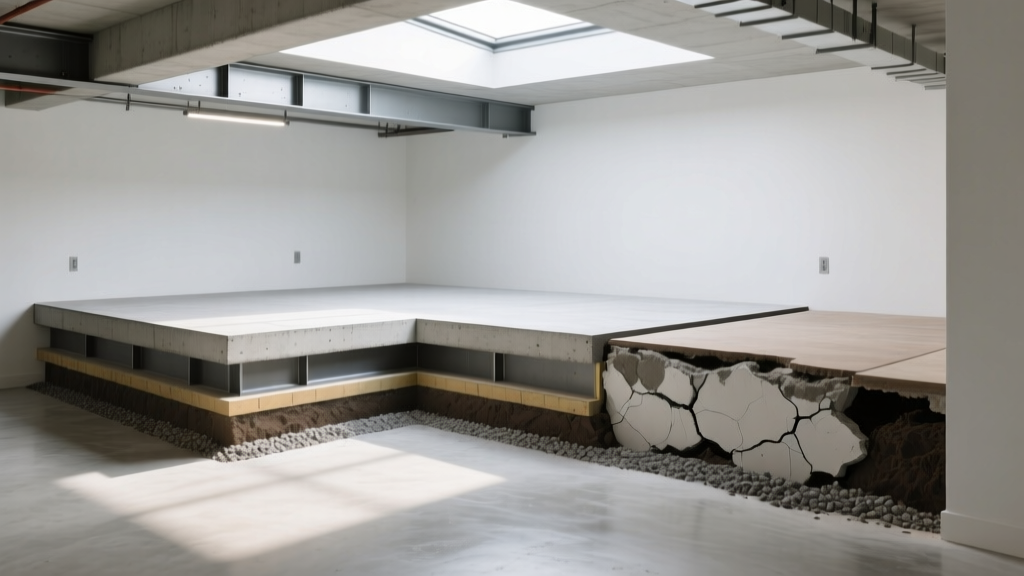
The Anatomy of a Structural Basement Floor
When evaluating below-grade construction, the term 'structural basement floor' refers to concrete slab systems designed to carry significant dead and live loads, resist hydrostatic uplift, or span over voids. Unlike a standard 4-inch residential slab-on-grade meant only to support foot traffic and light furniture, a true structural basement floor is engineered as a critical load-bearing diaphragm. These systems typically fall into three categories: heavily reinforced slab-on-grade with integrated grade beams, cast-in-place suspended slabs, and precast hollow core plank systems.
The durability and ultimate lifespan of these systems are dictated by their concrete mix design, reinforcement strategy, and exposure to below-grade moisture and soil gases. According to the Portland Cement Association (PCA), the primary determinant of concrete longevity is its permeability, which is directly controlled by the water-cementitious materials ratio (w/cm) and proper curing.
Expected Lifespan and Degradation Timelines
The baseline lifespan of a properly engineered structural basement floor is 75 to 100 years. However, specific system types exhibit different failure modes and maintenance intervals. The National Precast Concrete Association (NPCA) notes that factory-controlled precast systems often achieve higher initial densities than site-cast alternatives, altering their long-term degradation curves.
| Floor System Type | Expected Lifespan | Primary Failure Mode | Typical Load Capacity |
|---|---|---|---|
| Slab-on-Grade (4,500 psi) | 50 - 75 years | Differential settlement, ASR | 2,500 - 4,000 psf |
| Cast-in-Place Suspended | 75 - 100+ years | Rebar corrosion, mid-span deflection | 4,000 - 8,000 psf |
| Precast Hollow Core | 75 - 100+ years | Shear key failure, bearing loss | 6,000 - 12,000 psf |
| Post-Tensioned Slab | 100+ years | Tendon stress-corrosion cracking | 8,000 - 15,000 psf |
Critical Failure Modes in Below-Grade Structural Slabs
Understanding why structural basement floors fail is essential for specifying the right materials during the design phase. The American Concrete Institute (ACI) identifies several chemical and mechanical degradation pathways that severely truncate the lifespan of below-grade concrete.
1. Chloride-Induced Rebar Corrosion
In regions where de-icing salts are tracked into basement garage areas, or where soil contains high chloride concentrations, chloride ions penetrate the concrete matrix. Once the chloride threshold at the depth of the rebar is reached (typically 0.4% by weight of cement), the passive oxide layer protecting the steel breaks down. The resulting iron oxide (rust) occupies up to six times the volume of the original steel, causing tensile stresses that spall the concrete cover. To mitigate this, structural floors in high-risk zones should be specified with a maximum charge passed of 1,000 coulombs when tested per ASTM C1202 (Rapid Chloride Permeability Test).
2. Carbonation and pH Depassivation
Carbon dioxide from the atmosphere or soil gases diffuses into the concrete pores, reacting with calcium hydroxide to form calcium carbonate. This reaction lowers the concrete's alkalinity from a pH of ~12.5 down to below 9.0. While carbonation itself increases surface hardness, the drop in pH depassivates the embedded reinforcement, making it highly susceptible to corrosion even in the absence of chlorides. Utilizing supplementary cementitious materials (SCMs) like fly ash or slag cement can refine the pore structure and slow the carbonation front.
3. Post-Tensioning Sheathing Breaches
For post-tensioned structural basement floors, the 7-wire steel tendons are encased in high-density polyethylene (HDPE) sheathing filled with corrosion-inhibiting grease. If the sheathing is nicked by vibrators or sharp aggregate during the concrete pour, moisture infiltrates the tendon. Because PT steel is under immense continuous stress, this localized moisture leads to stress corrosion cracking—a sudden, catastrophic failure mode that provides zero visual warning before the tendon snaps.
Moisture Vapor Transmission (MVT) and Functional Lifespan
A structural basement floor may remain structurally sound for a century, but its 'functional lifespan' often ends much earlier due to Moisture Vapor Transmission (MVT). Concrete is a porous material; the calcium silicate hydrate (C-S-H) gel contains a microscopic capillary pore network that acts as a wick for soil moisture.
The MVT Trap: Installing impermeable floor coverings (like epoxy, vinyl plank, or rubber gym flooring) over a structural basement floor without a vapor barrier traps moisture. The resulting hydrostatic osmotic pressure can exceed 100 psi, blistering coatings and destroying adhesive bonds within 12 to 18 months.
Before installing any architectural flooring over a structural basement slab, in-situ relative humidity (RH) testing must be conducted per ASTM F2170. Probes drilled to 40% of the slab depth must read 75% RH or less. If readings exceed this threshold, the functional lifespan of the floor assembly is compromised, and mitigation is required.
Protective Treatments and Lifespan Extension Matrix
To maximize the durability of a structural basement floor, surface treatments must be applied to block the ingress of water, chlorides, and soil gases. The choice of treatment depends on whether the floor will remain exposed (e.g., a mechanical room or garage) or receive a secondary architectural floor covering.
| Treatment Type | Penetration Depth | Best Application | Lifespan Extension |
|---|---|---|---|
| 40% Silane Penetrating Sealer | 1/8 to 1/4 inch | Exposed structural floors, ramps | +15 to 25 years |
| Crystalline Waterproofing | Up to 4 inches (self-sealing) | High hydrostatic pressure zones | +30 to 50 years |
| Moisture Mitigation Epoxy | Surface film (10-20 mils) | Substrate prep for architectural flooring | Protects floor coverings 10+ years |
Maintenance Protocols for the 75-Year Benchmark
Achieving the upper limits of a structural basement floor's lifespan requires proactive, scheduled maintenance. Relying on a 'pour and forget' approach guarantees premature degradation.
- Annual Crack Mapping: Inspect the slab annually and map any cracking. According to ACI 224, crack widths in below-grade structural elements exposed to moisture should not exceed 0.012 inches. Wider cracks must be routed and sealed with a flexible polyurethane joint sealant to prevent water from reaching the reinforcement.
- Post-Tensioning Anchorage Audits: For PT slabs, the anchorages at the slab edges are the most vulnerable points. Inspect the anchorage caps every five years to ensure the grease packing remains intact and the caps are fully sealed against moisture intrusion.
- Drainage Plane Verification: The structural floor relies on the exterior drainage plane to relieve hydrostatic pressure. Ensure that perimeter French drains and sump pumps are operational. A structural floor is not designed to act as a permanent waterproofing dam; it is designed to resist temporary loads while the drainage system manages the water.
Frequently Asked Questions
Can a structural basement floor be core-drilled for new plumbing?
Core-drilling a structural basement floor is highly risky. Cutting through reinforcing steel or post-tensioning tendons compromises the slab's load-bearing capacity and can cause sudden, explosive failures if a tensioned tendon is severed. Always consult the original structural drawings and use ground-penetrating radar (GPR) to locate embedded steel before any cutting occurs.
Does adding fibers to the mix increase the structural lifespan?
Synthetic micro-fibers (like polypropylene) help reduce plastic shrinkage cracking during the initial cure, which indirectly protects the slab by minimizing early-age permeability pathways. However, they do not replace structural steel rebar or post-tensioning tendons for load-bearing capacity. For structural lifespan extension, macro-synthetic fibers or steel fibers can be used to control long-term shrinkage and improve impact resistance, but they must be engineered into the mix design by a structural engineer.