Vinyl Flooring Rolls Cost Estimator & Calculator 2026
Calculate exact costs and quantities for vinyl flooring rolls. Learn sheet vinyl math, 2026 pricing, waste factors, and subfloor prep requirements.
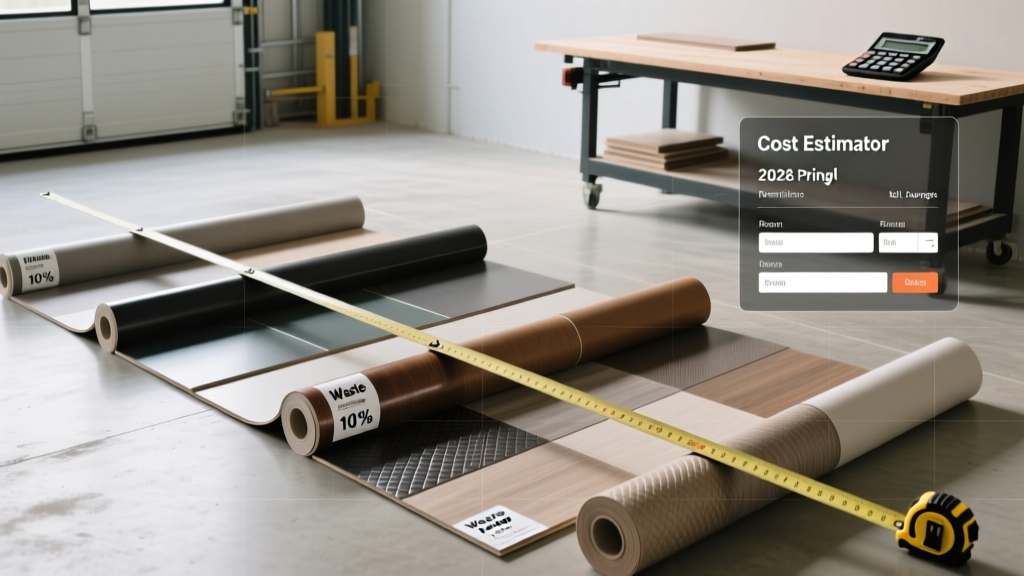
The Unique Math of Sheet Vinyl: Widths vs. Square Footage
Estimating vinyl flooring rolls requires a fundamentally different mathematical approach than calculating for Luxury Vinyl Plank (LVP) or ceramic tile. With modular flooring, you purchase square footage and accept a standard 10% waste factor. With sheet vinyl, you are purchasing linear footage off a fixed-width cylinder. Standard residential vinyl flooring rolls are manufactured in 12-foot widths, while some budget lines and commercial homogeneous sheets come in 6-foot widths.
Because you cannot buy fractions of a roll width, your room dimensions dictate your waste factor. If your room is 11 feet wide, a 12-foot roll leaves 1 foot of continuous offcut waste across the entire length of the room. Understanding this width constraint is the most critical step in accurately estimating material costs and preventing budget overruns.
Step-by-Step Quantity Calculator for Vinyl Flooring Rolls
To calculate the exact linear footage required, follow this estimator sequence rather than relying on basic square-footage calculators:
- Measure Maximum Dimensions: Measure the absolute maximum length and width of the room, including doorways, closets, and bay windows. Do not subtract for islands or cabinets; you need a continuous sheet to tuck under toe-kicks.
- Determine Drop Requirements: Divide the room's maximum width by your chosen roll width (typically 12 feet). Round up to the nearest whole number. This is your number of 'drops' (strips).
- Calculate Base Linear Footage: Multiply the number of drops by the maximum length of the room.
- Apply the Pattern-Matching Waste Factor: For each seam required, add 12 to 18 inches of linear footage per drop to allow for pattern shifting and trimming. For diagonal layouts or complex architectural features, increase your total linear footage by 15%.
Real-World Estimation Example: The 15x20 Kitchen
Consider a kitchen measuring 15 feet wide by 20 feet long. The total area is 300 square feet. A naive calculator would add 10% waste and estimate 330 square feet. Here is the actual sheet vinyl math:
- The room is 15 feet wide, exceeding the 12-foot roll width. You need two drops.
- Drop 1 covers 12 feet of width. Linear length needed: 20 feet.
- Drop 2 must cover the remaining 3 feet of width. However, to match the pattern at the seam, you must cut a 4.5-foot wide section from the second roll. Linear length needed: 20 feet.
- Total Linear Footage: 40 linear feet of a 12-foot wide roll.
- Total Purchased Area: 480 square feet (40 linear ft x 12 ft width).
In this scenario, your actual waste factor is 60%, not 10%. You are paying for 480 square feet of material to cover a 300-square-foot room. This is why professional estimators always draft a cutting diagram before ordering vinyl flooring rolls.
2026 Material & Installation Cost Breakdown
Pricing for sheet vinyl varies heavily based on the backing material, wear layer thickness, and manufacturing process. Below are the current 2026 market rates for materials and professional installation.
| Material / Service | Cost per Sq Ft | Specifications & Notes |
|---|---|---|
| Felt-Backed Vinyl | $1.50 - $2.80 | Requires full-spread adhesive. Prone to tearing during installation. 10-20 mil wear layer. |
| Fiberglass-Backed Vinyl | $2.50 - $4.50 | Dimensionally stable. Can be loose-laid or perimeter-bonded. 20-28 mil wear layer. |
| Commercial Homogeneous | $4.00 - $7.50 | Solid vinyl composition through entire thickness. Requires heat-welded seams. 40+ mil wear layer. |
| Full-Spread Adhesive | $0.50 - $0.85 | Hard-set acrylic. Mandatory for felt-backed and commercial sheet. |
| Professional Installation | $2.50 - $5.00 | Includes cutting, seaming, and rolling. Excludes subfloor preparation. |
Hidden Costs: Subfloor Prep and Telegraphing
Sheet vinyl is a 'telegraphing' material. Unlike rigid core LVP, which bridges minor subfloor imperfections, sheet vinyl will eventually conform to and expose every divot, nail head, and uneven seam in the subfloor beneath it. According to the Resilient Floor Covering Institute (RFCI), improper subfloor preparation is the leading cause of premature wear layer failure and seam separation in sheet vinyl installations.
Dealing with Embossing and Uneven Subfloors
If you are installing vinyl flooring rolls over existing textured vinyl or embossed ceramic tile, you cannot simply lay the new sheet over the old. The old texture will telegraph through within 12 to 18 months. You have two remediation options:
- Embossing Leveler: A specialized Portland cement-based patching compound applied with a flat trowel to fill texture gaps. Cost: $0.80 - $1.20 per sq ft (materials and labor).
- 1/4-Inch Lauan Underlayment: Installing a fresh layer of lauan or specialized plywood over the existing floor. This provides a flawless nailing surface and eliminates telegraphing. Cost: $1.50 - $2.20 per sq ft. As noted in This Old House's flooring guidelines, all underlayment seams must be staggered and filled with flexible floor patch to prevent joint ghosting.
Expert Insight: Never use standard drywall joint compound or lightweight spackle to level a subfloor for sheet vinyl. These materials lack the compressive strength to withstand point-loads (like high heels or chair legs) and will crush under the vinyl, creating permanent depressions.
Adhesive Selection and Coverage Rates
The type of backing on your vinyl flooring rolls dictates your adhesive strategy, which significantly impacts both material costs and installation time.
- Pressure-Sensitive Adhesive (Fiberglass Backing): Fiberglass-backed sheets are dimensionally stable and resist shrinking. They can be installed using a modified loose-lay method (adhesive only at the perimeter and seams) or a light full-spread pressure-sensitive tack. Coverage: ~150 sq ft per gallon. Cost: $45-$60 per gallon.
- Hard-Set Acrylic Adhesive (Felt Backing): Felt-backed vinyl is highly susceptible to expansion and contraction. It requires a 100% full-spread hard-set adhesive applied with a 1/16-inch notched trowel. Coverage: ~120 sq ft per gallon. Cost: $50-$75 per gallon.
- Two-Part Epoxy (Commercial Wet Areas): For commercial kitchens or healthcare facilities using homogeneous sheet vinyl, moisture-cured or two-part epoxy adhesives are required to prevent alkaline hydrolysis (adhesive breakdown from concrete moisture). Coverage: ~100 sq ft per gallon. Cost: $90-$120 per gallon.
Final Estimation Checklist
Before finalizing your order for vinyl flooring rolls, verify these critical parameters to ensure your budget holds:
- Confirm the exact roll width (6' or 12') of the specific SKU you are ordering.
- Draft a cutting diagram to calculate true linear footage and seam placements.
- Test concrete subfloors for moisture using a calcium chloride test (ASTM F1869); readings above 5 lbs/1000 sq ft/24hrs require a moisture mitigation primer ($1.50/sq ft).
- Order 10% extra chemical seam sealer and a spare seam-seaming iron if heat-welding commercial sheet.
- Factor in HVAC transition strips and custom edge binders for exposed seams at doorways.