Top Walk-Behind Floor Scraper Brands & Models for 2026
Compare top walk-behind floor scraper brands for 2026. Deep dive into National, Bartell, and EDCO models, blade metallurgy, pricing, and TCO.
The Shift from Manual to Mechanized Subfloor Preparation
The era of manual floor scraping in commercial environments is definitively over. Driven by stringent labor laws, rising wages, and strict occupational health standards, contractors in 2026 rely almost exclusively on mechanized walk-behind and ride-on floor scrapers for removing resilient flooring, epoxy coatings, and ceramic tile. A single operator with a modern 12-inch walk-behind scraper can clear 1,500 to 2,000 square feet of vinyl composition tile (VCT) per hour—a task that would take a three-person manual crew an entire day. This deep-dive analyzes the dominant brands in the commercial floor scraper market, evaluating specific model lines, metallurgy, and total cost of ownership (TCO) to help contractors make precise capital equipment decisions.
National Flooring Equipment: The S-Series Workhorses
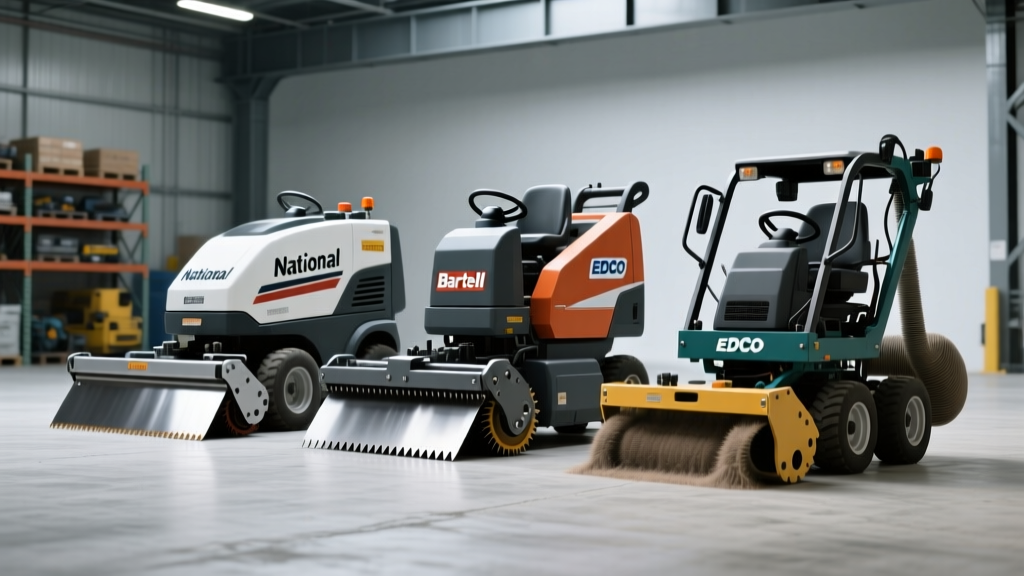
National Flooring Equipment has long been the benchmark for mid-sized commercial scrapers. Their S-Series line is engineered specifically for high-maneuverability environments like hospital corridors, school hallways, and retail spaces where tight turning radiuses are mandatory.
Model Spotlight: National S-12
The National S-12 features a 12-inch blade width and is powered by a 1.5 HP, 115V electric motor (with a 230V upgrade option). Weighing in at approximately 450 lbs, it provides the exact down-pressure required to sheer off VCT and thin-set epoxy without gouging the underlying concrete. The S-12 utilizes a continuous track drive system rather than wheels, which eliminates the 'fishtailing' effect common in wheeled scrapers when the blade encounters high-resistance adhesive patches. In 2026, the base MSRP for the S-12 hovers around $14,500, excluding the mandatory dust-extraction shroud attachment ($1,200).
Bartell Global: Heavy-Duty SRT Series for Industrial Demolition
When the scope shifts from thin VCT to thick, multi-layer epoxy systems or heavily bonded ceramic tile, National's mid-sized units stall out. This is where Bartell Global’s SRT (Scraper Ride-on/Track) series dominates. While Bartell manufactures ride-ons, their walk-behind SRT-24 is the bridge between standard commercial units and heavy demolition rigs.
The Bartell SRT-24 weighs over 1,500 lbs. This massive weight translates directly to the blade edge, generating up to 600 lbs of concentrated downward force. The primary failure mode contractors experience with the SRT-24 is track derailment when operators attempt to reverse direction while the blade is fully engaged in thick adhesive. Operators must always lift the blade via the hydraulic actuator before reversing. Current market pricing for the SRT-24 propane model is approximately $32,500.
EDCO: Ergonomics and the STR Line
EDCO approaches floor scraper design with a heavy emphasis on operator fatigue reduction and vibration dampening. The STR-8 (8-inch walk-behind scraper) is their flagship model for confined spaces, such as residential bathrooms or narrow commercial stairwells. Unlike competitors that use rigid steel handles, EDCO integrates a polyurethane-dampened, adjustable T-bar handle that absorbs up to 60% of the harmonic vibration generated by the reciprocating blade action. This reduces the risk of Hand-Arm Vibration Syndrome (HAVS) for operators running the machine for 8-hour shifts. The STR-8 is priced competitively at $9,800.
Performance & Pricing Matrix
| Brand / Model | Blade Width | Power Source | Weight | Est. Removal Rate (VCT) | 2026 Est. Price |
|---|---|---|---|---|---|
| EDCO STR-8 | 8 inches | 115V Electric | 285 lbs | 800 - 1,000 sq ft/hr | $9,800 |
| National S-12 | 12 inches | 230V Electric | 450 lbs | 1,500 - 2,000 sq ft/hr | $14,500 |
| Bartell SRT-24 | 24 inches | 35HP Propane | 1,500 lbs | 3,500 - 4,500 sq ft/hr | $32,500 |
Blade Metallurgy: The Hidden Variable in Scraper ROI
The most critical operational decision a contractor makes is not which scraper to buy, but which blade metallurgy to install. Using the wrong blade composition will either destroy the concrete subfloor or result in immediate blade failure.
High-Carbon Steel (HCS) Blades
HCS blades are relatively soft and feature a sharpened, beveled edge. They are strictly designed for soft, pliable adhesives like cutback asphalt, mastic, and pressure-sensitive acrylics. Failure Mode: If an operator uses an HCS blade to remove hard thin-set mortar or ceramic tile, the blade edge will 'roll' (work-harden and bend backward) within the first 50 square feet, rendering it useless and potentially gouging the concrete as the rolled edge drags.
Tungsten Carbide Tipped (TCT) Blades
TCT blades feature a blunt, flat edge with a brazed strip of tungsten carbide. They do not slice; they shatter and fracture brittle materials through sheer impact force. These are mandatory for epoxy, terrazzo, and ceramic tile removal. Failure Mode: Using a TCT blade on soft mastic causes 'plowing.' The blunt carbide edge pushes the soft adhesive into a thick ridge in front of the blade, eventually stalling the scraper's hydraulic drive and causing the machine to climb up over the adhesive pile rather than scraping it.
Maintenance Realities: Track Tension and Hydraulic Leaks
Walk-behind floor scrapers endure immense lateral stress. The continuous rubber tracks are the highest-wear component outside of the blades. A poorly tensioned track will snap under the torque required to break the suction of a 24-inch blade on wet adhesive.
Step-by-Step Track Tensioning Protocol
- Clear the Debris: Before adjusting, use a wire brush to clear cured adhesive and concrete dust from the drive sprocket and idler wheel. Packed debris creates false tension readings.
- Measure the Deflection: Apply 15 lbs of downward pressure to the center of the top track run. The track should deflect exactly 1/2 inch to 5/8 inch. More than 3/4 inch indicates a loose track (risk of derailment); less than 1/4 inch indicates over-tensioning (risk of blowing the hydraulic drive seals).
- Adjust the Idler: Use a 3/4-inch wrench to turn the grease zerk on the front idler wheel. Pump lithium-complex grease until the deflection reaches the 1/2 inch mark.
- Check Hydraulic Fluid: Track over-tensioning is the leading cause of hydraulic pump cavitation. Check the reservoir sight glass; if the fluid appears milky, water has bypassed the cylinder seals, requiring an immediate fluid flush to prevent pump scoring.
Calculating True Cost Per Square Foot
When bidding a 20,000 square foot VCT removal project, contractors must factor in consumable blade wear. An 8-inch HCS blade costs roughly $12 and lasts for 1,000 square feet of soft mastic. A 12-inch TCT blade costs $85 but can endure 5,000 square feet of hard epoxy. By mapping the exact adhesive type during the pre-bid site walk, contractors can accurately project consumable costs, ensuring that the capital depreciation of a $14,500 National S-12 is amortized correctly across the project lifecycle, ultimately protecting the profit margin on complex demolition bids.