Best Residential Flooring Options Compared: 2026 Guide
Compare the top residential flooring options for 2026. Explore costs, durability, and installation specs for hardwood, LVP, tile, and laminate.

The 2026 Residential Flooring Matrix: Quick Decision Framework
Selecting the right material requires balancing upfront costs, long-term durability, and specific environmental tolerances. The table below synthesizes the performance metrics for the four dominant residential flooring options currently on the market.
| Material Category | Avg. Material Cost (per sq. ft.) | Expected Lifespan | Water Resistance | Best Application |
|---|---|---|---|---|
| Rigid Core LVP (SPC) | $3.50 - $6.50 | 15 - 25 years | 100% Waterproof | Kitchens, basements, high-traffic zones |
| Engineered Hardwood | $6.00 - $12.00 | 30 - 50+ years | Water-Resistant (Surface) | Living rooms, bedrooms, formal areas |
| Porcelain Tile | $4.00 - $9.00 | 50+ years | 100% Waterproof | Bathrooms, mudrooms, radiant heat systems |
| Waterproof Laminate | $3.00 - $5.50 | 15 - 20 years | Highly Water-Resistant | Living areas, dining rooms, playrooms |
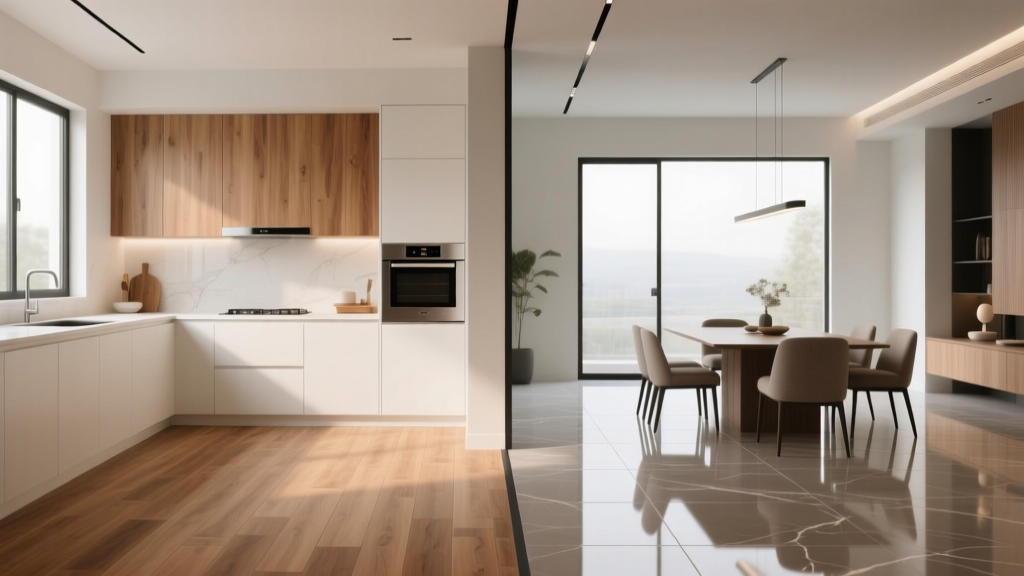
Luxury Vinyl Plank (LVP) & Rigid Core: The Market Leader
Rigid core vinyl has captured the majority of the residential market due to its dimensional stability and 100% waterproof core. However, not all LVP is engineered equally. The critical differentiator in 2026 is the core composition: Stone Plastic Composite (SPC) versus Wood Plastic Composite (WPC).
SPC vs. WPC Core Densities
- SPC (Stone Plastic Composite): Formulated with limestone powder and PVC stabilizers. It is highly dense, rigid, and resistant to indentation from heavy furniture (e.g., piano casters or kitchen islands). SPC is the mandatory choice for areas with direct sunlight or extreme temperature fluctuations, as it exhibits minimal thermal expansion.
- WPC (Wood Plastic Composite): Incorporates a foaming agent, making it thicker, softer underfoot, and superior for sound dampening. WPC is ideal for second-story installations where impact noise transfer (IIC ratings) is a concern, but it is more susceptible to denting under concentrated point loads.
Engineered Hardwood: Authenticity Meets Stability
While solid hardwood remains a legacy choice, engineered hardwood is the technical superior for modern construction. Its cross-plywood core construction neutralizes the natural expansion and contraction of wood, allowing installation over concrete slabs, below-grade basements, and hydronic radiant heating systems.
Veneer Thickness and Refinishing Limits
The lifespan of engineered hardwood is dictated entirely by the thickness of the top hardwood veneer. According to the National Wood Flooring Association (NWFA), a veneer must be at least 2mm thick to withstand a single professional sand-and-refinish cycle. For a true lifetime floor, specify a 3mm to 4mm+ sawn veneer. Avoid rotary-peeled veneers under 1.5mm, as they cannot be refinished and are prone to surface checking (micro-cracking).
Finish Technology
Look for UV-cured aluminum oxide finishes. These factory-applied coatings penetrate the wood pores and are cured with ultraviolet light, creating a surface that is significantly more resistant to abrasion and chemical spills than site-applied polyurethane.
Porcelain Tile: The Heavyweight Champion
Porcelain tile offers unmatched longevity and zero water permeability. When evaluating porcelain for residential use, the primary metric is the PEI (Porcelain Enamel Institute) wear rating.
'For residential floors, a PEI rating of 3 (moderate traffic) or 4 (moderate-to-heavy traffic) is required. PEI 1 and 2 are strictly for wall applications and will rapidly show wear patterns in high-traffic corridors.'
Subfloor Deflection Standards
The most common cause of tile failure (cracked grout and popped tiles) is subfloor deflection. The Tile Council of North America (TCNA) mandates a maximum deflection of L/360 for ceramic and porcelain tile. This means a floor joist spanning 15 feet (180 inches) must not deflect more than 1/2 inch under a 300 lb concentrated load. If your subfloor fails this metric, you must sister the joists or install an uncoupling membrane like Schluter-DITRA to absorb lateral movement and prevent crack transfer.
Waterproof Laminate: Closing the Gap
Historically, laminate flooring failed catastrophically when exposed to moisture due to its swelling high-density fiberboard (HDF) core. The 2026 generation of waterproof laminate solves this by utilizing hydrophobic resins and tight-click locking mechanisms that prevent water from penetrating the seams for up to 72 hours.
Understanding AC Ratings
Laminate durability is classified by the AC (Abrasion Class) rating system:
- AC3: Moderate residential (bedrooms, closets).
- AC4: Heavy residential / Light commercial (living rooms, kitchens, hallways). This is the recommended minimum for main living areas.
- AC5: Heavy commercial (retail spaces, high-traffic foyers).
Critical Subfloor Preparation & Moisture Mitigation
Material selection is irrelevant if the subfloor is compromised. Skipping subfloor prep accounts for over 70% of post-installation flooring warranty claims.
Concrete Slab Moisture Testing
Before installing any moisture-sensitive floor (hardwood, laminate, or glue-down LVP) over a concrete slab, conduct a quantitative moisture test. The industry standard is the ASTM F2170 relative humidity (RH) probe test, which measures moisture deep within the slab. If RH levels exceed 75% to 80% (depending on the adhesive manufacturer's specs), you must apply a two-part epoxy moisture mitigation system, which adds approximately $4.00 to $6.00 per square foot to the project cost.
Wood Subfloor Leveling
Rigid core LVP and large-format tile require exceptionally flat subfloors. The tolerance is typically no more than 3/16-inch deviation over a 10-foot radius. Low spots must be filled with a Portland cement-based self-leveling underlayment (SLU). Note that SLU requires a specific primer coat to ensure bonding and prevent the wood subfloor from absorbing the water out of the compound too quickly, which leads to cracking.
Room-by-Room Selection Protocol
- Kitchens & Mudrooms: SPC Rigid Core LVP or Porcelain Tile. Both handle dropped pots, water spills, and heavy appliance movement without structural failure.
- Bathrooms: Porcelain Tile with a slip-resistant texture (DCOF > 0.42). Avoid hardwood and standard laminate entirely.
- Living & Dining Rooms: Engineered Hardwood or WPC LVP. These areas prioritize acoustic warmth, underfoot comfort, and high-end aesthetics.
- Basements: SPC LVP or floating Waterproof Laminate. Never glue down flooring in a below-grade environment where concrete moisture vapor transmission is a constant variable.
Indoor Air Quality and VOC Considerations
When selecting synthetic flooring options like LVP or laminate, off-gassing of volatile organic compounds (VOCs) is a primary health consideration. The Environmental Protection Agency (EPA) notes that indoor VOC levels can be significantly higher than outdoor levels, heavily influenced by building materials. Always specify flooring that carries FloorScore or GREENGUARD Gold certifications. These third-party verifications ensure the product and its adhesives meet strict, health-based limits for VOC emissions, safeguarding your home's indoor air quality.
Written by
Elena RodriguezElena Rodriguez is a civil engineer and technical writer specializing in concrete technology, masonry systems, and ASTM/ACI compliance. She earned her B.S. in Civil Engineering from Texas A&M University and spent a decade at a materials testing laboratory, performing over 2,000 concrete compressive strength tests and masonry prism evaluations. Elena is an ACI-certified Field Testing Technician (Grade I) and a member of ASTM Committee C12 on Natural Building Stone. She currently consults on forensic engineering cases involving concrete failures and moisture intrusion. Based in San Antonio, TX, Elena is a proud member of the Society of Women Engineers (SWE) and coaches her daughter's FIRST Robotics team.
More from Elena Rodriguez
View all
Walls & Panels
Cost Analysis: Light Gauge Steel Framing Advantages and Disadvantages
Evaluate light gauge steel framing advantages and disadvantages through a strict cost analysis lens, comparing material, labor, and lifecycle expenses.
Aug 4, 2026

Walls & Panels
Gypsum Board Types: Exact Specifications, Thickness & Dimensions
Compare standard, Type X, and moisture-resistant gypsum board types. Get exact specifications, thicknesses, dimensions, and ASTM standards for your project.
Aug 4, 2026

Fire Resistance
Best Fire-Resistant Outdoor Decking Materials: 2026 Buyer Guide
Discover the best fire-resistant outdoor decking materials for 2026. Compare Class A PVC, aluminum, and hardwood options for WUI compliance and safety.
Aug 4, 2026