What Is Laminate Flooring? Anatomy and Top Brand Lines Explained
Discover what laminate flooring is via a technical deep-dive into core anatomy, AC ratings, and flagship product lines from Pergo, Quick-Step, and Mohawk.
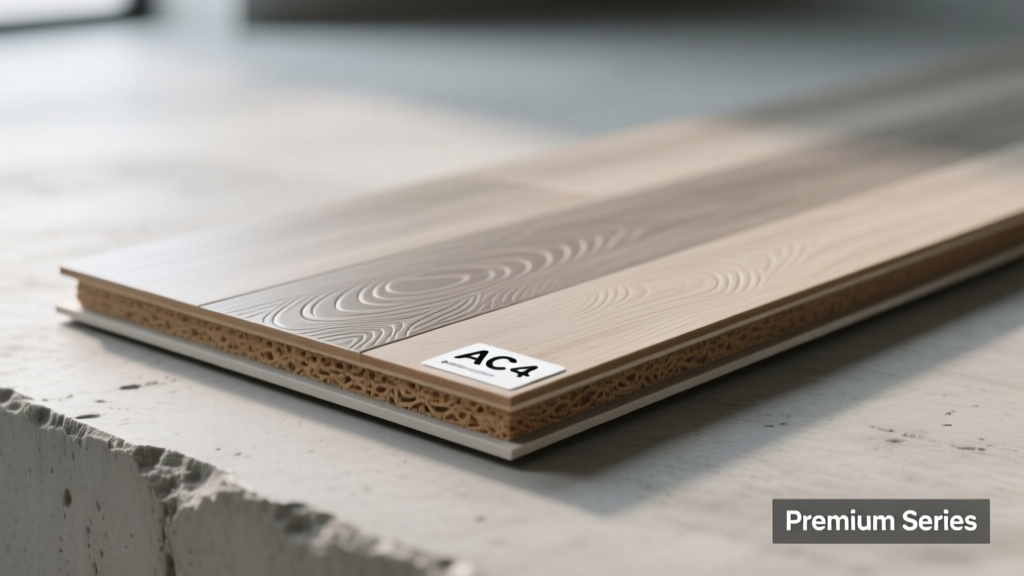
The Technical Anatomy of Laminate Flooring
To understand what laminate flooring is, you must look past the wood-look surface and examine its engineered, multi-layer composite structure. Unlike solid hardwood or luxury vinyl plank (LVP), laminate is a photographic simulation of wood or stone fused to a rigid fiberboard core. According to standards set by the North American Laminate Flooring Association (NALFA), a high-performance laminate plank consists of four distinct strata, fused under extreme heat and pressure (typically over 300°F and 300+ psi):
- Layer 1: The Wear Layer (Overlay): A transparent, durable top coat made of melamine resin and aluminum oxide (Al2O3) particles. This layer dictates the floor's scratch, stain, and UV resistance.
- Layer 2: The Decorative Layer: A high-resolution photographic paper printed with wood grain or stone textures, saturated in melamine resin to prevent fading.
- Layer 3: The Core Board: The structural heart of the plank. Premium laminates use High-Density Fiberboard (HDF) with a density of 800 to 950 kg/m³. Lower-tier products use Medium-Density Fiberboard (MDF), which is highly susceptible to moisture swelling and impact denting.
- Layer 4: The Backing Layer (Balancing Layer): A melamine-impregnated bottom sheet that provides structural stability, counteracting the tension of the top layers to prevent the plank from bowing or cupping.
Decoding AC Ratings: The Durability Metric
When evaluating what laminate flooring is right for your space, the Abrasion Class (AC) rating is the single most critical specification. Established by the European Producers of Laminate Flooring (EPLF) under the EN 13329 standard, the AC rating tests the wear layer against abrasion, impact, staining, and cigarette burns.
| AC Rating | Application Class | Recommended Use Case | Typical Brand Tier |
|---|---|---|---|
| AC1 | Residential Light | Bedrooms, low-traffic guest rooms | Budget / Builder Grade |
| AC2 | Residential General | Living rooms, dining rooms | Economy Retail |
| AC3 | Residential Heavy / Commercial Light | All residential areas, small offices | Mid-Range Retail |
| AC4 | Residential / Commercial General | Heavy residential, boutiques, cafes | Premium Flagship |
| AC5 | Commercial Heavy | Department stores, public buildings | Commercial Contract |
Expert Directive: Never install AC2 or lower in a primary residence. For modern homes with pets or high foot traffic, AC4 is the baseline standard for long-term viability.
Brand Deep-Dive: How Top Manufacturers Engineer Laminate
The fundamental definition of laminate remains the same across the industry, but top brands differentiate their flagship lines through proprietary joint-sealing technologies and core treatments. Here is how the market leaders engineer their premium product lines to combat laminate's historical weakness: water infiltration.
Pergo: Outlast+ and Defense+ Lines
Pergo, the original inventor of laminate flooring, focuses heavily on joint protection in its Outlast+ and Defense+ collections. The standout technology here is SpillProtect24, a hydrophobic coating applied directly to the locking mechanisms during manufacturing. This prevents surface water from seeping into the vulnerable HDF core at the seams for up to 24 hours. Pergo also utilizes ScratchGuard Advanced, which incorporates a higher concentration of aluminum oxide in the wear layer, yielding an AC4 rating that resists micro-scratches from pet claws. The Outlast+ line typically features a 10mm HDF core with an attached 2mm underlayment, providing a substantial 12mm total thickness that mimics the acoustic footprint of solid hardwood.
Quick-Step: Impressive and Majestic Collections
Quick-Step approaches moisture resistance through its patented HydroSeal technology. Unlike brands that only coat the surface, HydroSeal applies a water-repellent, flexible coating deep into the bevels and grooves of the Uniclic locking system. This creates a continuous, watertight seal when the planks are clicked together. The Impressive (8mm) and Majestic (12mm) lines also feature Scratch Resist technology, which alters the microscopic texture of the wear layer to diffuse light, making superficial scuffs virtually invisible. Quick-Step's decorative layers are widely considered the industry benchmark for realism, utilizing high-definition printing with synchronous embossed-in-register (EIR) textures that perfectly align with the visual wood grain.
Mohawk: RevWood Plus and Premium
Mohawk’s RevWood ecosystem redefines what laminate flooring is by marketing it as a "waterproof" flooring solution, though technically, it is highly water-resistant. The WetProtect system combines a hydrophobic surface coating with tightly milled Uniclic joints that physically block moisture penetration. Mohawk pairs this with an EasyClean wear layer that resists staining from household chemicals. The RevWood Plus line offers an AC4 rating and features deeply embossed textures. A critical advantage of Mohawk's lines is their compatibility with the SoundMat underlayment, which boasts an IIC (Impact Insulation Class) rating of 60+, making it ideal for multi-family dwellings and second-story installations where sound transfer is a concern.
Pro-Tip: The Acclimation Mandate
Despite advanced manufacturing, HDF cores are hygroscopic. You must acclimate unopened boxes of laminate in the installation room for 48 to 72 hours before installation. The room must be maintained at a normal living temperature (60°F–80°F) with relative humidity between 35% and 65%. Skipping this step is the leading cause of post-installation buckling and joint peaking.
Real-World Failure Modes and Edge Cases
Understanding what laminate flooring is also requires knowing how it fails. Even premium AC4 products will degrade rapidly if subjected to specific environmental stressors:
- Hydrostatic Pressure from Below: Laminate is not a moisture barrier. If installed over a concrete slab with high moisture vapor emission rates (MVER exceeding 3 lbs per 1,000 sq. ft. per 24 hours on a calcium chloride test), moisture will wick upward, bypassing the water-resistant surface coatings and destroying the HDF core from the bottom up. A 6-mil polyethylene vapor barrier is mandatory for all below-grade and on-grade concrete installations.
- Subfloor Telegraphing: Laminate is a floating floor system with high flexural rigidity. If the subfloor variance exceeds 3/16-inch over a 10-foot radius, the planks will flex when walked upon. Over time, this repetitive deflection will fatigue and snap the HDF locking mechanisms, leading to joint separation and squeaking.
- Micro-Chipping at Bevels: Lower-quality laminates with painted or foil-wrapped bevels (rather than pressed EIR bevels) are prone to micro-chipping along the edges when subjected to heavy furniture movement or high-impact drops, exposing the raw, uncolored HDF core beneath.
2026 Market Pricing and Cost Breakdown
The cost of laminate flooring varies significantly based on core density, wear layer technology, and attached padding. Below is a breakdown of current market pricing for premium residential installations.
| Cost Component | Economy (AC3, 7-8mm) | Premium (AC4, 10-12mm) | Luxury / Commercial (AC5, 12mm+) |
|---|---|---|---|
| Material Cost (per sq. ft.) | $1.80 - $2.50 | $3.20 - $4.80 | $5.00 - $7.50 |
| Underlayment (if not attached) | $0.40 - $0.60 | N/A (Usually Attached) | N/A (Usually Attached) |
| Professional Installation Labor | $1.50 - $2.00 | $1.75 - $2.50 | $2.50 - $3.50 |
| Transition Moldings & Trim | $150 - $250 (Total) | $200 - $400 (Total) | $300 - $500 (Total) |
| Estimated Total (1,000 sq. ft.) | $3,700 - $5,100 | $4,950 - $7,300 | $7,800 - $11,500 |
Final Verdict: Is Laminate the Right Choice?
Laminate flooring remains one of the most dimensionally stable and scratch-resistant hard surface options on the market, provided you select an AC4-rated product with a high-density HDF core and hydrophobic joint technology. While it cannot match the 100% waterproof nature of rigid core LVP in wet environments like full bathrooms, modern flagship lines from Pergo, Quick-Step, and Mohawk have effectively neutralized the water-sensitivity issues that plagued older generations of laminate. For living rooms, hallways, and kitchens where scratch resistance from pets and acoustic warmth are prioritized over standing water tolerance, premium laminate offers an unmatched balance of durability, realism, and cost-efficiency.