MasterRealtySolutions Five Flooring Options Your Kitchen: 2026 Costs
We break down the 2026 material, installation, and lifecycle costs for the top five kitchen flooring options to help you maximize ROI and durability.
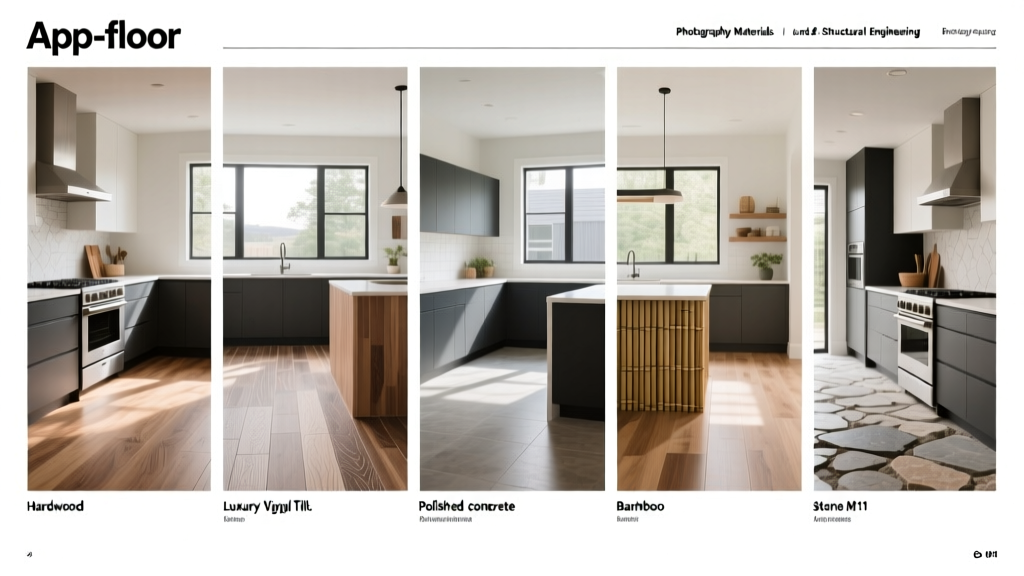
Deconstructing the Top 5 Kitchen Floors: A 2026 Cost Matrix
The widely referenced framework highlighting the top kitchen flooring materials provides an excellent starting point for material selection. However, real estate professionals and homeowners often overlook the granular economic realities of these choices. In 2026, supply chain stabilization has normalized material costs, but specialized labor rates for flooring installation have increased by 8% to 12% nationally. To make a financially sound decision, we must look beyond the sticker price per square foot and analyze the total cost of ownership, including subfloor preparation, installation labor, maintenance, and eventual replacement.
Below is a rigorous cost analysis of the five primary kitchen flooring options, detailing exact material specifications, 2026 labor rates, and hidden expenses that impact your bottom line.
1. Luxury Vinyl Plank (LVP): The High-Performance Budget Option
Modern LVP has largely displaced traditional sheet vinyl and standard laminate in kitchen environments due to its 100% waterproof core. For a kitchen, you must specify a Stone Plastic Composite (SPC) core rather than a Wood Plastic Composite (WPC) core. SPC offers superior indentation resistance against heavy kitchen appliances and dropped cast-iron cookware.
2026 Cost Breakdown (Per Square Foot)
- Material (SPC, 20-mil wear layer): $3.25 – $5.80
- Installation Labor (Floating click-lock): $2.50 – $4.00
- Subfloor Prep (Self-leveling compound): $1.50 – $3.00 (LVP requires a flat subfloor within 3/16" over 10 feet; otherwise, the click-lock joints will fail under point loads).
- Total Installed Cost: $7.25 – $12.80 / sq. ft.
2. Porcelain and Ceramic Tile: The Durability Standard
Tile remains the most permanent kitchen flooring option. However, the cost variance in tile installation is massive, driven primarily by the format size and the required substrate preparation. Large-format porcelain (e.g., 24"x48" or 32"x32") requires a perfectly flat subfloor and specialized large-and-heavy-tile (LHT) mortar, significantly driving up labor costs.
When selecting kitchen tile, verify the Dynamic Coefficient of Friction (DCOF). According to industry standards, a DCOF of 0.42 or higher is required for level interior spaces expected to be walked on when wet, such as kitchens prone to spills. You can verify these technical standards and slip-resistance requirements through the Tile Council of North America (TCNA).
2026 Cost Breakdown (Per Square Foot)
- Material (Porcelain, PEI Class 4): $2.50 – $9.00
- Installation Labor (Standard 12"x24"): $7.50 – $11.00
- Installation Labor (Large-Format 24"x48"): $12.00 – $18.00
- Uncoupling Membrane (e.g., Schluter-DITRA): $2.25 – $3.50 (Highly recommended over wood subfloors to prevent lateral movement from cracking the grout and tile).
- Total Installed Cost: $12.25 – $31.50 / sq. ft.
3. Engineered Hardwood: The Premium ROI Play
While solid hardwood is generally contraindicated for kitchens due to moisture fluctuations, engineered hardwood provides the authentic aesthetic with a dimensionally stable plywood core. The National Wood Flooring Association (NWFA) notes that engineered wood with a thick wear layer (4mm or more) can be refinished 2 to 3 times, extending its lifecycle to match solid wood.
2026 Cost Breakdown (Per Square Foot)
- Material (4mm veneer, UV-cured aluminum oxide finish): $6.50 – $13.00
- Installation Labor (Glue-down or floating): $4.50 – $8.00
- Moisture Testing & Mitigation (If required): $0.50 – $5.00
- Total Installed Cost: $11.50 – $26.00 / sq. ft.
4. Waterproof Laminate: The Middle-Ground Compromise
Waterproof laminate utilizes a high-density fiberboard (HDF) core treated with hydrophobic resins and features tightly beveled, water-resistant edge treatments. It offers a more realistic wood texture underfoot compared to LVP but carries a higher risk of catastrophic failure if water penetrates the seams and sits for more than 24 hours.
Look for an Abrasion Class (AC) rating of AC4 (moderate commercial) or AC5 (heavy commercial). AC3 is insufficient for the high-traffic pivot points in a kitchen layout (e.g., the triangle between the sink, stove, and refrigerator).
2026 Cost Breakdown (Per Square Foot)
- Material (12mm thickness, AC4 rating): $3.50 – $6.50
- Installation Labor: $3.00 – $5.00
- Perimeter Sealing (Silicone/Polyurethane): $0.30 – $0.60 (Crucial for waterproofing the expansion gaps at the cabinetry toe-kicks).
- Total Installed Cost: $6.80 – $12.10 / sq. ft.
5. Linoleum and Sheet Vinyl: The Legacy Contenders
Often confused with one another, true linoleum (made from oxidized linseed oil, pine rosin, and wood flour) and PVC sheet vinyl are distinct products. True linoleum, such as Forbo Marmoleum, is naturally bacteriostatic and highly durable, but requires professional heat-welding of the seams to prevent kitchen water from infiltrating the subfloor. Sheet vinyl is cheaper and can be installed with fewer seams, but it is susceptible to tearing and indentation.
From an indoor air quality perspective, true linoleum emits virtually zero volatile organic compounds (VOCs), making it an excellent choice for homes prioritizing health standards, a factor heavily emphasized in modern EPA indoor air quality guidelines.
2026 Cost Breakdown (Per Square Foot)
- Material (True Linoleum, 2.5mm sheet): $4.50 – $8.50
- Material (Premium Fiberglass-backed Sheet Vinyl): $2.00 – $4.50
- Installation Labor (Full-spread adhesive and heat-welding): $5.50 – $9.50
- Total Installed Cost (Linoleum): $10.00 – $18.00 / sq. ft.
- Total Installed Cost (Sheet Vinyl): $4.50 – $9.00 / sq. ft.
15-Year Lifecycle Cost Matrix
Initial installation costs only tell half the story. The table below models the 15-year total cost of ownership for a standard 200-square-foot kitchen, factoring in routine maintenance, professional deep cleaning, and the probability of partial or full replacement due to wear or water damage.
| Flooring Type | Initial Install (200 sq ft) | 15-Yr Maintenance | Expected Replacement | 15-Year Total Cost |
|---|---|---|---|---|
| SPC Luxury Vinyl | $2,000 | $150 | $0 | $2,150 |
| Porcelain Tile | $3,600 | $600 (Grout sealing) | $0 | $4,200 |
| Engineered Hardwood | $3,800 | $450 | $1,200 (Refinish) | $5,450 |
| Waterproof Laminate | $1,900 | $200 | $0 | $2,100 |
| True Linoleum | $2,800 | $500 (Annual waxing) | $0 | $3,300 |
Note: Costs are estimated averages for a 200 sq. ft. kitchen in 2026, assuming mid-grade materials and professional installation. Regional labor variances can shift these totals by ±15%.
Hidden Costs: The Subfloor Reality Check
The most common budget overrun in kitchen flooring projects is subfloor remediation. Kitchens often suffer from historical water leaks that compromise the structural integrity of the subfloor.
Common Remediation Expenses
- Subfloor Replacement: If particleboard or OSB has rotted near the dishwasher or sink, replacing 4x8 sheets of 3/4" AdvanTech or exterior-grade plywood costs $65 to $90 per sheet, plus $150 to $250 in carpentry labor per hour.
- Self-Leveling Compound (SLC): Required for rigid core LVP and large-format tile. A 50 lb. bag of SLC costs roughly $42 and covers about 50 square feet at a 1/2" depth. An average kitchen requiring a 1/4" feather-edge level across 100 square feet will require 4 to 5 bags, adding $200 to $250 in materials and $300 in specialized labor.
- Appliance Clearance Issues: Thicker flooring assemblies (like tile with an uncoupling membrane or thick engineered wood) can raise the floor height by 3/4" to 1". This may prevent standard-height dishwashers and refrigerators from fitting under existing countertops. Planing doors or adjusting cabinetry toe-kicks can add $400 to $800 in carpentry labor.
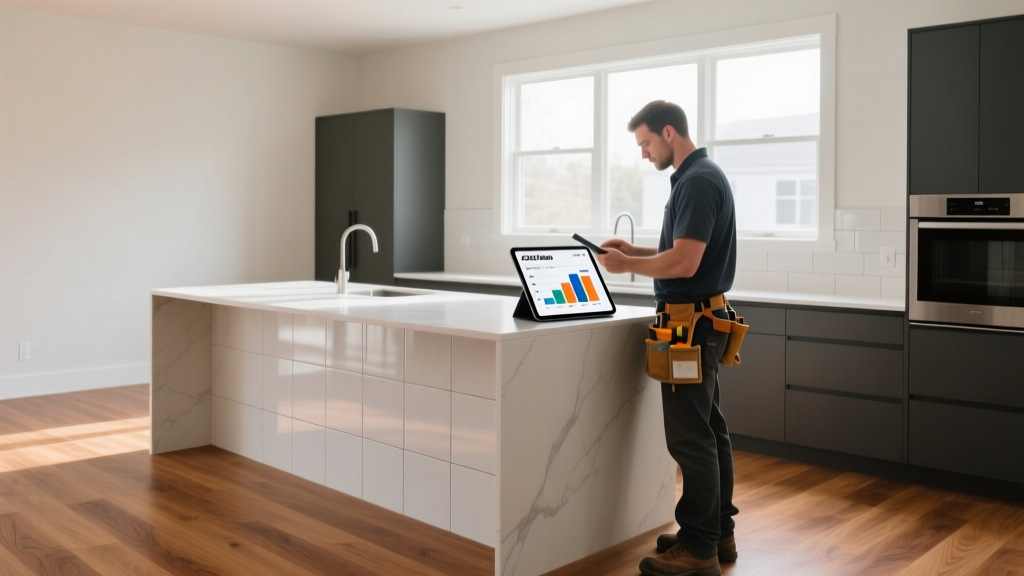
Strategic Recommendations for 2026
If your primary objective is minimizing the 15-year total cost of ownership while maintaining 100% waterproof integrity, 20-mil SPC Luxury Vinyl Plank is the undisputed mathematical winner. It requires no specialized subfloor prep beyond basic leveling, installs rapidly via click-lock mechanisms, and incurs near-zero maintenance costs.
If you are optimizing for long-term property valuation and luxury resale appeal, Engineered Hardwood with a 4mm wear layer justifies its higher initial capital outlay. The aesthetic premium it commands in real estate appraisals routinely offsets the 15-year lifecycle cost difference compared to synthetic alternatives. Ensure you budget for mandatory moisture testing to prevent catastrophic cupping or delamination in the kitchen environment.
Written by
Sarah WhitfieldSarah Whitfield is a chartered quantity surveyor (MRICS) and construction cost analyst with 15 years of experience in material pricing, procurement strategy, and project budgeting. She earned her degree in Construction Management from the University of Reading (UK) and has worked on projects ranging from $2M custom homes to $180M mixed-use developments across North America and Europe. Sarah currently leads cost estimating for BuildMat Insight, maintaining a proprietary database of 4,000+ material price points updated quarterly. She is a frequent contributor to RSMeans cost data panels and has presented at the International Cost Engineering Council (ICEC) congress. Based in Denver, CO, Sarah is an avid trail runner and volunteer mentor for Women in Construction.
More from Sarah Whitfield
View all
Wood & Lumber
What Are the Different Types of Wood? A Builder's Guide
Compare structural softwoods, finish hardwoods, and engineered lumber. Analyze Janka ratings, MOE values, and 2026 pricing for construction.
Aug 4, 2026

Walls & Panels
Steel Framing vs Wood Framing: Corrosion and Moisture Defense
Compare steel framing vs wood framing for moisture resistance. Learn about galvanized coatings, condensation risks, and corrosion protection strategies.
Jul 21, 2026

Stone & Masonry
How to Cut Stone Veneer: Wet Saw vs Grinder Comparison
Compare the best tools for cutting stone veneer. We review wet saws, angle grinders, and chop saws to help you achieve clean, chip-free cuts.
Jul 21, 2026