Average Foundation Repair Cost in 2026: Selection Framework
Discover the average foundation repair cost in 2026. Use our selection framework to choose between piering, slabjacking, and carbon fiber based on damage type.

The True Cost Variables Behind Foundation Repair
Calculating the average foundation repair cost requires moving beyond national averages, which often blur the line between cosmetic patching and structural stabilization. In 2026, the national average for structural foundation repair sits between $5,500 and $12,500, but this metric is virtually useless for budgeting a specific project. The actual cost is dictated by a triad of variables: soil plasticity, the structural load of the superstructure, and the specific failure mode of the concrete or masonry.
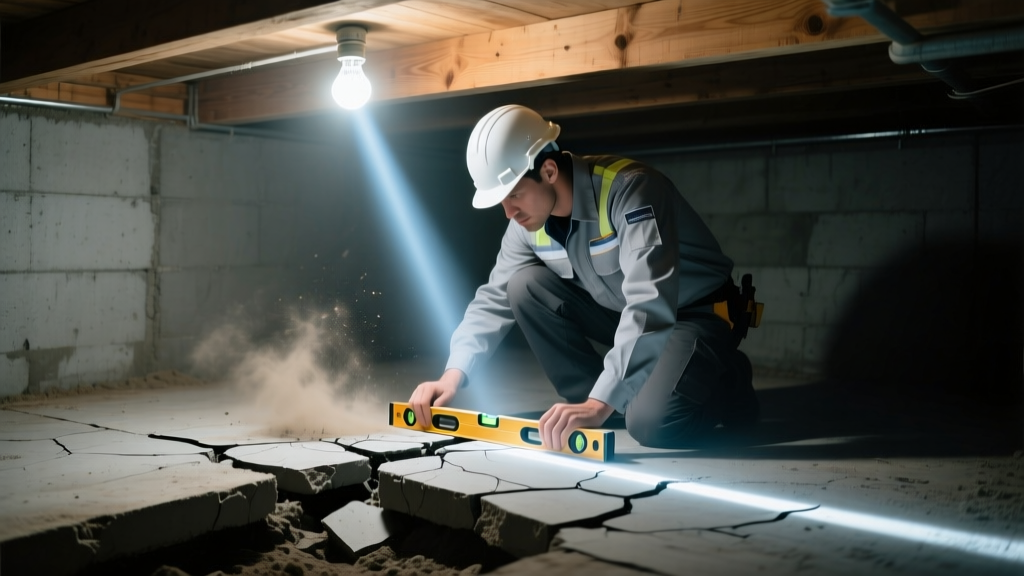
2026 Cost Matrix: Repair Method vs. Damage Profile
To build an accurate budget, you must match the repair technology to the structural deficiency. The table below breaks down the current market rates for primary stabilization methods, separating unit costs from total project scopes.
| Repair Method | Primary Application | Unit Cost (2026) | Total Project Range |
|---|---|---|---|
| Steel Push Piers | Deep settlement, bedrock refusal | $1,500 - $2,200 / pier | $15,000 - $35,000+ |
| Helical Piers | Light loads, high water tables, no bedrock | $1,800 - $2,500 / pier | $12,000 - $28,000 |
| Polyurethane Slabjacking | Slab settling, void filling, non-structural lift | $10 - $15 / sq ft | $2,500 - $8,000 |
| Carbon Fiber Straps | Bowing basement walls, horizontal shear | $800 - $1,200 / strap | $4,000 - $12,000 |
| Steel I-Beam Bracing | Severe wall deflection (>2 inches) | $700 - $1,000 / beam | $5,000 - $15,000 |
The Selection Framework: Matching Soil Type to Repair Method
The most common cause of repair failure is selecting a method incompatible with the underlying soil mechanics. According to the Texas A&M AgriLife Extension, expansive soils cause more financial damage to property owners annually than floods, tornadoes, and earthquakes combined. Your selection framework must begin with a geotechnical soil analysis.
Expansive Clay (Plasticity Index > 25)
Clay soils absorb water and expand volumetrically, then shrink during droughts, causing severe differential settlement. Selection: Steel push piers or helical piers driven past the active soil zone (typically 15 to 25 feet deep) into load-bearing strata. Avoid slabjacking, as the underlying clay will continue to heave and crack the newly lifted slab.
Sandy/Loamy Soils with Hydrostatic Pressure
Sandy soils do not expand, but they wash out easily and transmit hydrostatic pressure rapidly against basement walls. Selection: For sinking foundations, helical piers are ideal because they do not require bedrock for refusal; their capacity is generated by the torque applied to the helical plates. For bowing walls, carbon fiber grids combined with exterior French drains are required to relieve the hydrostatic load.
Peat and Organic Fill
Organic soils compress under structural loads and degrade over time. Selection: Helical piers with multi-helix lead sections to distribute the load across a wider area of weak soil. Push piers will fail here, as there is no dense strata to achieve hydraulic refusal.
Decision Tree: When to Repair vs. When to Walk Away
Not every foundation warrants repair. Use this structural threshold framework to determine if the investment yields a positive return or if the structure has exceeded its service life. The International Association of Certified Home Inspectors (InterNACHI) outlines critical deflection limits that dictate structural viability.
- Threshold 1: Differential Settlement < 1 Inch. If the settlement is uniform or less than 1 inch of differential drop across a 20-foot span, and moisture levels are stabilized, structural intervention is rarely needed. Invest in cosmetic masonry patching and exterior grade correction.
- Threshold 2: Settlement 1 to 3 Inches (Active). This requires underpinning (piering). The cost of repair is generally justified by the preservation of the property value, provided the superstructure (framing, roof) has not suffered irreversible racking.
- Threshold 3: Basement Wall Deflection > 2 Inches. At this stage, carbon fiber is insufficient. Steel I-beams or complete wall rebuilds are necessary. If the cost of wall rebuilding exceeds 30% of the home's total value, the property is a candidate for demolition or a steep discount in a real estate transaction.
- Threshold 4: Severe Slab Disintegration. If a concrete slab is suffering from Alkali-Silica Reaction (ASR) or severe sulfate attack, the concrete itself is chemically failing. Piering will not save a disintegrating slab. Replacement is the only option.
Hidden Cost Multipliers in 2026
When calculating the average foundation repair cost, homeowners frequently overlook the ancillary expenses required to execute the repair legally and safely. Budget an additional 15% to 25% above the contractor's base quote for the following multipliers:
- Structural Engineering Report ($500 - $1,200): Never rely solely on a contractor's assessment. An independent, licensed Professional Engineer (PE) must design the piering layout and specify the depth of refusal.
- Municipal Permits ($200 - $800): Most jurisdictions require permits for underpinning and structural wall reinforcement. Unpermitted work will halt future real estate transactions.
- Plumbing Isolation and Testing ($400 - $1,500): Lifting a settled slab can shear cast-iron or PVC sewer lines. A hydrostatic pressure test must be performed post-lift to ensure the plumbing system remains intact.
- Landscaping and Hardscape Restoration ($1,000 - $5,000): Installing push piers requires excavating a 3-foot trench around the perimeter. Concrete walkways, HVAC lines, and landscaping will need to be removed and replaced.
"The single most expensive mistake in foundation repair is treating a symptom rather than the soil mechanic. Lifting a slab without addressing the exterior drainage that caused the soil to wash out guarantees a callback within 24 months."
— Geotechnical Engineering Best Practices, 2026
Sourcing and Vetting Structural Stabilization Contractors
The barrier to entry in the foundation repair industry is notoriously low. To protect your investment, mandate the following criteria during the selection process:
Verify ICC-ES Evaluation Reports
Any piering system or carbon fiber product installed on your property must have an active International Code Council Evaluation Service (ICC-ES) report. This proves the product has been independently tested for load capacity and durability. Ask the contractor for the specific ESR (Evaluation Service Report) number and verify it on the ICC-ES directory.
Demand Torque-to-Capacity Data
If helical piers are being used, the installer must measure the installation torque. The torque directly correlates to the soil's bearing capacity. A reputable contractor will provide a log showing the torque readings at 5-foot depth increments, proving the pier achieved the engineered load requirement (e.g., 4,000 ft-lbs of torque to achieve a 40,000 lb capacity). If a contractor cannot explain or provide torque logs, do not hire them.
By applying this selection framework, you move beyond the ambiguous "average foundation repair cost" and develop a precise, engineered budget tailored to your property's specific geotechnical and structural realities.
Written by
Marcus ChenMarcus Chen is a licensed structural engineer (PE) and building materials analyst with over 12 years of experience across residential, commercial, and industrial construction. He holds a Master of Science in Civil Engineering from UC Berkeley and spent six years at Thornton Tomasetti before transitioning to independent consulting and technical writing. Marcus specializes in material selection for seismic-prone regions, concrete reinforcement strategies, and lifecycle cost analysis. His work has been cited by the American Concrete Institute (ACI) and the Structural Engineers Association of California (SEAOC). When he is not on a job site or at his desk, you will find him hiking the Sierra Nevada or restoring a 1920s craftsman bungalow in Oakland, CA.
More from Marcus Chen
View all
Construction Cost
How Much Did the Eiffel Tower Cost to Build?
How much did the Eiffel Tower cost to build in 1889? We adjust for inflation and compare its budget to modern skyscraper construction.
Aug 4, 2026

Fire Resistance
What Is a Fire Resistant Material? Testing & Certification Guide
Discover what is a fire resistant material through ASTM and UL testing. Learn how fire ratings, certifications, and assemblies work in construction.
Aug 4, 2026

Construction Cost
How Much Did the Burj Khalifa Cost to Build?
How much did the Burj Khalifa cost to build? We break down the $1.5B project and extract 5 money-saving strategies for your next build.
Jul 30, 2026