Best Basement Encapsulation Liner Brands & Product Lines (2026)
Compare top basement encapsulation vapor barrier brands. Deep-dive into CleanSpace, SilverBack, and Rhino liners, costs, and mil ratings for 2026.
The Anatomy of a Premium Basement Encapsulation Liner
Not all vapor barriers are created equal. The foundational mistake in many basement encapsulation projects is relying on builder-grade 6-mil polyethylene sheeting. While 6-mil poly meets basic code minimums for temporary moisture control, it fails rapidly under the mechanical stress of foot traffic, storage loads, and the alkaline degradation caused by direct contact with concrete and soil. According to the HUD Residential Moisture Guide, long-term moisture control requires materials that maintain structural integrity over decades, not months.
A true basement encapsulation liner must meet ASTM E1745 standards for plastic water vapor retarders. Premium liners in the 12-mil to 20-mil range utilize string-reinforcement, cross-laminated weaving, or multi-layer co-extrusion to achieve Class A, B, or C puncture resistance. When evaluating product lines for 2026, contractors and advanced DIYers must look beyond the 'mil' thickness and examine the tensile strength (measured in pounds per linear inch), the water vapor transmission rate (WVTR), and the fire retardant ratings required by local building codes.
Brand Deep-Dive: The Industry Leaders
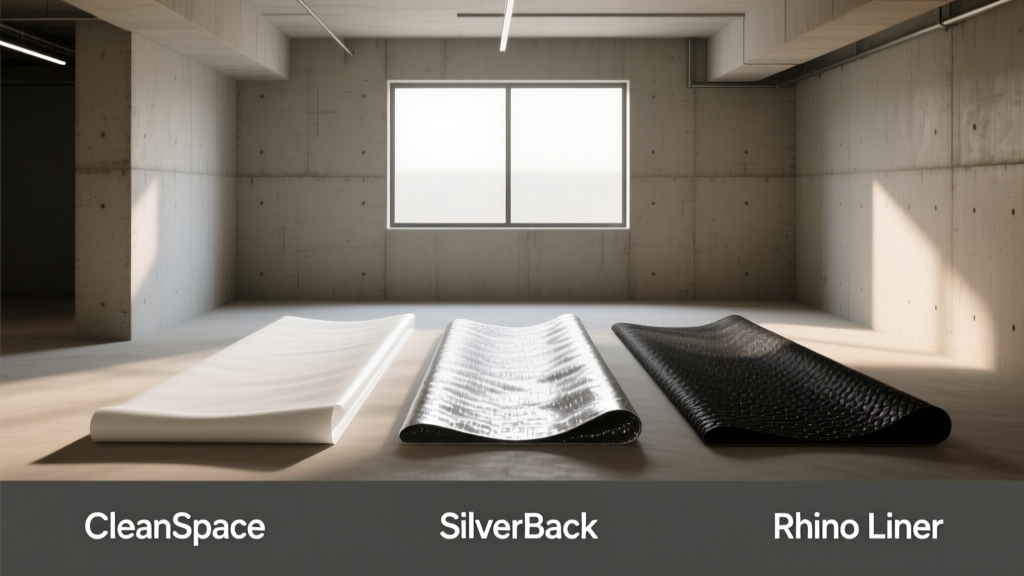
The basement encapsulation market is dominated by a few key manufacturers, each with distinct product philosophies. Below is a technical breakdown of the top three vapor barrier brands currently setting the industry standard.
1. CleanSpace (by Basement Systems)
CleanSpace is the franchise standard, heavily marketed through the Basement Systems dealer network. It is not a single product, but a tightly controlled ecosystem.
- Material Composition: 20-mil, 7-layer co-extruded polyethylene with a polyester cord reinforcement grid.
- Performance Data: Achieves a Class A fire rating and an exceptionally low WVTR of 0.01 perms. The 7-layer construction makes it highly resistant to tearing during the installation of mechanical fasteners.
- Installation System: Designed to be paired with proprietary CleanSpace Tape (a 4-inch acrylic-based adhesive) and mechanical batten strips for wall termination.
- Pricing & Availability: At $0.75 to $0.95 per square foot, it is a premium-priced product. It is primarily available only through certified franchise dealers, making it difficult for independent contractors or DIYers to source at wholesale rates.
2. SilverBack (by Crawlspace Depot)
SilverBack is the preferred choice for independent foundation repair contractors who want commercial-grade materials without franchise restrictions.
- Material Composition: Available in 15-mil and 20-mil variants, utilizing a woven, cross-laminated high-density polyethylene (HDPE) core coated with low-density polyethylene (LDPE).
- Performance Data: The woven grid provides superior tensile strength (over 100 lbs/inch in the machine direction). The bright white reflective surface has a reflectivity rating of 87%, which significantly brightens dark basements and aids in visual leak detection.
- Installation System: Compatible with standard butyl tapes and double-sided acrylic seam tapes. The woven texture allows construction adhesives to bond more aggressively to the liner than smooth co-extruded films.
- Pricing & Availability: Highly competitive at $0.45 to $0.60 per square foot. Readily available direct-to-consumer and via wholesale contractor accounts.
3. Rhino Vapor Barrier
Rhino positions itself as the heavy-duty, puncture-resistant contender, ideal for basements that will be used for active storage or workshop space.
- Material Composition: 20-mil string-reinforced polyethylene. The scrim (string) layer is visibly thicker than competitors, utilizing a tighter weave pattern.
- Performance Data: Passes ASTM E1745 Class A requirements. Its primary advantage is impact resistance; it withstands the dropping of tools and the dragging of heavy storage bins better than standard woven liners.
- Installation System: Due to its thickness and string reinforcement, sealing seams requires aggressive 4-inch butyl tape or specialized mastic. Standard acrylic tapes can struggle to bond to the textured surface over time.
- Pricing & Availability: Mid-range pricing at $0.55 to $0.70 per square foot. Widely available through specialized building supply distributors.
Product Line Comparison Matrix
| Brand / Model | Thickness | Core Structure | WVTR (Perms) | Est. Cost / Sq Ft | Best Use Case |
|---|---|---|---|---|---|
| CleanSpace 20-mil | 20-mil | 7-Layer Co-extruded | 0.01 | $0.85 | Franchise installs, high-end residential |
| SilverBack 15-mil | 15-mil | Woven Cross-Laminated | 0.02 | $0.45 | Standard encapsulation, budget-conscious |
| SilverBack 20-mil | 20-mil | Woven Cross-Laminated | 0.01 | $0.58 | Independent contractor standard |
| Rhino 20-mil | 20-mil | String Reinforced | 0.01 | $0.65 | Active storage, workshop basements |
| Builder Grade Poly | 6-mil | Unreinforced Film | 0.10+ | $0.12 | Temporary use only (Not recommended) |
Hidden Costs & Critical Failure Modes
Warning: The Seam and Termination Trap
The liner itself rarely fails; the seams and wall terminations do. According to building science principles outlined by Building Science Corporation, moisture vapor migrates through the path of least resistance. If you overlap liner sheets by only 2 inches and use cheap duct tape, the system will fail within 18 months.
- The Fix: Overlap all floor seams by a minimum of 6 inches (12 inches preferred). Use a 4-inch wide, double-sided acrylic seam tape or a high-tack butyl tape. Never use cloth-backed duct tape or standard packaging tape.
- Wall Termination: Do not just tape the liner to the cinder block wall. Concrete is porous and dusty; tape will not adhere long-term. Mechanically fasten the top edge using a wooden batten strip or aluminum termination bar, or use a specialized terminated mastic adhesive designed for below-grade masonry.
Sizing the Dehumidification System
Encapsulating a basement traps the moisture inside if you do not actively manage the air. The EPA Mold Guide emphasizes that keeping indoor relative humidity below 50% is non-negotiable for preventing fungal growth. A sealed basement requires a dedicated, high-capacity dehumidifier, not a portable big-box store unit.
Top Dehumidifier Brands for Encapsulated Spaces
- Santa Fe (Classic & Advance2 Models): The gold standard for basement encapsulation. The Santa Fe Advance2 removes up to 90 pints of moisture per day (at AHAM conditions) and features a built-in condensate pump capable of a 15-foot vertical lift, allowing you to route water directly into a basement sump pit or exterior drain.
- AlorAir (Sentinel HDi350): A favorite among restoration professionals. It offers smart app controls, a robust epoxy-coated coil that resists corrosion from musty basement air, and an impressive 125-pint removal capacity. It is often 15-20% cheaper than equivalent Santa Fe models.
Pro-Tip: Airflow Dynamics
Do not place the dehumidifier in a corner. Elevate it 12 to 18 inches off the encapsulated floor and position it centrally to draw air across the entire footprint. Ensure the unit's exhaust air is not blowing directly against a cold exterior wall, which can create localized condensation spots behind the liner.
Purchasing Framework: Which System Should You Choose?
Selecting the right basement encapsulation product line depends on your budget, the intended use of the space, and whether you are hiring a professional or executing a DIY installation.
- The Premium / Franchise Route (CleanSpace): Choose this if you are hiring a certified Basement Systems dealer and want a single-source warranty that covers both the materials and the labor. Expect to pay $5,000 to $9,000+ for a professionally installed 1,000 sq ft basement.
- The Independent Pro Route (SilverBack 20-mil + AlorAir): Choose this if you are an independent contractor or a highly skilled DIYer. SilverBack offers 95% of the performance of franchise liners at half the material cost. Pair it with an AlorAir Sentinel for a robust, cost-effective system. Material costs for a 1,000 sq ft space will hover around $800 to $1,200.
- The Heavy-Duty Workshop Route (Rhino 20-mil): Choose this if the basement will serve as a gym, woodshop, or active storage area where the floor will endure heavy rolling loads, dropped tools, and high foot traffic. The string-reinforced core provides the necessary mechanical defense.
Ultimately, a successful basement encapsulation relies less on the brand name printed on the roll and more on the meticulous execution of the seams, wall terminations, and air-sealing details. Invest in premium tapes, properly sized dehumidification, and a liner that meets ASTM E1745 Class A standards to ensure your foundation remains dry and structurally sound for decades.