Sourcing Foundation Building Materials in Los Angeles (2026)
Discover the best foundation building materials in Los Angeles for 2026. Expert guide on seismic concrete, methane barriers, and local sourcing costs.

Navigating LA’s Unique Geotechnical and Seismic Demands
Building a foundation in Los Angeles requires navigating a complex matrix of micro-climates, volatile soil conditions, and stringent seismic codes. The geotechnical reality of Southern California means a slab-on-grade in the San Fernando Valley faces entirely different material threats than a raised pier-and-beam system in the Hollywood Hills or a coastal basement in Santa Monica. Standard national building practices often fail here. The 2025/2026 California Building Code (CBC) and local amendments enforced by the Los Angeles Department of Building and Safety (LADBS) mandate specialized material selections to counteract expansive clays, high-sulfate soils, liquefaction risks, and subterranean methane gas.
Selecting the correct foundation building materials in Los Angeles is not merely a structural decision; it is a risk-mitigation strategy. This guide details the exact material specifications, mix designs, and sourcing logistics required for durable foundation construction in the LA basin.
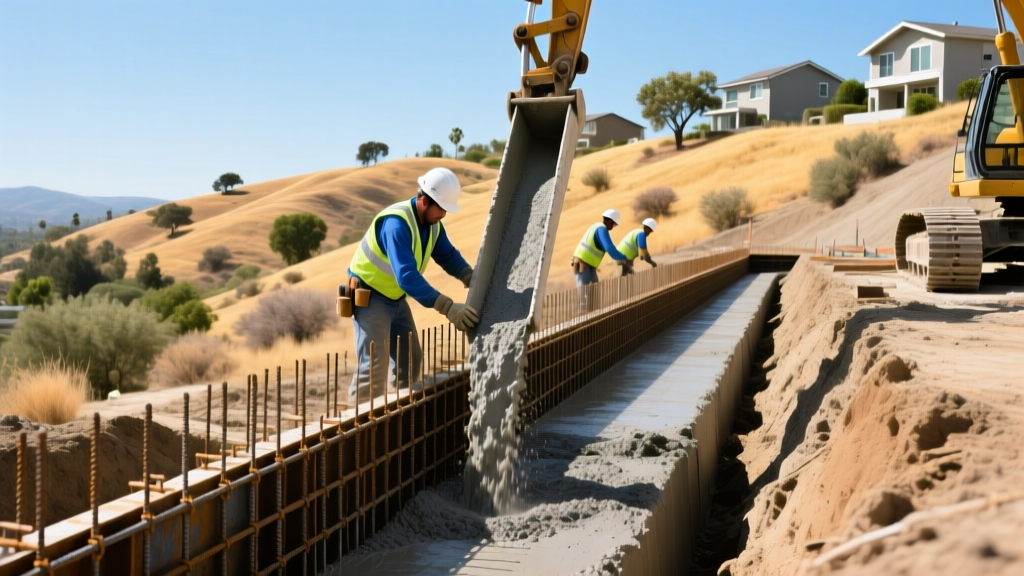
Concrete Mix Designs for Southern California Soils
Ready-mix concrete is the backbone of LA foundations, but ordering a standard 2,500 PSI mix from a local batch plant will result in premature degradation in many LA zip codes. The region's soil profile dictates the cementitious blend.
Sulfate Resistance and Slag Blends
Coastal basins and inland valley areas frequently exhibit high concentrations of water-soluble sulfates. When standard Portland cement reacts with sulfates, it forms ettringite, causing the concrete to expand, crack, and spall. For these zones, specify Type V (sulfate-resistant) Portland cement or, more commonly in 2026, a blended cement utilizing 50% Ground Granulated Blast-Furnace Slag (GGBFS). Major regional suppliers like CalPortland and Vulcan Materials offer optimized slag blends that drastically reduce permeability and halt sulfate attack while lowering the carbon footprint of the pour.
LA foundation sites are notoriously tight, often requiring concrete pumps with long boom reaches. Do not order a high-slump (6+ inch) mix by adding water on-site, as this destroys the water-cement ratio and compromises structural integrity. Instead, specify a 4-inch to 5-inch slump and require the batch plant to use a mid-range water reducer (plasticizer) to maintain workability without sacrificing the 3,200 to 4,000 PSI compressive strength required for structural footings.
Seismic Reinforcement: Rebar and Post-Tensioning
Seismic lateral forces require foundations to act as rigid diaphragms. The choice of reinforcement depends heavily on the project's proximity to the coast and the structural engineer's lateral force-resisting design.
Reinforcement Material Comparison Matrix
| Material Type | Best Application in LA | Key Specifications | 2026 Est. Cost |
|---|---|---|---|
| Grade 60 Carbon Steel | Inland residential slabs, standard footings | ASTM A706 (weldable), #4 and #5 bars | $1.10 - $1.30 / lb |
| Epoxy-Coated Rebar | Coastal zones (within 1,500 ft of ocean) | ASTM A775, requires careful handling to avoid coating chips | $1.60 - $1.90 / lb |
| GFRP (Glass Fiber) | Highly corrosive marine environments, MRI facilities | Non-magnetic, rust-proof, 1/4 the weight of steel | $2.50 - $3.20 / lb |
| Post-Tensioning (PT) | Expansive clay soils (e.g., Pasadena, Irvine margins) | 270 ksi low-relaxation steel strands, encapsulated in grease-filled sheathing | $0.85 - $1.15 / sq ft of slab |
For standard inland projects, ASTM A706 Grade 60 rebar is the baseline. A706 is specifically manufactured for weldability and controlled tensile strength, which is critical for the moment frames and grade beams required in LA seismic design. In coastal areas like Venice or Malibu, the salt-laden air accelerates carbonation and chloride ingress. Here, transitioning to GFRP rebar (such as Owens Corning's PinkBar) eliminates the risk of rust-jacking, where expanding corroded steel spalls the concrete cover from the inside out.
Methane Mitigation and Sub-Slab Vapor Barriers
One of the most heavily regulated aspects of foundation construction in Los Angeles is subterranean methane and hydrogen sulfide gas mitigation. Due to the region's historical oil fields and natural asphalt seeps, LADBS designates numerous Methane Buffer Zones (e.g., Fairfax District, Playa Vista, parts of the Westside). Building in these zones requires a multi-layered defense system integrated directly into the foundation materials.
The Stego Wrap Standard
Standard 6-mil polyethylene sheeting is entirely insufficient for LA methane zones. The industry standard mandated by most LA geotechnical engineers is a 15-mil or 10-mil reinforced polyolefin membrane, such as Stego Wrap.
- Permeance Rating: Must meet ASTM E1745 Class A, B, or C with a water vapor permeance of less than 0.03 perms.
- Methane Resistance: The membrane must be specifically tested and rated for methane gas transmission.
- Seaming Protocol: All overlaps must be a minimum of 6 inches, sealed with proprietary butyl-based Stego Tape. Penetrations (plumbing, electrical conduits) require specialized sealing mastic and prefabricated boot kits.
Beneath the methane barrier, a 4-inch layer of clean, washed 3/4-inch gravel acts as a sub-slab venting layer, connected to passive or active PVC vent pipes that route soil gases safely above the roofline.
Title 24 Compliance: Slab Edge Insulation
California's Title 24 Energy Efficiency Standards dictate that unconditioned slabs and foundation perimeters must be insulated to prevent thermal bridging. In the LA climate zones (primarily Zones 6, 8, and 9), this requires installing rigid foam insulation at the slab edge.
Specify Extruded Polystyrene (XPS) or high-density Expanded Polystyrene (EPS) with a minimum R-value of R-8 to R-10, extending 24 inches down from the top of the slab or to the bottom of the footing, whichever is less. Materials like Dow Styrofoam SM or Owens Corning FOAMULAR 250 are standard. Ensure the insulation is rated for below-grade moisture exposure and protected from UV degradation and physical damage during the backfilling process.
Sourcing Logistics and 2026 Cost Breakdown
Procuring foundation building materials in Los Angeles involves navigating severe logistical bottlenecks. Batch plants are concentrated in industrial corridors like Vernon, Irwindale, and Pacoima. Delivering ready-mix concrete to a hillside site in Silver Lake or a congested street in Santa Monica requires precise scheduling to avoid concrete setting in the truck drum during traffic delays.
Concrete trucks typically carry 8 to 10 cubic yards. If your foundation pour requires less than a full truck (e.g., a 4-yard footing pour for an ADU), batch plants will charge a 'short-load fee' ranging from $150 to $300. To mitigate this, consolidate small pours or utilize volumetric mixers, which mix the concrete on-site and charge strictly by the exact cubic yard dispensed.
Estimated Material Costs for a 2,000 Sq Ft LA Foundation
The following table outlines baseline material costs for a standard 2,000-square-foot raised foundation with a continuous perimeter footing and interior cripple wall footings in the Los Angeles metro area for 2026. Labor, engineering, and permitting are excluded.
| Material Category | Specification | Estimated 2026 Cost |
|---|---|---|
| Ready-Mix Concrete | 3,200 PSI, 50% Slag Blend, 45 cu. yards | $7,800 - $8,500 |
| Concrete Pumping | Boom pump, 1-day rental + hose crew | $1,400 - $1,800 |
| Reinforcement Steel | Grade 60 A706, #4 and #5 bars, approx 6,000 lbs | $6,600 - $7,200 |
| Formwork Lumber/Plywood | 2x12 Doug Fir, 3/4" CDX Plywood (consumables) | $3,500 - $4,200 |
| Vapor/Methane Barrier | 15-mil Stego Wrap, tape, and boots (if required) | $1,200 - $1,800 |
| Anchor Bolts & Hardware | 1/2" x 10" galvanized wedge bolts, Simpson Strong-Tie | $450 - $600 |
Quality Assurance and Testing Requirements
Sourcing the right materials is only half the battle; verifying them is legally required. The American Concrete Institute (ACI) standards, adopted by LADBS, mandate third-party testing during the pour. You must budget for a certified testing agency to perform slump tests, air-content tests (targeting 2-4% for non-air-entrained LA mixes), and cast cylindrical compressive strength samples. These cylinders are cured and crushed at 7 and 28 days to verify the concrete achieved its specified 3,200 or 4,000 PSI design strength. Failing to secure these testing reports will result in the building inspector halting the framing phase.
Written by
James ThorntonJames Thornton is a construction industry veteran with 25 years of hands-on experience in wood framing, lumber grading, and residential building codes. He started as a framing carpenter in rural Oregon, earned his ICC Residential Building Inspector certification, and eventually became a senior plan reviewer for the City of Portland Bureau of Development Services. James holds a B.S. in Wood Science & Technology from Oregon State University and is a certified lumber grader through the West Coast Lumber Inspection Bureau (WCLIB). He has inspected over 3,000 residential construction sites and authored the city's internal guide on advanced framing techniques (2x6 at 24" O.C.). James lives in Bend, OR, where he builds custom timber-frame cabins and competes in lumberjack sports.
More from James Thornton
View all
Insulation
Best Home Insulation Materials: Complete 2026 Guide
Compare top home insulation materials for 2026. Find R-values, installed costs per square foot, and best uses for fiberglass, spray foam, and mineral wool.
Aug 4, 2026

Sustainable Building
Certify Your Green Building Material for LEED and WELL
Step-by-step guide to certifying a green building material for LEED v5 and WELL v2. Master EPDs, HPDs, and VOC limits for 2026 project specifications.
Aug 4, 2026

Stone & Masonry
Veneer Stacked Stone Panels: Interior Design & Style Showcase
Discover how veneer stacked stone panels transform interiors. Explore modern design profiles, material pairings, and technical installation specs.
Aug 4, 2026