2026 Foundation Repair Costs Average: Selection Framework
Navigate the 2026 foundation repair costs average with our selection framework. Match specific structural symptoms to exact repair methods and pricing.

The True Baseline: Decoding the Foundation Repair Costs Average
The national foundation repair costs average sits between $5,200 and $8,500 for standard residential projects in 2026, but this aggregate figure masks severe pricing variances based on specific structural failure modes. Relying solely on a generalized average leads to catastrophic underbudgeting for deep foundation stabilization or overpaying for cosmetic epoxy injections. To allocate capital effectively, property owners and facility managers must decouple the 'average' and instead evaluate costs through a symptom-to-method selection framework.
According to Angi's national cost database, minor crack sealing can cost as little as $500, while severe structural underpinning routinely exceeds $25,000. The variance is dictated by soil mechanics, structural load, and access constraints. This framework categorizes repair methodologies into three distinct damage tiers, allowing you to match your specific structural symptoms to the correct engineering solution and its associated true cost.
2026 Cost Data Highlight: The Extremes
Low-End Average (Cosmetic/Minor): $500 - $1,500 (Epoxy crack injection, minor mudjacking)
Mid-Range Average (Moderate Settlement): $5,200 - $12,000 (Polyurethane lifting, localized piering)
High-End Average (Severe Failure): $15,000 - $35,000+ (Full perimeter steel piers, grade beam reconstruction)
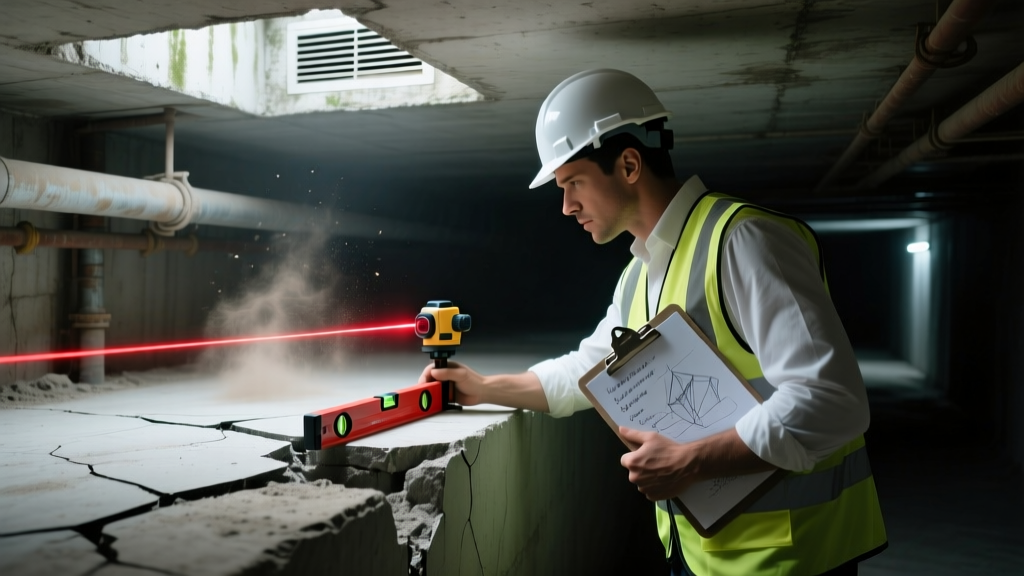
Damage Tier Selection Matrix: Matching Symptoms to Methods
Selecting the correct repair method requires identifying the root cause of the structural distress. The International Association of Certified Home Inspectors (InterNACHI) categorizes foundation defects by their physical manifestation. Use the matrix below to align your observed symptoms with the appropriate engineering intervention and current market unit costs.
| Observed Symptom | Engineering Method | Unit Cost (2026) | Estimated Total Range |
|---|---|---|---|
| Slab voids, minor sinking patios | Polyurethane Foam Jacking | $10 - $25 / sq ft | $1,500 - $4,000 |
| Stair-step cracks, sticking doors | Steel Push Piers | $1,500 - $2,500 / pier | $8,000 - $18,000 |
| Light structure settlement, new builds | Helical Piers | $1,800 - $3,000 / pier | $10,000 - $22,000 |
| Bowing basement walls (inward lean) | Carbon Fiber Straps | $800 - $1,500 / strap | $4,000 - $9,000 |
Tier 1: Minor Settlement & Slab Voids (Polyurethane vs. Mudjacking)
When a concrete slab loses subgrade support due to soil erosion or poorly compacted fill, the resulting void causes the slab to sink. Traditional mudjacking (pumping a cement-sand slurry) costs between $3 and $6 per square foot. However, the slurry weighs roughly 100 lbs per cubic foot, which can exacerbate soil compression and lead to secondary settlement.
The modern selection framework favors high-density polyurethane foam jacking (using products like Alchemy-Spetec Deep Lift). At $10 to $25 per square foot, it is more expensive upfront, but the foam weighs only 2 to 4 lbs per cubic foot, cures in 15 minutes, and is impervious to water washout. For long-term cost efficiency, polyurethane eliminates the recurring repair cycle associated with traditional mudjacking.
Tier 2: Moderate Differential Settlement (Push Piers vs. Helical Piers)
Differential settlement occurs when one section of a foundation sinks faster than another, causing severe shear stress and stair-step cracking in masonry. Correcting this requires bypassing unstable surface soils and transferring the structural load to load-bearing strata or bedrock.
- Steel Push Piers: These are driven hydraulically into the ground using the actual weight of the structure for resistance. They are ideal for heavy, multi-story masonry buildings. Installation requires heavy hydraulic rams, and costs average $1,500 to $2,500 per pier. The depth is determined by 'refusal'—the point where the pier can no longer be driven downward.
- Helical Piers: Featuring helical bearing plates welded to a central steel shaft (e.g., Chance Helical Piers), these are mechanically screwed into the soil. Because they do not rely on the structure's weight for installation, they are mandatory for lighter structures (wood-frame, single-story) or when lifting capacities must be pre-verified via torque-to-capacity correlations. Expect to pay $1,800 to $3,000 per helical pier.
Tier 3: Severe Lateral Bowing & Structural Failure
Basement walls subjected to extreme hydrostatic pressure from expansive soils will bow inward. If the deflection is less than 2 inches, Fortress Stabilization carbon fiber straps (Kevlar-reinforced epoxy matrices) can halt movement at $800 to $1,500 per strap. However, if deflection exceeds 2 inches, the wall must be excavated externally, pushed back to plumb, and reinforced with steel I-beams or completely rebuilt with grade beams—a process that routinely pushes the foundation repair costs average past $30,000.
The Soil & Site Variable: Why Your Quote Deviates from the Average
The primary reason a localized quote deviates from the national foundation repair costs average is geotechnical site conditions. Expansive clays, characterized by a Plasticity Index (PI) greater than 25, undergo massive volumetric changes based on moisture content. The American Society of Civil Engineers (ASCE) notes that soil moisture fluctuation is the leading cause of light-frame foundation distress.
'Pier depth in expansive clay regions must bypass the active zone—the soil layer subject to seasonal moisture changes. In regions like Texas and Colorado, this active zone can extend 8 to 12 feet deep, requiring significantly longer pier shafts and driving up the total project cost well above the national average.'
Furthermore, site access constraints severely impact labor costs. If a repair requires working in a crawl space with less than 18 inches of clearance, or if heavy excavators cannot access the perimeter due to fencing or landscaping, contractors must rely on manual labor or micro-equipment, adding a 20% to 40% access premium to the final invoice.
Contractor Selection Framework: Vetting Beyond the Bottom Line
When evaluating bids against the foundation repair costs average, the lowest quote is frequently subsidized by substandard materials or inadequate depth specifications. Use this technical checklist to vet contractors and ensure the proposed solution aligns with structural engineering standards:
- Demand ICC-ES Reports: Require the contractor to provide International Code Council Evaluation Service (ICC-ES) reports for their specific pier or carbon fiber products. This proves the materials have been independently tested for load capacities and code compliance.
- Verify Engineering Stamps: A reputable foundation repair plan must be designed and stamped by a licensed Professional Engineer (PE) specializing in geotechnical or structural engineering, not just a salesperson with a tablet.
- Scrutinize the Warranty: Look for a fully transferable, lifetime warranty that covers both the materials and the labor. Ensure the warranty is backed by a third-party insurance trust, protecting you if the installation company goes out of business.
- Check for Root Cause Mitigation: If a contractor proposes piers without addressing surface drainage, gutter routing, or plumbing leaks, reject the bid. Underpinning a foundation without fixing the water management system guarantees future settlement.
Financing and ROI: Evaluating Long-Term Value
While the upfront foundation repair costs average can cause sticker shock, delaying intervention results in compounding secondary damages: ruptured plumbing lines, compromised rooflines, and destroyed interior finishes. From a real estate perspective, a professionally repaired foundation with a transferable, engineer-stamped warranty restores the property's marketability. Conversely, an unrepaired foundation will trigger mandatory price reductions during buyer inspections that typically exceed 1.5 to 2 times the actual cost of the repair. By applying this selection framework, you transition from reacting to an intimidating average cost to executing a targeted, structurally sound capital improvement.
Written by
Marcus ChenMarcus Chen is a licensed structural engineer (PE) and building materials analyst with over 12 years of experience across residential, commercial, and industrial construction. He holds a Master of Science in Civil Engineering from UC Berkeley and spent six years at Thornton Tomasetti before transitioning to independent consulting and technical writing. Marcus specializes in material selection for seismic-prone regions, concrete reinforcement strategies, and lifecycle cost analysis. His work has been cited by the American Concrete Institute (ACI) and the Structural Engineers Association of California (SEAOC). When he is not on a job site or at his desk, you will find him hiking the Sierra Nevada or restoring a 1920s craftsman bungalow in Oakland, CA.
More from Marcus Chen
View all
Construction Cost
How Much Did the Eiffel Tower Cost to Build?
How much did the Eiffel Tower cost to build in 1889? We adjust for inflation and compare its budget to modern skyscraper construction.
Aug 4, 2026

Fire Resistance
What Is a Fire Resistant Material? Testing & Certification Guide
Discover what is a fire resistant material through ASTM and UL testing. Learn how fire ratings, certifications, and assemblies work in construction.
Aug 4, 2026

Construction Cost
How Much Did the Burj Khalifa Cost to Build?
How much did the Burj Khalifa cost to build? We break down the $1.5B project and extract 5 money-saving strategies for your next build.
Jul 30, 2026