Who Owns Foundation Building Materials During Construction?
Discover who legally owns foundation building materials during transit and on-site, covering UCC title transfer, FOB terms, and contractor risk of loss.

The Legal Ambiguity of Material Ownership on the Job Site
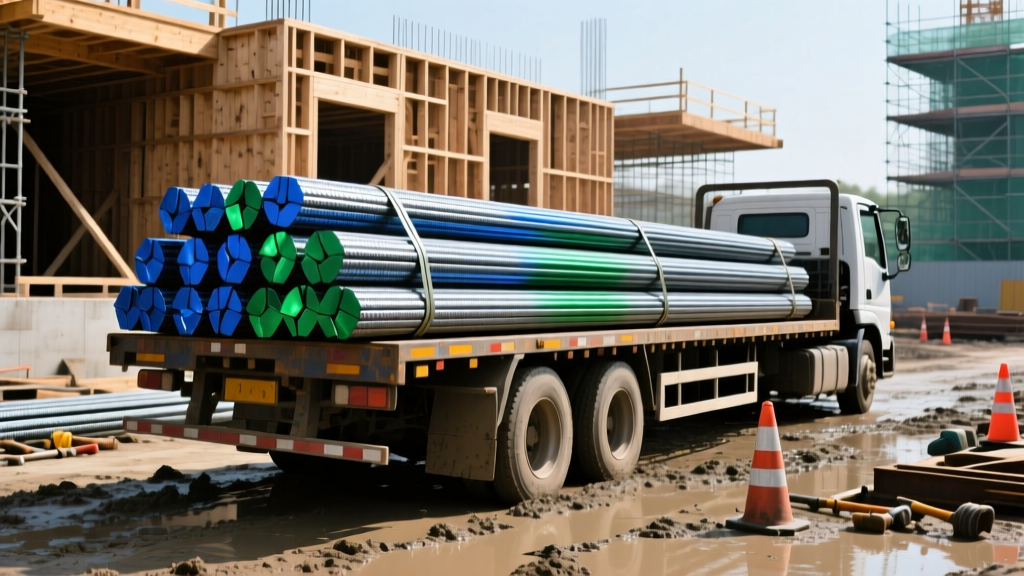
When a flatbed truck drops 15 tons of ASTM A775 epoxy-coated rebar or a fleet of mixers delivers 40 cubic yards of high-strength concrete to a subgrade, a critical legal question arises: who exactly owns these foundation building materials at that precise moment? If a severe storm washes out the excavation, or if copper-grounding wires and helical piers are stolen overnight, the financial liability hinges entirely on the legal concept of title transfer and risk of loss. For general contractors, foundation subcontractors, and property owners, misunderstanding these boundaries can lead to catastrophic uninsured losses and stalled project schedules.
UCC Article 2 and the Transition to Real Property
In the United States, the sale and delivery of physical construction materials are governed by Article 2 of the Uniform Commercial Code (UCC). Under UCC § 2-401, foundation materials such as insulating concrete forms (ICFs), precast pilings, and post-tension cables are classified as 'goods' (chattel) while in transit and during storage. They do not become 'real property' until they are physically affixed to the land.
The Fixture Doctrine in Foundation Work
The legal threshold where ownership shifts from the supplier/contractor to the property owner is dictated by the Fixture Doctrine. For foundation systems, this transition is absolute and often irreversible:
- Ready-Mix Concrete (ASTM C94): Ownership transfers to the property owner the moment the concrete is discharged from the chute into the forms. If the batch fails a slump test or cures improperly, the supplier may owe a replacement batch, but the physical material in the forms belongs to the owner.
- Steel Rebar and Wire Mesh: Title transfers once the steel is tied, placed within the forms, and encased in concrete. Prior to pouring, the rebar remains the personal property of the contractor or supplier, depending on the purchase agreement.
- Helical Piers and Driven Piles: Ownership shifts as each section is mechanically driven or screwed into the load-bearing strata. Materials left stacked on the dirt pad remain goods under the UCC.
Decoding FOB Terms for Heavy Foundation Materials
The point at which ownership and the 'risk of loss' transfer from the manufacturer to the foundation contractor is dictated by Free On Board (FOB) shipping terms. Misinterpreting these terms is a leading cause of litigation in commercial foundation projects.
| Material Type | Standard Delivery Term | Title Transfer Point | Risk of Loss Bearer |
|---|---|---|---|
| Precast Concrete Piles | FOB Destination | Upon offloading at site | Supplier (until offloaded) |
| Ready-Mix Concrete | FOB Batch Plant | When loaded into mixer truck | Contractor (during transit) |
| ICF Blocks (e.g., Nudura, Fox) | FOB Origin | When handed to freight carrier | Contractor (during transit) |
| Epoxy Anchor Systems | FOB Destination | Upon signed delivery receipt | Supplier (until signed for) |
As of 2026, global supply chain volatilities have prompted many foundation contractors to negotiate FOB Destination terms for high-value items like post-tensioning steel and specialized waterproofing membranes, forcing the supplier to carry the inland marine insurance risk until the materials physically cross the property line.
AIA A201 and Stored Materials on the Job Site
For commercial foundation projects governed by American Institute of Architects (AIA) contracts, ownership of materials stored on-site is explicitly addressed. Under the AIA A201 General Conditions, once a contractor submits a pay application that includes the cost of 'stored materials,' and the owner approves the progress payment, the legal title of those materials transfers to the owner.
Off-Site Storage of Helical Piers and Sheet Piling
Foundation contractors frequently store massive quantities of steel sheet piling or helical piers at off-site laydown yards due to space constraints on urban infill sites. Under standard AIA provisions, the owner will only pay for (and thus take ownership of) off-site stored materials if the contractor provides:
- Proof of insurance covering the materials at the secondary location.
- A bill of sale or title transfer document explicitly assigning ownership to the owner while the materials remain off-site.
- Photographic or GPS-tracked inventory verification.
Expert Warning on Mechanic's Liens: If a foundation subcontractor delivers $50,000 worth of structural steel to a job site, but the general contractor defaults before paying the sub, the subcontractor does not automatically have the right to drive onto the site and repossess the steel. Once materials are delivered to the property, they are generally subject to the real estate owner's mechanic's lien laws. Repossessing affixed or delivered materials without a court order can result in trespassing and conversion charges.
Protecting Your Foundation Materials from Theft and Damage
Foundation sites are notoriously vulnerable to theft and environmental damage before the structure is enclosed. Copper grounding grids, aluminum forms, and brass plumbing stub-outs embedded in slab-on-grade foundations are prime targets. To protect ownership interests and mitigate risk of loss, contractors must implement modern security and insurance frameworks.
Strategic Insurance Coverage
Standard commercial general liability (CGL) policies do not cover the theft or damage of materials you own but have not yet installed. According to the Insurance Information Institute, contractors must secure specific coverages:
- Builder’s Risk Insurance: Covers materials on-site that are intended to become part of the permanent foundation structure.
- Inland Marine Floater: Essential for foundation contractors who own expensive, reusable materials like aluminum trench shields, custom steel batter boards, and hydraulic pile-driving attachments that move from site to site.
Physical and Digital Security Protocols
In 2026, relying solely on chain-link fencing is insufficient for high-value foundation materials. Best practices include:
- GPS Asset Trackers: Concealing Bluetooth/GPS pucks inside pallets of ICF blocks or welded to the inner flanges of steel H-piles.
- Just-in-Time (JIT) Delivery: Coordinating with batch plants and steel fabricators to deliver materials within 4 hours of installation, eliminating overnight storage risks entirely.
- Micro-stamping: Using forensic micro-dot technology on reusable aluminum concrete forms to deter theft and ensure recovery by local law enforcement.
Summary: Establishing Clear Chain of Custody
Ultimately, the question of who owns foundation building materials is answered by a combination of UCC shipping terms, the physical act of affixation, and the execution of progress payments. General contractors and foundation specialists must ensure their purchase orders explicitly state FOB terms, their site security matches the value of the stored goods, and their insurance policies bridge the gap between the supplier's loading dock and the final concrete pour. By treating material ownership as a strict legal and logistical framework rather than an afterthought, construction firms can protect their profit margins from the unpredictable realities of the job site.
Written by
David NakamuraDavid Nakamura is a licensed architect (AIA) and construction technology writer focused on sustainable building methods, mass timber engineering, and high-performance building envelopes. He holds a Master of Architecture from the University of Washington and is a certified Passive House Consultant (CPHC). David spent eight years at the Seattle firm Mithun, where he led the design of three LEED Platinum projects, before founding his own practice specializing in net-zero residential design. He serves on the editorial advisory board of GreenBuilder Magazine and has authored peer-reviewed papers on cross-laminated timber (CLT) connections for the Journal of Structural Engineering. In his spare time, David teaches woodworking at Pratt Fine Arts Center and kayaks the Puget Sound.
More from David Nakamura
View all
Construction Cost
Labor Cost to Build a Deck Per Sq Ft: 2026 Installation Guide
Discover the exact labor cost to build a deck per sq ft in 2026. This installation guide breaks down contractor rates, complexity factors, and hidden fees.
Aug 4, 2026

Construction Cost
How Much Does It Cost to Build a 3 Bedroom House? Financing Guide
Learn exactly how much it costs to build a 3 bedroom house and explore 2026 financing options, construction loan types, and budget frameworks for your build.
Aug 4, 2026

Construction Cost
Cost to Build a Tennis Court: 2026 Guide
How much does it cost to build a tennis court in 2026? Breakdowns for asphalt, concrete, and synthetic surfaces plus fencing and lighting.
Jul 30, 2026