Basement Leakage Solutions: Material Taxonomy & Selection Guide
Discover the definitive material taxonomy for basement leakage solutions. Compare crystalline, polyurethane, and exterior membrane options.
The Physics of Foundation Water Intrusion
Selecting effective basement leakage solutions requires moving beyond generic sealants and understanding the specific hydrostatic and capillary forces acting on a foundation. Water enters basements through three primary mechanisms: hydrostatic pressure forcing liquid water through cold joints and cracks, capillary action drawing moisture through the concrete matrix, and gravity-driven surface runoff pooling at the foundation perimeter. According to the U.S. Department of Energy, managing bulk water intrusion is the absolute prerequisite for any basement finishing or insulation strategy, as trapped moisture inevitably leads to structural degradation and mold proliferation.
This guide categorizes waterproofing materials by their chemical taxonomy and application side (positive/exterior vs. negative/interior), providing specific product formulations, installation metrics, and 2026 pricing data to inform structural material selection.
Exterior Barrier Materials (Positive-Side Waterproofing)
Positive-side waterproofing is applied to the exterior surface of the foundation wall, placing the waterproofing layer between the structure and the water source. This is the only method that protects the concrete matrix itself from freeze-thaw cycling and chemical degradation.
Material Taxonomy & Performance Metrics
| Material Class | Specific Formulation | Application Thickness | 2026 Installed Cost | Primary Failure Mode |
|---|---|---|---|---|
| Bentonite Clay Panels | Sodium bentonite sandwiched in geotextile (e.g., Bentofix) | 3/16 inch (swells to 1 inch) | $6.50 - $9.00 / sq ft | Desiccation in fluctuating water tables |
| Liquid Polyurethane | Two-component, high-build elastomeric (e.g., Tremco Tufflex) | 60 mils wet / 40 mils dry | $9.50 - $14.00 / sq ft | Improper substrate moisture during curing |
| Self-Adhered Rubberized Asphalt | SBS-modified asphalt with PE film (e.g., Bakor Blueskin WP) | 40 mils nominal | $7.00 - $11.00 / sq ft | Punctures during backfill operations |
Interior Penetrating & Reactive Coatings (Negative-Side)
Negative-side waterproofing is applied to the interior face of the foundation. Because hydrostatic pressure pushes against the coating rather than pressing it into the substrate, standard film-forming paints (acrylics, epoxies) will inevitably blister and delaminate under pressure. Negative-side solutions must be penetrative or chemically reactive.
Crystalline Waterproofing Technology
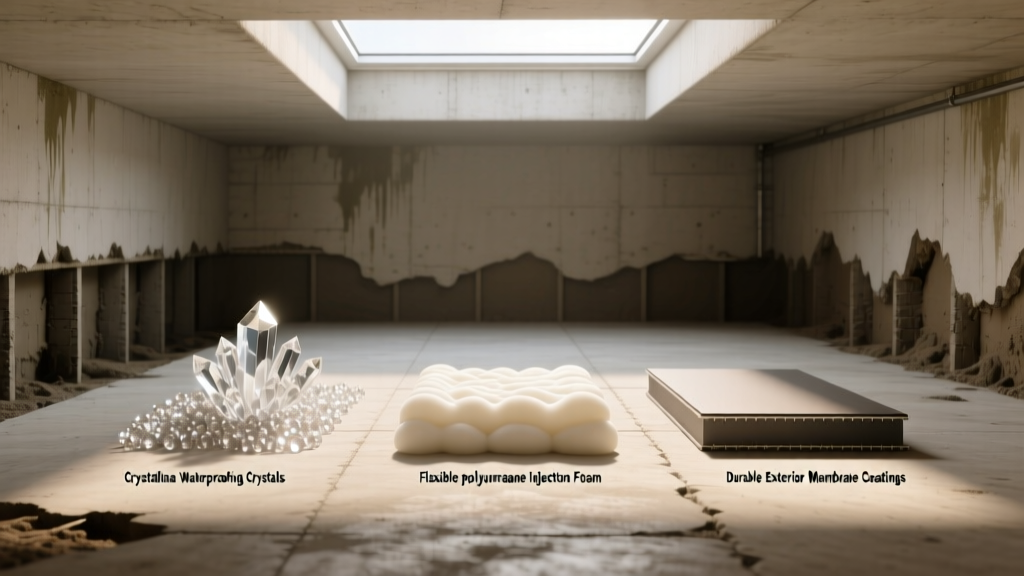
Crystalline admixtures and coatings (such as Xypex Concentrate or Penetron) utilize a proprietary blend of Portland cement, finely graded silica sand, and active chemicals. When mixed with water and applied to damp concrete, these chemicals catalyze a reaction with the free calcium hydroxide (lime) naturally present in cured concrete. This reaction generates insoluble calcium silicate hydrate dendritic crystals that permanently block capillary tracts and micro-cracks up to 0.4mm wide.
- Preparation: Concrete must be aggressively profiled via shot blasting or high-pressure water blasting (minimum 4,000 PSI) to open capillaries. Acid etching is strictly prohibited as it neutralizes the calcium hydroxide required for the crystalline reaction.
- Application Rate: 1.5 lbs per square yard (0.8 kg/m²) applied as a slurry coat using a stiff masonry brush.
- Curing Requirement: The coating must be kept continuously damp by misting for 48 to 72 hours post-application to allow crystal growth to propagate deep into the matrix.
- Cost: $3.50 to $6.00 per square foot for professional interior application.
Hydraulic Cement for Active Leaks
For active, flowing leaks at cold joints or tie-holes, expansive hydraulic cement (e.g., Quikrete FastSet Hydraulic Water Stop) is the mandatory first step. This material sets in 3 to 5 minutes and expands slightly as it cures, locking into the void against active water flow. However, hydraulic cement lacks structural flexibility and will crack if the foundation experiences differential settlement. It must be used strictly as a plug, followed by a flexible polyurethane sealant or crystalline overcoat.
Crack Injection Taxonomy: Epoxy vs. Polyurethane
Structural and non-structural cracks require distinct injection chemistries. Misidentifying the crack type leads to rapid repair failure.
Structural Cracks (Epoxy Injection)
Cracks wider than 0.005 inches that exhibit vertical displacement or are located in load-bearing shear walls require high-modulus epoxy injection. Epoxies (like SikaDur 35 Hi-Mod) possess tensile strengths exceeding 7,000 PSI, effectively welding the concrete back together. The limitation of epoxy is its rigidity; if the foundation shifts further, the epoxy will hold, but a new crack will form adjacent to the repair.
Non-Structural & Hydrostatic Cracks (Polyurethane Injection)
For static cracks leaking water without structural displacement, hydrophobic or hydrophilic polyurethane resins are required. Hydrophobic polyurethanes (e.g., Alchemy-Spetec H900) react with water to expand up to 20 times their original volume, creating a dense, flexible, closed-cell foam gasket inside the crack. Unlike epoxy, polyurethane accommodates minor seasonal thermal expansion and contraction of the concrete without losing its watertight seal. Professional injection typically costs $350 to $600 per crack, depending on depth and accessibility.
Sub-Slab Drainage Aggregates & Geotextiles
Waterproofing membranes must be paired with sub-slab drainage systems to relieve hydrostatic pressure. The Federal Emergency Management Agency (FEMA) mandates that materials used in flood-prone below-grade environments must resist water absorption and degradation. This extends to the drainage aggregate itself.
Specify ASTM C33 washed coarse aggregate (typically 3/4-inch washed river rock) for all perimeter drain beds. This material is free of fine particulates that cause siltation. Furthermore, the aggregate bed and perforated PVC pipe (ASTM D2729) must be entirely wrapped in a non-woven geotextile filter fabric, such as Mirafi 140N or US Fabrics 8oz. Woven fabrics will clog with silt; non-woven fabrics allow water passage while mechanically filtering soil particles.
Material Selection Decision Matrix
Use the following framework to match the specific basement leakage symptom with the correct material taxonomy.
| Leakage Symptom | Root Cause | Primary Material Solution | Secondary/Backup System |
|---|---|---|---|
| Efflorescence (white powdery deposits) | Capillary action drawing mineral-laden water through pores | Interior Crystalline Coating (Xypex/Penetron) | Exterior grading and downspout extensions |
| Active flowing water at floor/wall joint | Hydrostatic pressure exceeding footing seal | Hydraulic Cement Plug + Polyurethane Sealant | Interior perimeter French drain to sump pump |
| Damp, weeping walls without active flow | Porous concrete matrix or missing exterior dampproofing | Exterior Liquid Polyurethane Membrane | Interior vapor-permeable silicate densifier |
| Vertical crack leaking during heavy rain | Foundation settling / thermal contraction | Hydrophobic Polyurethane Crack Injection | Carbon fiber structural straps if displacement continues |
Effective basement leakage solutions are never single-product fixes. A resilient foundation system relies on the synergy between exterior hydrostatic relief (drainage aggregates and geotextiles), positive-side barrier membranes, and negative-side reactive treatments. By selecting materials based on their chemical taxonomy and structural behavior rather than marketing claims, contractors and homeowners can engineer permanent, dry below-grade environments.