Horizontal Crack in Foundation Repair Cost: Method Comparison
Compare the horizontal crack in foundation repair cost across epoxy, carbon fiber, and steel beam methods to choose the right structural fix.

The Structural Reality of Horizontal Foundation Cracks
When evaluating the horizontal crack in foundation repair cost, homeowners and contractors must first understand that horizontal fissures are fundamentally different from vertical or diagonal ones. While vertical cracks often result from normal concrete shrinkage or minor differential settlement, horizontal cracks are almost exclusively caused by lateral earth pressure, hydrostatic loading, or frost heave pushing against the foundation wall. In structural engineering terms, a horizontal crack indicates that the wall's tensile strength has been exceeded and the foundation is actively bowing or failing inward.
Ignoring these cracks or attempting superficial cosmetic patches will inevitably lead to catastrophic structural failure, water intrusion, and exponentially higher repair bills. The correct repair method depends entirely on the wall material (poured concrete vs. CMU block), the degree of inward deflection (bowing), and the underlying soil mechanics. Below, we break down the primary repair methodologies, their engineering applications, and the true costs associated with each in the current market.
Horizontal Crack in Foundation Repair Cost: Matrix Comparison
The following matrix provides a baseline comparison of the four primary repair types. Costs are estimated per linear foot or per structural unit, excluding exterior excavation and drainage corrections.
| Repair Method | Best Application | Average Cost Range | Max Deflection Tolerance |
|---|---|---|---|
| Epoxy / PU Injection | Dormant cracks, zero bowing, water sealing | $400 - $900 per crack | 0 inches (Must be plumb) |
| Carbon Fiber Straps | Moderate bowing, CMU and poured walls | $800 - $1,200 per strap | Up to 2 inches inward |
| Steel I-Beams / Channels | Severe bowing, high-load bearing walls | $1,500 - $2,500 per beam | Up to 4 inches inward |
| Helical Wall Anchors | Severe bowing with exterior access | $2,000 - $3,500 per anchor | Can pull walls back to plumb |
| Complete Wall Rebuild | Total structural failure, severe shearing | $15,000 - $35,000+ per wall | N/A (Wall is replaced) |
Method 1: Epoxy and Polyurethane Injection
Injection is the least invasive and least expensive method, but it is strictly limited to non-structural horizontal cracks where the wall remains perfectly plumb (zero inward deflection). High-modulus epoxies (such as Simpson Strong-Tie FX-70 or Emecole 510) are used to weld the concrete back together, restoring the wall's original tensile strength. Polyurethane resins are used when the primary goal is stopping active water leaks, as the foam expands to fill voids and creates a watertight seal.
Limitations and Failure Modes
If a horizontal crack in a CMU (cinder block) wall is injected without installing supplemental reinforcement, the lateral soil pressure will simply create a new horizontal crack adjacent to the repaired one within 12 to 24 months. According to guidelines from the International Association of Certified Home Inspectors (InterNACHI), horizontal cracks in block foundations are a primary indicator of lateral overload, meaning injection alone is rarely a permanent solution unless exterior drainage and soil grading are simultaneously overhauled.
Method 2: Carbon Fiber Straps and Kevlar Mesh
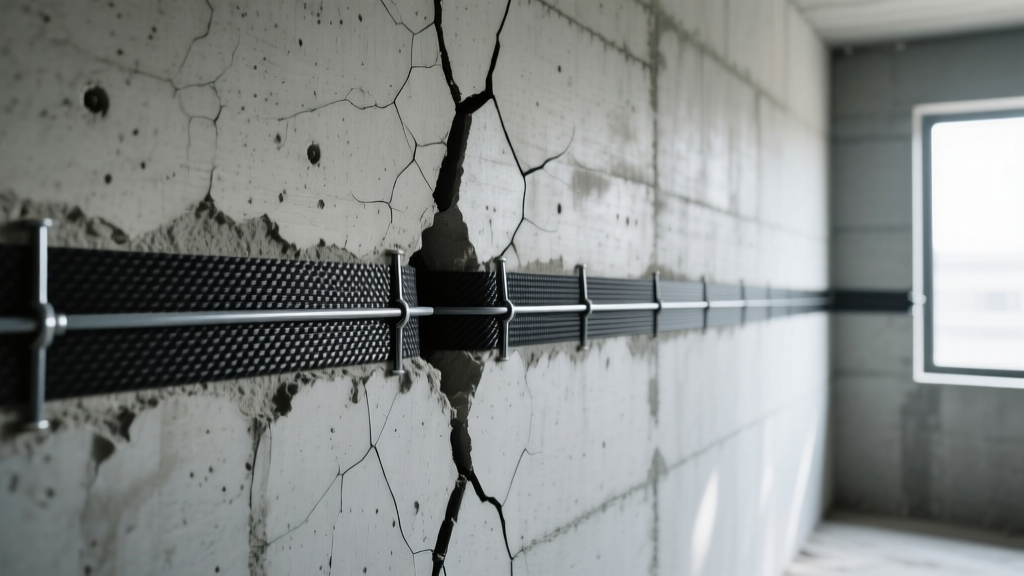
Carbon Fiber Reinforced Polymer (CFRP) systems have revolutionized foundation stabilization. These straps utilize aerospace-grade carbon fibers embedded in a high-strength epoxy matrix, creating a composite material with a tensile strength up to 10 times greater than steel on a pound-for-pound basis. Brands like Fortress Stabilization and Rhino Carbon Fiber dominate this space.
For a standard 8-foot tall basement wall, contractors typically install straps spaced 48 inches on-center for moderate loading, or 24 inches on-center for heavy clay soils. The installation requires meticulous surface preparation: the concrete must be ground down to expose the aggregate, and any existing horizontal cracks must be routed and filled with structural paste before the carbon fiber is applied.
Code Compliance and Cost Factors
When calculating the horizontal crack in foundation repair cost for carbon fiber, expect to pay between $800 and $1,200 per strap. A typical 30-foot wall requires 7 to 8 straps, bringing the total reinforcement cost to roughly $6,000 to $9,600. Crucially, ensure the selected CFRP system holds an active ICC-ES Evaluation Report (specifically compliant with ICC-ES AC451), which is the acceptance criteria for externally bonded FRP composite systems. Non-certified, unbranded carbon fiber kits purchased online lack the engineered load tables required by local building officials and structural engineers.
Method 3: Steel I-Beams and Helical Wall Anchors
When a foundation wall has deflected inward by more than 2 inches, carbon fiber is no longer sufficient. The wall has entered a state of plastic deformation, and rigid steel reinforcement is required. Steel I-beams (typically W6x9 or W8x10 profiles) are installed vertically against the wall, anchored into the concrete floor slab below and bolted to the floor joists above. Modern systems use adjustable turnbuckles at the top bracket, allowing the contractor to slowly tighten the beam over several months to gradually push the wall back toward plumb.
Alternatively, helical wall anchors (tiebacks) involve driving a steel helical pier through the foundation wall into the stable soil outside, then attaching a steel plate to the interior wall. By tightening the nut on the tie rod, the wall can be actively pulled back into alignment. While highly effective, tiebacks require exterior excavation to install the helical plates, which significantly increases the overall horizontal crack in foundation repair cost due to labor and landscaping restoration.
Method 4: Complete Foundation Wall Rebuild
If a horizontal crack is accompanied by severe step-cracking, shearing (where the top half of the wall slides inward relative to the bottom half), or if the concrete/CMU is heavily spalled and degraded, stabilization is no longer viable. The wall must be completely demolished and rebuilt. This requires temporarily shoring the first-floor framing, excavating the exterior soil, demolishing the compromised wall, pouring a new reinforced concrete footing, and laying new CMU or pouring a new concrete wall with #5 or #6 vertical rebar. This is the most expensive and disruptive option, often exceeding $25,000 per wall, but it is the only safe remedy for total structural failure.
Diagnostic Decision Framework: Which Method Do You Need?
- Measure the Deflection: Stretch a taut masonry string from the top corner of the wall to the bottom corner. Measure the gap between the string and the center of the wall at the horizontal crack.
- 0 inches: Wall is plumb. Epoxy injection + exterior drainage correction is sufficient.
- 0.5 to 2.0 inches: Wall is bowing. Carbon fiber straps are the optimal, code-compliant choice.
- Greater than 2.0 inches: Severe failure. Steel I-beams or helical tiebacks are mandatory.
- Assess the Water Table: If the horizontal crack is actively weeping water year-round, you must pair any structural repair with an interior French drain and a high-capacity sump pump (e.g., Zoeller M53 or Liberty Pumps 257) to relieve hydrostatic pressure.
- Consult a Structural Engineer: Always hire an independent, licensed structural engineer (not a foundation repair salesman) to draft the repair specifications. Expect to pay $500 to $1,500 for this report, which will save you from overselling and ensure the repair meets local building codes.
Hidden Cost Factors That Inflate Your Quote
The baseline costs listed in the comparison matrix only cover the structural reinforcement itself. To accurately budget for a horizontal crack in foundation repair cost, you must account for the following ancillary expenses:
- Engineering Reports ($500 - $1,500): Most municipalities require a stamped engineering drawing before issuing a permit for steel beam or carbon fiber installations.
- Interior Drainage Systems ($4,000 - $8,000): Relieving hydrostatic pressure often requires jackhammering the interior perimeter, installing perforated corrugated pipe, and adding a sump basin.
- Exterior Excavation and Waterproofing ($100 - $250 per linear foot): If the exterior soil must be dug up to apply a rubberized asphalt membrane (like Tremco Paraseal) and install rigid insulation to protect against frost heave.
- Finishing Restoration ($2,000 - $10,000+): Steel I-beams protrude 4 to 6 inches from the wall, requiring you to furr out and re-drywall the entire basement. Carbon fiber lies flush, saving significant finishing costs.
Authoritative References and Standards
Proper foundation repair relies on strict adherence to established engineering standards. For further reading on structural evaluation and repair protocols, consult the following resources:
- The Foundation Performance Association (FPA) provides extensive guidelines on evaluating soil-structure interaction and lateral earth pressure failures in residential foundations.
- The American Concrete Institute (ACI 318) outlines the structural requirements for concrete reinforcement, including the integration of externally bonded FRP systems and steel supports.
- The U.S. Department of Housing and Urban Development (HUD) publishes comprehensive rehabilitation guidelines that include detailed protocols for diagnosing and repairing masonry and concrete foundation failures.
By understanding the specific mechanics causing your horizontal crack and selecting the repair method that matches the deflection data, you can ensure a permanent, code-compliant stabilization that protects your property's structural integrity and long-term value.
Written by
Priya KapoorPriya Kapoor is a real estate market analyst and construction economics researcher with expertise in housing affordability, development feasibility, and infrastructure investment. She holds a Master of Regional Planning from Cornell University and previously worked as a senior analyst at CBRE's Investment Properties group, where she modeled returns for $4B in mixed-use development pipelines. Priya now runs an independent research practice advising developers, municipalities, and REITs on construction cost forecasting and market timing. She publishes the quarterly "BuildMat Market Pulse" report tracking material price indices across 12 commodity categories. Based in Austin, TX, Priya serves on the board of Habitat for Humanity Austin and is a marathon runner.
More from Priya Kapoor
View all
Construction Cost
Cost to Build a 1600 Sq Ft Home in 2026: Full Breakdown
Accurate 2026 cost to build a 1600 sq ft home—material, labor, and regional pricing breakdowns included. Plan your budget with real-time estimates.
Aug 11, 2026

Wood & Lumber
Name the Types of Wood for Pressure Treatment and Preservation
Learn how to name the types of wood best suited for pressure treatment. Compare species treatability, chemical retention levels, and 2026 preservation costs.
Aug 4, 2026

Stone & Masonry
Stone Veneer Suppliers Lindenhurst: 2026 Cost Analysis
Analyze 2026 stone veneer costs in Lindenhurst, NY. Compare local supplier pricing, delivery fees, and Suffolk County installation labor rates.
Aug 4, 2026