Cost of Foundation Repair in Dallas: 2026 Methods & Pricing Guide
Analyze the 2026 cost of foundation repair in Dallas. Compare pressed pilings, drilled piers, and polyurethane jacking for DFW expansive soils.

The Dallas Soil Factor: Why DFW Foundations Fail
The cost of foundation repair in Dallas typically ranges from $4,500 to $18,000+ in 2026, but understanding the pricing requires understanding the dirt. The Dallas-Fort Worth metroplex sits primarily on the Blackland Prairie, characterized by highly expansive montmorillonite clay. This soil has a Plasticity Index (PI) frequently exceeding 35, meaning it swells dramatically when wet and shrinks severely during droughts.
When soil moisture fluctuates, the slab-on-grade foundations common in DFW experience differential settlement. A house in Plano might sink 2 inches on the north side due to a plumbing leak, while a property in Frisco might heave upward near a mature oak tree. Because the soil mechanics dictate the repair strategy, the cost of foundation repair in Dallas is rarely a flat rate; it is a calculated response to subsurface strata and structural load.
Ignoring diagonal drywall cracks or sticking doors in Dallas will not save money. Expansive clay exerts up to 5,000 pounds per square foot (psf) of uplift pressure. Delaying repair allows secondary damage—such as severed cast-iron plumbing lines and compromised roof trusses—to compound, potentially adding $10,000+ to your total remediation costs.
Breakdown of Foundation Repair Methods and 2026 Costs
Dallas foundation repair contractors primarily utilize four underpinning and lifting methods. The right choice depends on the depth to stable moisture zones, the weight of the structure, and site access.
1. Pressed Concrete Pilings
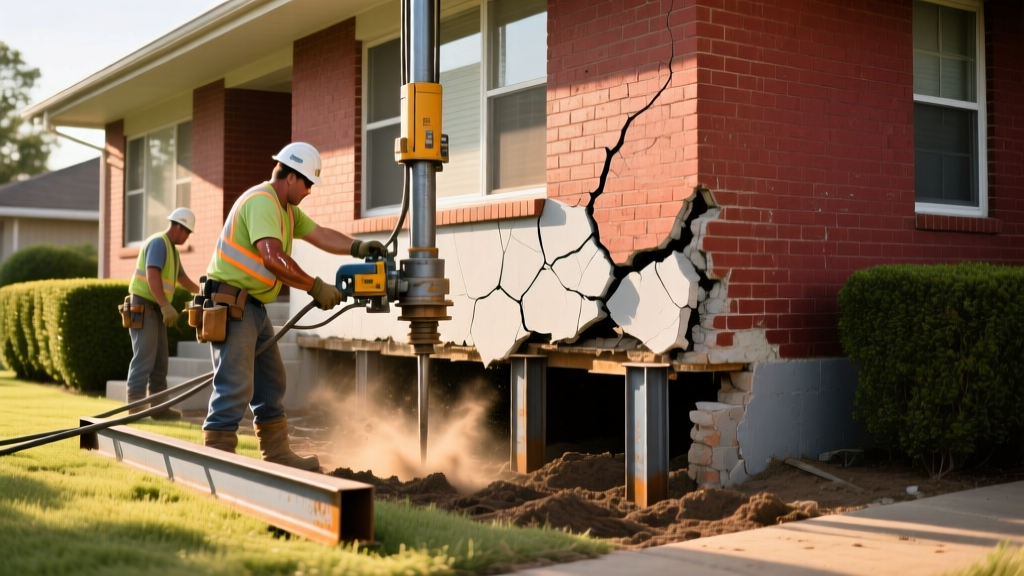
This is the most common and cost-effective method in DFW. Contractors use the weight of the house to hydraulically press cylindrical concrete segments (typically 6 inches in diameter and 12 inches long) into the ground until they reach "refusal" (a stable load-bearing stratum or bedrock).
- 2026 Unit Cost: $160 – $240 per pier
- Depth Limitation: Usually effective up to 15–20 feet. In northern suburbs like Prosper or Celina, stable strata can be deeper, making concrete pilings less viable.
- Best For: Standard single-story slab-on-grade homes with perimeter settlement.
2. Pressed Steel Pilings
Steel piers utilize high-strength steel pipe sections (usually 2.875 inches in diameter) pressed hydraulically into the soil. Because steel has a smaller surface area than concrete, it creates less skin friction, allowing it to be driven much deeper to reach true bedrock or load-bearing shale.
- 2026 Unit Cost: $260 – $380 per pier
- Depth Limitation: Can be driven 40+ feet deep.
- Best For: Two-story homes, heavy brick veneer structures, and areas with deep unstable clay layers.
3. Drilled Concrete Piers (Bell-Bottom)
This method involves mechanically drilling a shaft (usually 10 to 12 inches in diameter) down to a stable depth, bellying out the bottom, and filling it with reinforced concrete. It is a new-construction standard adapted for heavy commercial or severe residential repairs.
- 2026 Unit Cost: $450 – $700+ per pier
- Depth Limitation: Drilled to exact engineering specifications, often 20–30 feet.
- Best For: Massive structural loads, commercial buildings, or homes where vibration from pressing pilings could damage adjacent structures.
4. Polyurethane Foam Jacking (Deep Injection)
For slab settlement where the foundation itself is intact but the supporting soil has compacted or washed out, high-density polyurethane resin is injected through 5/8-inch holes drilled into the slab. The foam expands, compacting loose soils and lifting the concrete.
- 2026 Unit Cost: $18 – $28 per square foot
- Best For: Interior floor leveling, sunken patios, and garage slabs. Not suitable for lifting heavy exterior perimeter grade beams.
2026 Dallas Foundation Repair Cost Matrix
| Repair Method | 2026 Avg. Unit Cost | Typical Total Job Cost | Lifespan / Warranty |
|---|---|---|---|
| Pressed Concrete | $160 - $240 / pier | $4,500 - $8,500 | Lifetime (Transferable) |
| Pressed Steel | $260 - $380 / pier | $7,500 - $14,000 | Lifetime (Transferable) |
| Drilled Bell-Bottom | $450 - $700 / pier | $12,000 - $25,000+ | Lifetime (Structural) |
| Polyurethane Foam | $18 - $28 / sq. ft. | $2,500 - $6,000 | 10 - 20 Years |
Hidden Variables That Spike Your Dallas Repair Bill
The per-pier cost is only the baseline. When evaluating the true cost of foundation repair in Dallas, homeowners must account for site-specific complications that contractors categorize as "access and restoration" fees.
- Interior Tunneling: If interior piers are required to support a sagging central beam, contractors must dig tunnels beneath your slab. Expect to pay $800 to $1,200 per tunnel, plus the cost of breaking out and repouring the concrete floor.
- Landscaping and Hardscape Removal: Concrete patios, decks, and AC units resting on the grade beam must be removed or tunneled under. Deck demolition and reinstallation can add $1,500 to $4,000 to the project.
- Hydrostatic Plumbing Tests: Before lifting a slab, a master plumber must test the underground drain lines. Lifting a house can snap old cast-iron or PVC pipes. A hydrostatic test costs $350 to $600, and repairing a sub-slab leak can add $2,000+.
- Root Barriers: If a mature tree is causing soil desiccation, installing a high-density polyethylene (HDPE) root barrier is mandatory to protect the repair. Budget $60 to $85 per linear foot for trenching and installation.
How to Evaluate a Dallas Foundation Repair Estimate
The Texas foundation repair industry is heavily populated by sales-driven companies. To protect your investment, cross-reference your estimates against the standards set by the Foundation Performance Association (FPA), the premier authority on Texas foundation guidelines.
- Demand a Structural Engineer's Report: Never rely solely on a contractor's free inspection. Hire an independent structural engineer (member of the Structural Engineers Association of Texas) to perform a manometer survey and write a repair plan. This costs $600–$900 but prevents contractors from overselling piers you do not need.
- Verify Pier Spacing: Standard perimeter pier spacing in DFW is 6 to 8 feet on center. If an estimate proposes spacing piers 10 feet apart to lower the price, reject it. The grade beam will deflect between widely spaced piers.
- Check the "Shim" Policy: All pressed piling systems require future adjustments (shimming) as soils continue to move. Ensure the contract explicitly states that lifetime adjustments are included in the warranty, not just the initial lift.
"In the Dallas-Fort Worth area, the foundation repair is only 50% of the battle. The other 50% is post-repair moisture management. Without a calibrated drip-line soaker hose system or automated subsurface drip irrigation to maintain consistent soil moisture around the perimeter, even the deepest steel piers will eventually experience lateral soil drag and seasonal movement."
— Geotechnical Engineering Best Practices for Expansive Soils, North Texas
Insurance and Financing Realities in Texas
A common misconception is that a standard Texas HO-3 homeowner's insurance policy will cover foundation settlement. It will not. Insurance covers sudden, accidental water damage (like a burst pipe that washes away soil), but it explicitly excludes "earth movement," settling, and shrinking/expanding soils.
For a $12,000 steel pier project in 2026, most Dallas homeowners utilize one of the following financing routes:
- Contractor-Partnered Financing: Many established DFW repair firms offer unsecured personal loans through third-party lenders (e.g., GreenSky, Synchrony). Rates in 2026 range from 8.99% to 24.99% APR based on credit tier.
- HELOC or Home Equity Loan: With DFW property values remaining robust, tapping into home equity offers the lowest interest rates (typically 7% to 10%), and the interest may be tax-deductible if the repair is classified as a capital improvement that prolongs the home's life.
- FHA 203(k) Rehab Loan: If you are purchasing a distressed property in Dallas that requires foundation work, rolling the repair costs into an FHA 203(k) mortgage is the most capital-efficient method, as it requires only a 3.5% down payment on the total purchase-plus-repair amount.
Securing your home's structural integrity in the Blackland Prairie requires moving past sticker shock and focusing on engineering precision. By matching the correct underpinning method to your specific soil profile and enforcing strict adherence to FPA spacing guidelines, you ensure the cost of foundation repair in Dallas translates into a permanent, stable solution.
Written by
David NakamuraDavid Nakamura is a licensed architect (AIA) and construction technology writer focused on sustainable building methods, mass timber engineering, and high-performance building envelopes. He holds a Master of Architecture from the University of Washington and is a certified Passive House Consultant (CPHC). David spent eight years at the Seattle firm Mithun, where he led the design of three LEED Platinum projects, before founding his own practice specializing in net-zero residential design. He serves on the editorial advisory board of GreenBuilder Magazine and has authored peer-reviewed papers on cross-laminated timber (CLT) connections for the Journal of Structural Engineering. In his spare time, David teaches woodworking at Pratt Fine Arts Center and kayaks the Puget Sound.
More from David Nakamura
View all
Construction Cost
Labor Cost to Build a Deck Per Sq Ft: 2026 Installation Guide
Discover the exact labor cost to build a deck per sq ft in 2026. This installation guide breaks down contractor rates, complexity factors, and hidden fees.
Aug 4, 2026

Construction Cost
How Much Does It Cost to Build a 3 Bedroom House? Financing Guide
Learn exactly how much it costs to build a 3 bedroom house and explore 2026 financing options, construction loan types, and budget frameworks for your build.
Aug 4, 2026

Construction Cost
Cost to Build a Tennis Court: 2026 Guide
How much does it cost to build a tennis court in 2026? Breakdowns for asphalt, concrete, and synthetic surfaces plus fencing and lighting.
Jul 30, 2026