How Much Does a Foundation Repair Cost? 2026 Structural Analysis
Discover how much a foundation repair costs in 2026. A structural analysis of underpinning, slabjacking, and wall stabilization pricing and failure modes.

The Structural Mechanics of Foundation Pricing
When homeowners ask, "How much does a foundation repair cost?", the answer is rarely a flat rate. From a structural engineering perspective, repair costs are a direct mathematical function of three variables: the dead and live loads of the superstructure, the shear strength of the underlying soil strata, and the depth required to reach competent load-bearing bedrock or stable friction zones. A single-story wood-frame home exerts roughly 1,500 to 2,000 linear pounds per foot (PLF) on its foundation, whereas a two-story masonry veneer structure can exceed 4,500 PLF. This load differential dictates whether a contractor can use shallow polyurethane foam or must drive deep steel push piers, resulting in cost variances of tens of thousands of dollars.
Uniform settlement rarely causes structural damage; it is differential settlement—where one section of the foundation drops relative to another—that induces shear stresses in the superstructure, leading to drywall fissures, racking door frames, and compromised load paths. Stabilizing these differential forces requires precise, engineered interventions.
2026 Cost Matrix: Repair Methods vs. Structural Load Requirements
The following matrix breaks down current 2026 market pricing for primary foundation repair systems, mapped to their specific structural applications and load-transfer mechanisms.
| Repair Method | Mechanism of Action | 2026 Cost Range | Ideal Structural Scenario |
|---|---|---|---|
| Polyurethane Foam Jacking | Injects high-density, closed-cell resin (2-4 lbs/cu ft) to fill voids and lift slabs. | $1,500 - $3,500 per zone | Slab-on-grade curl, minor differential settlement, and erosion voids under light loads. |
| Steel Push Piers | Uses the structure's weight as reaction force to drive steel tubes to end-bearing strata. | $1,800 - $2,800 per pier | Heavy structures (2-story, masonry) experiencing deep differential settlement. |
| Helical Piers | Advanced into soil like a screw; relies on both friction and bearing plates for capacity. | $2,000 - $3,200 per pier | Light structures where push piers lack reaction weight; new construction tie-backs. |
| Carbon Fiber Straps | Applies high-tensile strength (up to 150 ksi) to resist lateral bowing from hydrostatic pressure. | $800 - $1,300 per strap | Poured concrete or CMU basement walls with inward deflection under 2 inches. |
| Cementitious Mudjacking | Pumps heavy sand/cement slurry (~100 lbs/cu ft) to lift sunken concrete. | $600 - $1,500 per section | Exterior flatwork, driveways, and non-structural porches. |
Soil-Structure Interaction: Why Geotech Dictates the Bill
The most significant cost driver in deep underpinning is the depth of the unstable soil profile. In regions dominated by expansive clays—specifically soils rich in smectite and montmorillonite minerals—moisture fluctuations cause volumetric swelling and shrinking that exert uplift pressures exceeding 5,000 pounds per square foot (PSF). According to research on foundations on expansive soils by Texas A&M AgriLife Extension, these soils are responsible for billions in structural damage annually.
Applying cementitious mudjacking beneath a failing slab-on-grade foundation adds massive dead load (approx. 100 lbs per cubic foot) to an already compromised, low-bearing-capacity subgrade. While cheaper upfront, this added weight can accelerate secondary settlement in highly compressible clays, leading to repeat failures within 3 to 5 years. Polyurethane foam, weighing less than 4 lbs per cubic foot, adds negligible dead load while providing compressive strengths exceeding 60 PSI, justifying its higher initial cost for structural slab stabilization.
To bypass these active zones, engineers must specify piers driven to the "depth of seasonal moisture variation," which can range from 8 feet in temperate climates to over 30 feet in arid regions with deep desiccation cracks. Every additional 3-foot pier section adds $250 to $450 to the per-pier cost. A structural engineer's geotechnical soil boring report (typically $1,500 to $3,000) is non-negotiable for accurately pricing these deep foundation interventions.
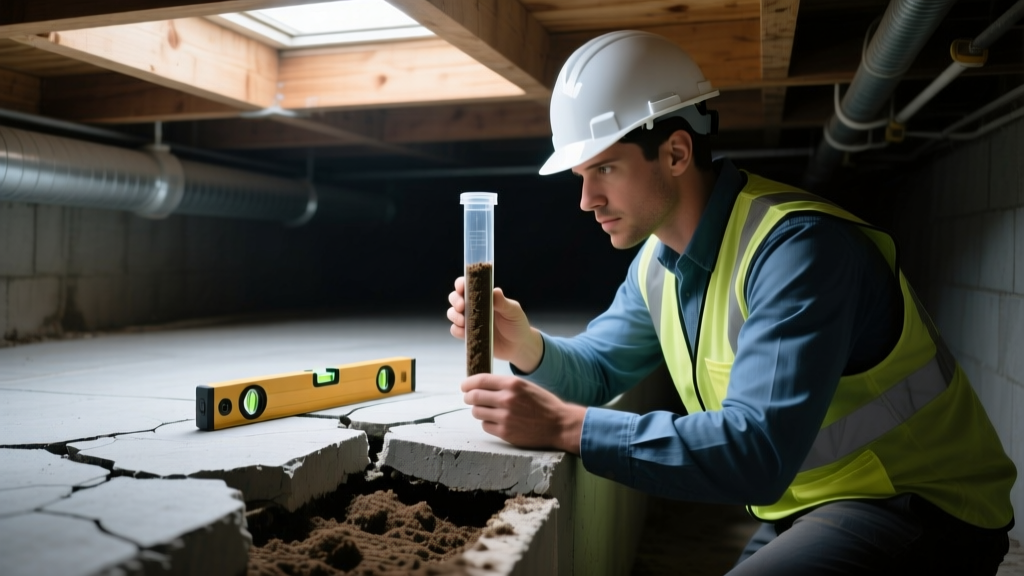
Decision Framework: Matching Failure Modes to Repair Systems
Selecting the correct repair system requires diagnosing the specific vector of structural failure. Misdiagnosis leads to catastrophic financial waste and ongoing structural degradation.
Vector 1: Vertical Differential Settlement (Deep Underpinning)
When a corner or continuous footing drops due to soil consolidation or washout, the structure requires deep underpinning to transfer loads to stable strata.
- Push Piers: Best for heavy structures. The hydraulic manifold uses the immense dead load of the house to push the pier down. If the house is too light, the pier will simply push the house up rather than penetrating the soil.
- Helical Piers: Best for lighter structures (e.g., single-story wood frame, porches). The hydraulic torque motor drives the pier independently of the structure's weight. Installation depth is verified using torque-to-capacity correlations per American Society of Civil Engineers (ASCE) geotechnical standards.
Vector 2: Lateral Hydrostatic Pressure (Basement Wall Deflection)
Saturated soil outside a basement wall creates lateral hydrostatic pressure. When this pressure exceeds the tensile strength of the concrete or masonry, the wall bows inward, creating horizontal shear cracks.
- Carbon Fiber Grids/Straps: Systems like Simpson Strong-Tie or Fortress Stabilization use epoxy-saturated carbon fiber to create an external tensile membrane. Costing roughly $1,000 per strap (spaced 4 feet on center), this is highly effective for walls with less than 2 inches of deflection.
- Steel I-Beam Bracing: For walls deflected beyond 2 inches, carbon fiber loses efficacy. Galvanized steel I-beams, anchored to the floor slab and the floor joists above, are required. These cost $1,200 to $1,800 per beam and require invasive interior excavation.
Vector 3: Slab Curl and Subgrade Voids (Shallow Stabilization)
If the foundation walls are stable but the interior concrete slab has separated from the subgrade (often due to clay shrinkage during droughts), the slab lacks support for interior partition walls. Polyurethane foam injection is the engineered solution here, lifting the slab back to plumb and providing a continuous, waterproof bearing surface without adding destructive dead load.
The "Hidden" Engineering and Compliance Costs
Contractor estimates often exclude the preliminary and administrative costs required to ensure the repair meets local building codes and structural safety standards. When budgeting for a foundation repair, you must account for the following line items:
- Independent Structural Engineering Report ($500 - $1,500): Never rely solely on a contractor's free inspection. An independent, licensed Professional Engineer (PE) will provide an unbiased repair design, specifying exact pier depths, spacing, and bracket types.
- Geotechnical Soil Borings ($1,500 - $3,500): Required for deep underpinning to identify the depth of bedrock or stable load-bearing strata, preventing contractors from underestimating pier lengths.
- Municipal Permits and Inspections ($200 - $800): Most jurisdictions require permits for structural underpinning. The FEMA Building Science division heavily recommends adhering to local code adaptations of the International Existing Building Code (IEBC) to ensure life-safety standards are maintained during load transfers.
- Superstructure Remediation ($1,000 - $5,000+): Lifting a foundation back to level tolerance (typically defined by the ASCE as L/360 deflection limits) will often crack recently patched drywall or bind newly hung doors. Budget for post-lift cosmetic and carpentry remediation.
Long-Term Load Transfer: Warranties and Structural Lifespan
The true cost of foundation repair must be evaluated against the lifespan of the intervention. Galvanized steel push and helical piers, when installed to verified end-bearing strata, effectively possess an infinite structural lifespan, often backed by 50-year to lifetime transferable warranties. The galvanization coating (typically 3.0 oz/sq ft per ASTM A123) prevents subterranean corrosion, ensuring the load path remains intact for the life of the structure.
Conversely, shallow treatments like mudjacking or unengineered drainage corrections offer temporary relief but do not alter the underlying soil-structure interaction mechanics. By viewing foundation repair through the lens of structural load transfer and soil mechanics, property owners can accurately interpret quotes, reject superficial band-aid fixes, and invest in engineered solutions that permanently stabilize the structural envelope.
Written by
Marcus ChenMarcus Chen is a licensed structural engineer (PE) and building materials analyst with over 12 years of experience across residential, commercial, and industrial construction. He holds a Master of Science in Civil Engineering from UC Berkeley and spent six years at Thornton Tomasetti before transitioning to independent consulting and technical writing. Marcus specializes in material selection for seismic-prone regions, concrete reinforcement strategies, and lifecycle cost analysis. His work has been cited by the American Concrete Institute (ACI) and the Structural Engineers Association of California (SEAOC). When he is not on a job site or at his desk, you will find him hiking the Sierra Nevada or restoring a 1920s craftsman bungalow in Oakland, CA.
More from Marcus Chen
View all
Construction Cost
How Much Did the Eiffel Tower Cost to Build?
How much did the Eiffel Tower cost to build in 1889? We adjust for inflation and compare its budget to modern skyscraper construction.
Aug 4, 2026

Fire Resistance
What Is a Fire Resistant Material? Testing & Certification Guide
Discover what is a fire resistant material through ASTM and UL testing. Learn how fire ratings, certifications, and assemblies work in construction.
Aug 4, 2026

Construction Cost
How Much Did the Burj Khalifa Cost to Build?
How much did the Burj Khalifa cost to build? We break down the $1.5B project and extract 5 money-saving strategies for your next build.
Jul 30, 2026