Foundation Building Materials in Orange: Cost Analysis & Pricing
Analyze 2026 costs for foundation building materials in Orange. Compare concrete, rebar, and seismic upgrade pricing for local California builds.

Regional Cost Drivers for Orange Foundation Projects
Procuring foundation building materials in Orange requires navigating a unique intersection of high seismic risk, expansive adobe clay soils, and strict California Building Code (CBC) mandates. Unlike national averages where a standard slab-on-grade foundation might cost between $6 and $8 per square foot, the Orange market commands a premium. Local geotechnical reports frequently mandate deepened grade beams, post-tensioning, or specialized sulfate-resistant concrete mixes, pushing material costs significantly higher.
Labor rates for skilled concrete finishers and ironworkers in the Orange region currently range from $85 to $125 per hour, which indirectly inflates material delivery and placement logistics. Furthermore, local municipal grading ordinances require stringent erosion control and soil import/export management, meaning the raw material cost is only one fraction of the total foundation budget.
2026 Orange County Foundation Material Baselines
Standard Slab-on-Grade: $13.50 - $17.00 per sq. ft. (materials only)
Post-Tension Slab: $18.00 - $23.50 per sq. ft. (materials and stressing hardware)
Raised Crawl Space: $24.00 - $32.00 per sq. ft. (concrete piers, girders, and moisture barriers)
Concrete Mix Designs: Sulfate Resistance and PSI Requirements
The default specification for residential and light commercial foundations is 2,500 to 3,000 PSI concrete. However, soil tests in many Orange tracts reveal high concentrations of soluble sulfates, which degrade standard Portland cement over time. According to the Portland Cement Association sulfate guidelines, structures exposed to severe sulfate soils require Type V cement or a blend utilizing slag cement (typically 50% to 70% slag replacement).
For foundation building materials in Orange, specifying a 4,000 PSI mix with a maximum water-cementitious ratio (w/c) of 0.45 is the standard defensive strategy against both sulfate attack and expansive soil moisture intrusion. This specialized mix design adds approximately $25 to $40 per cubic yard compared to a standard 3,000 PSI 3/4-inch aggregate mix.
Itemized Material Cost Matrix: Orange vs. National Average
| Material Component | Specification | Orange Unit Cost | National Avg. |
|---|---|---|---|
| Ready-Mix Concrete | 4,000 PSI, Type V / Slag Blend | $185 - $215 / CY | $135 - $155 / CY |
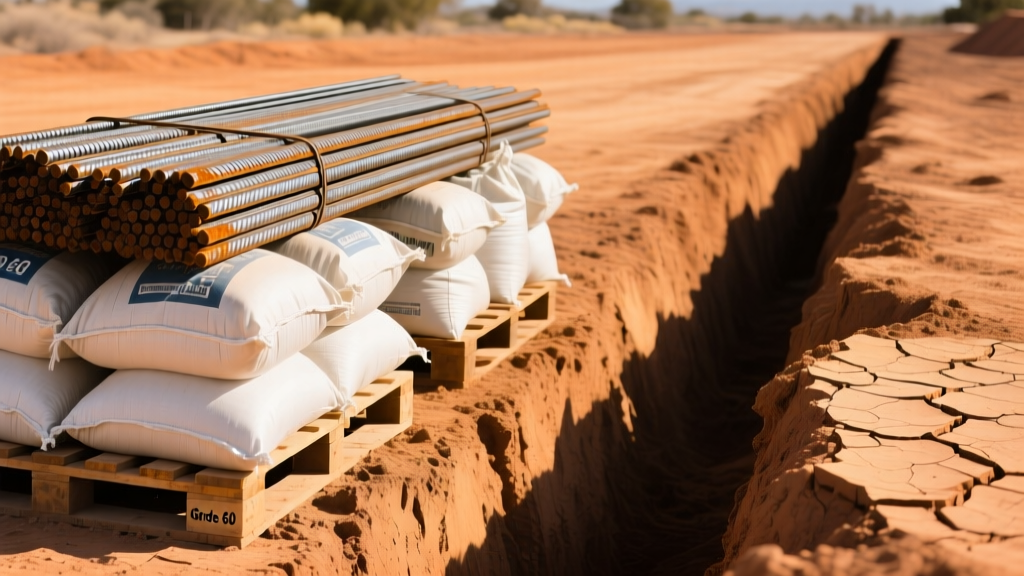
| Reinforcing Steel | Grade 60, #4 and #5 Epoxy-Coated | $1.15 - $1.40 / lb | $0.85 - $1.05 / lb |
| Post-Tension Tendons | 270 KSI, 0.5-inch 7-wire strand | $2.85 - $3.50 / LF | $2.10 - $2.60 / LF |
| Vapor Retarder | 15-mil Stego Wrap (ASTM E1745 Class A) | $0.35 - $0.45 / sq. ft. | $0.25 - $0.32 / sq. ft. |
| Seismic Hold-Downs | Simpson Strong-Tie HDU Series | $45.00 - $85.00 / ea | $35.00 - $65.00 / ea |
Soil and Seismic Upgrades: The Hidden Costs in Orange
The California Geological Survey maps significant portions of the inland Orange region as susceptible to highly expansive soils and seismic liquefaction. When building on expansive adobe clay, standard shallow footings will crack and differential settlement will occur. To mitigate this, structural engineers typically specify post-tensioned slabs or deepened, heavily reinforced grade beams that extend below the active moisture zone (often 36 to 48 inches deep in this region).
Seismic upgrades represent another major material expense. The CBC requires continuous load paths to transfer lateral forces from the roof down to the foundation. This necessitates the use of heavy-duty mechanical anchors and hold-downs. Simpson Strong-Tie structural connectors, specifically the HDU series with screw anchors or epoxy-set threaded rods, are the regional standard. A typical 2,500-square-foot footprint in a high seismic design category may require 15 to 25 hold-downs, adding $1,500 to $2,500 in hardware costs alone before factoring in the specialized epoxy adhesives (like Simpson SET-3G) required for cracked concrete installations.
⚠ Short-Load Fee Warning for Local Batch Plants
When ordering ready-mix concrete for smaller foundation repairs or detached ADU footings in Orange, be highly cautious of short-load fees. Local suppliers (such as CalPortland or Vulcan Materials) typically charge a premium of $75 to $125 per cubic yard for orders under 5 cubic yards. For small pours, evaluate the cost-benefit of using volumetric mobile mixers or high-strength bagged concrete mixes to avoid these punitive delivery surcharges.
Waterproofing and Moisture Control Materials
While Orange is known for its arid climate, seasonal atmospheric rivers and the presence of perched water tables in certain hillside developments make below-grade waterproofing critical for any raised foundation or basement (where permitted). Standard asphalt dampproofing is insufficient for hydrostatic pressure.
- Peel-and-Stick Membranes: Rubberized asphalt membranes (e.g., GCP Applied Technologies Bituthene) cost between $2.50 and $4.00 per square foot installed. They require a primer and must be applied to smooth, cured concrete surfaces.
- Bentonite Clay Panels: Sodium bentonite panels cost $1.80 to $2.75 per square foot. These are highly effective in Orange's clay-heavy soils because the clay swells upon contact with moisture, creating an impermeable seal against the footing.
- Drainage Mats: Dimpled high-density polyethylene (HDPE) drainage boards are required over the waterproofing membrane to relieve hydrostatic pressure, adding $1.20 to $1.80 per square foot to the material budget.
Decision Framework: Slab vs. Raised Foundation in Orange
Choosing the right foundation system dictates your entire material procurement strategy. Use this framework to align your material purchases with site-specific constraints.
| Site Condition | Recommended System | Key Material Requirements |
|---|---|---|
| Flat lot, stable soils, standard tract home | Post-Tension Slab | 270 KSI tendons, 4000 PSI concrete, 15-mil vapor barrier |
| Hillside, expansive adobe clay, high swell potential | Raised Floor with Drilled Piers | Deep cast-in-drilled-hole (CIDH) piers, Grade 60 vertical rebar, isolated grade beams |
| Flood zone or high water table (coastal Orange) | Elevated Stem Wall | Sulfate-resistant concrete, epoxy-coated rebar, continuous waterproofing membranes |
Frequently Asked Questions
Why is epoxy-coated rebar frequently specified in Orange foundation plans?
Epox-coated rebar (ASTM A775) is often mandated by geotechnical engineers in Orange when soil tests reveal high chloride or sulfate content, or when the foundation is located within three miles of the coast where salt spray intrusion is a factor. The epoxy coating prevents the steel from oxidizing, which would otherwise cause the rebar to expand and spall the surrounding concrete. Expect to pay a 20% to 30% premium over standard black rebar.
How do post-tension cables reduce material costs in expansive soils?
Post-tensioning compresses the concrete slab, keeping it tightly bound and resistant to the tensile cracking caused by expansive soils heaving upward. By utilizing high-strength steel tendons to provide the structural tension resistance, engineers can reduce the overall thickness of the concrete slab and decrease the amount of conventional Grade 60 rebar needed. While the tendons and stressing equipment add upfront costs, the reduction in concrete volume often results in a net savings of 5% to 8% on large commercial pads.
What are the local requirements for foundation insulation in Orange?
Under California's Title 24 Energy Code, slab-on-grade foundations in Climate Zone 10 (which covers much of inland Orange) require perimeter insulation if the slab is heated or if the building utilizes specific HVAC configurations. Extruded polystyrene (XPS) or expanded polystyrene (EPS) boards with an R-value of R-5 to R-10 must be installed vertically at the slab edge or horizontally under the footing. Budget approximately $1.50 to $2.50 per linear foot for these rigid foam insulation materials.
Written by
Sarah WhitfieldSarah Whitfield is a chartered quantity surveyor (MRICS) and construction cost analyst with 15 years of experience in material pricing, procurement strategy, and project budgeting. She earned her degree in Construction Management from the University of Reading (UK) and has worked on projects ranging from $2M custom homes to $180M mixed-use developments across North America and Europe. Sarah currently leads cost estimating for BuildMat Insight, maintaining a proprietary database of 4,000+ material price points updated quarterly. She is a frequent contributor to RSMeans cost data panels and has presented at the International Cost Engineering Council (ICEC) congress. Based in Denver, CO, Sarah is an avid trail runner and volunteer mentor for Women in Construction.
More from Sarah Whitfield
View all
Wood & Lumber
What Are the Different Types of Wood? A Builder's Guide
Compare structural softwoods, finish hardwoods, and engineered lumber. Analyze Janka ratings, MOE values, and 2026 pricing for construction.
Aug 4, 2026

Walls & Panels
Steel Framing vs Wood Framing: Corrosion and Moisture Defense
Compare steel framing vs wood framing for moisture resistance. Learn about galvanized coatings, condensation risks, and corrosion protection strategies.
Jul 21, 2026

Stone & Masonry
How to Cut Stone Veneer: Wet Saw vs Grinder Comparison
Compare the best tools for cutting stone veneer. We review wet saws, angle grinders, and chop saws to help you achieve clean, chip-free cuts.
Jul 21, 2026