Cracked Slab Foundation Repair Cost: US Regional Guide
Discover the cracked slab foundation repair cost by US region. Compare soil types, underpinning methods, and current pricing for clay, sand, and frost zones.

The Geography of Slab Failure: Why Region Dictates Price
A slab-on-grade foundation is only as stable as the soil beneath it. When evaluating a cracked slab foundation repair cost, homeowners and contractors must look beyond the visible fracture and analyze the regional geotechnical profile. A hairline crack in a California seismic zone requires a vastly different intervention—and budget—than a 1/2-inch stair-step fracture caused by expansive clay in Texas or frost heave in the Northeast.
According to geotechnical guidelines published by FEMA Building Science, regional soil mechanics and climate cycles are the primary drivers of differential settlement. In 2026, material costs for high-density structural resins and galvanized steel push piers have stabilized, but regional labor rates and permitting requirements continue to cause massive price disparities across the United States.
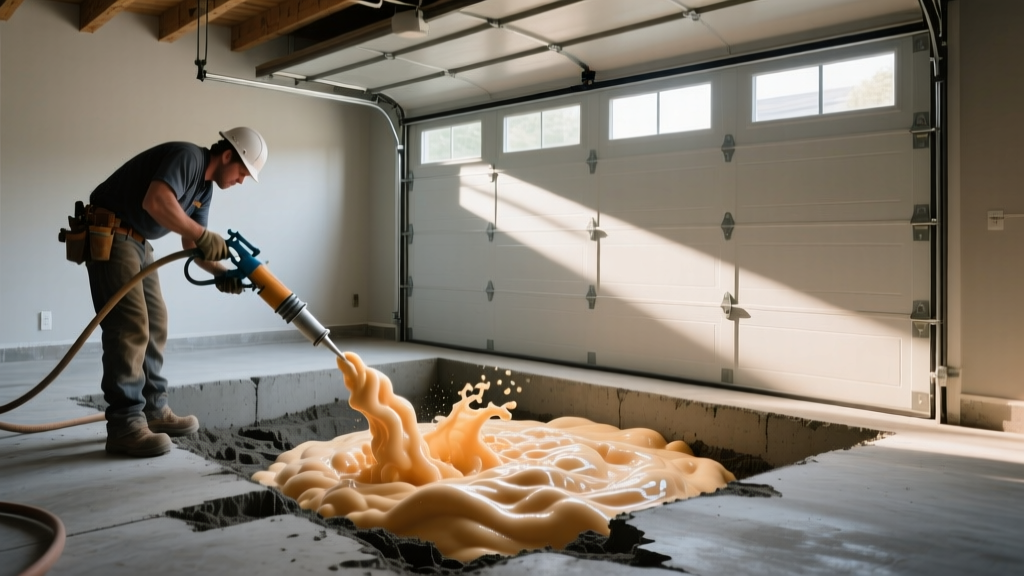
Cracked Slab Foundation Repair Cost Matrix by Region
The following matrix breaks down average 2026 repair costs based on regional soil profiles and their dominant failure modes.
| US Region | Primary Soil Profile | Common Failure Mode | Dominant Repair Method | Average Cost Range |
|---|---|---|---|---|
| Texas & South | Expansive Clay | Seasonal swelling/shrinking | Pressed Concrete Piers / Mudjacking | $5,000 – $25,000+ |
| Florida & Southeast | Sandy / Karst | Soil washout / Sinkhole activity | Compaction Grouting / Polyurethane | $3,000 – $20,000 |
| Northeast & Midwest | Glacial Till / Silt | Frost heave / Freeze-thaw cycles | Perimeter Drainage / Helical Piers | $2,500 – $18,000 |
| California & West | Colluvial / Seismic | Lateral slope creep / Seismic shear | Epoxy Stitching / Grade Beams | $4,000 – $30,000 |
Deep Dive: Regional Repair Methods & Pricing
Texas & The South: Battling Expansive Clay
In regions like Dallas-Fort Worth and San Antonio, highly plastic clay soils expand during wet seasons and contract during droughts, causing severe differential settlement. The standard for severe structural cracks here is underpinning with pressed concrete pilings or steel push piers.
- Pressed Concrete Piers: Costing $600 to $900 per pier, this method uses hydraulic rams to drive concrete cylinders down to a stable load-bearing stratum. A typical 15-pier job costs between $9,000 and $13,500.
- Steel Push Piers: For heavier loads or deeper bedrock, galvanized steel piers (such as those manufactured by Earth Anchor) are driven to refusal. Expect to pay $1,800 to $2,800 per pier.
- Root Barriers: Often required alongside piering to stop oak and willow trees from extracting sub-slab moisture. Installation runs $60 to $90 per linear foot.
Florida & Coastal Southeast: Sand, Water, and Washouts
Sandy soils lack cohesion, and heavy subtropical rains frequently wash out the substrate beneath slabs, leaving voids that lead to cracking and sinking. Traditional mudjacking (slurry pumping) is often too heavy for these soils and can exacerbate the washout.
The Northeast & Midwest: Frost Heave and Freeze-Thaw
Slabs poured above the frost line or without adequate sub-slab insulation are subject to frost heave. When the ground freezes, it expands upward, cracking the slab; when it thaws, the slab drops. Repairing the crack is useless if the frost vector isn't addressed.
Repairs here focus on exterior perimeter insulation (retrofitting Frost-Protected Shallow Foundation principles) and French drain installation to divert hydrostatic pressure. If the slab has permanently displaced, helical piers ($1,500–$2,200 each) are used to anchor the slab below the frost line. The American Concrete Institute (ACI) provides strict guidelines on cold-weather concrete performance and subgrade preparation that contractors must follow in these zones.
California & The West: Seismic Shear and Slope Creep
In seismic zones and hillside developments, slabs experience lateral tension and shear forces, resulting in wide, jagged structural cracks. Simply filling these with standard caulk will fail during the next minor tremor.
The industry standard is epoxy injection combined with carbon fiber stitching. Using structural epoxies like Simpson Strong-Tie SET-XP, contractors weld the concrete back together chemically. They then route grooves across the crack and embed carbon fiber staples (e.g., Fortress Stabilization systems) to provide tensile strength. This localized structural stitching costs $800 to $1,500 per linear foot of crack but prevents the need for total slab replacement, which can exceed $40,000 in sloped terrains.
Material & Labor Cost Breakdown (2026 Estimates)
When reviewing contractor bids, use this baseline to verify material and labor markups:
- Structural Epoxy Injection (Low-Viscosity): $150 – $300 per linear foot (Materials: $40/ft, Labor: $110-260/ft).
- Polyurethane Foam Jacking: $12 – $25 per square foot. (Requires specialized proportioning rigs; DIY kits are strictly for non-structural cosmetic voids).
- Helical Piers: $1,500 – $2,200 per pier installed (Includes hydraulic driving and slab bracketing).
- Mudjacking (Cementitious Slurry): $5 – $9 per square foot (Declining in use for residential slabs due to weight and washout risks).
Decision Framework: Patch, Lift, or Underpin?
Use this diagnostic flowchart to determine the correct intervention level for a cracked slab:
- Step 1: Measure Differential Settlement. Use a laser level. If the floor is out of level by less than 1/2 inch over 20 feet, and cracks are under 1/8 inch, proceed to Step 2. If settlement exceeds 1 inch, skip to Step 4 (Underpinning).
- Step 2: Check for Active Moisture. Tape a 2x2 foot square of clear polyethylene to the slab. Wait 48 hours. If condensation forms underneath, you have hydrostatic vapor drive. You must install a vapor barrier or exterior drainage before sealing cracks, or the epoxy will delaminate.
- Step 3: Route and Inject (Cosmetic/Dormant Cracks). For stable, dry cracks, V-groove the fracture with a diamond blade grinder and inject with a flexible polyurethane sealant (like SikaFlex) to allow for minor thermal expansion.
- Step 4: Underpin and Lift (Active Structural Failure). If doors are sticking, drywall is tearing at the corners, and the laser level shows severe slope, the soil has failed. Hire a geotechnical engineer ($800–$1,500) to design a piering or compaction grouting plan before soliciting contractor bids.
Frequently Asked Questions
Does homeowners insurance cover cracked slab foundation repair?
Generally, no. Standard HO-3 policies exclude earth movement, settling, and expansive soil damage. However, if the crack and subsequent slab failure were caused by a sudden, covered peril—such as a ruptured municipal water main washing out your subgrade, or a vehicle striking the foundation—you may have coverage. In Florida, sinkhole coverage requires a specific rider or separate policy.
How long does a polyurethane foam slab repair last?
High-density structural polyurethane foam is inert and does not degrade in soil. According to data reviewed by HUD User regarding advanced foundation materials, closed-cell structural foams have a verified lifespan exceeding 50 to 100 years underground, provided they are not exposed to direct, prolonged UV radiation on the surface.
Can I sell a house with an unrepaired cracked slab foundation?
You can legally sell it, but you must disclose known structural defects in most states. Unrepaired structural cracks will cause FHA and VA appraisals to fail, forcing you to sell to cash buyers or investors at a 15% to 30% discount. Completing the repair and transferring a lifetime warranty from a reputable underpinning company is usually the most financially sound route to preserve your home's equity.
Written by
Priya KapoorPriya Kapoor is a real estate market analyst and construction economics researcher with expertise in housing affordability, development feasibility, and infrastructure investment. She holds a Master of Regional Planning from Cornell University and previously worked as a senior analyst at CBRE's Investment Properties group, where she modeled returns for $4B in mixed-use development pipelines. Priya now runs an independent research practice advising developers, municipalities, and REITs on construction cost forecasting and market timing. She publishes the quarterly "BuildMat Market Pulse" report tracking material price indices across 12 commodity categories. Based in Austin, TX, Priya serves on the board of Habitat for Humanity Austin and is a marathon runner.
More from Priya Kapoor
View all
Construction Cost
Cost to Build a 1600 Sq Ft Home in 2026: Full Breakdown
Accurate 2026 cost to build a 1600 sq ft home—material, labor, and regional pricing breakdowns included. Plan your budget with real-time estimates.
Aug 11, 2026

Wood & Lumber
Name the Types of Wood for Pressure Treatment and Preservation
Learn how to name the types of wood best suited for pressure treatment. Compare species treatability, chemical retention levels, and 2026 preservation costs.
Aug 4, 2026

Stone & Masonry
Stone Veneer Suppliers Lindenhurst: 2026 Cost Analysis
Analyze 2026 stone veneer costs in Lindenhurst, NY. Compare local supplier pricing, delivery fees, and Suffolk County installation labor rates.
Aug 4, 2026