Diagnosing Settling: Warning Signs & Porch Foundation Repair Cost
Identify early warning signs of porch settling and discover the true porch foundation repair cost for mudjacking, helical piers, and full replacement.

The Mechanics of Porch Separation
Porches fail at a disproportionately higher rate than primary house foundations due to a fundamental difference in construction methodology. While modern homes are typically built on continuous, frost-protected footings or deep structural piers tied to stable load-bearing strata, porch slabs are frequently poured as independent, shallow structures. According to the International Residential Code (IRC), exterior concrete slabs must be supported on undisturbed soil or engineered fill, yet many older porches were poured directly onto poorly compacted backfill left behind by the original excavation crew.
When the soil beneath a porch settles, shrinks during drought, or expands during heavy rainfall, the slab moves independently of the main house. This differential movement creates severe shear stress at the connection point—usually the ledger board or the threshold where the porch meets the home's exterior wall. Understanding the precise mechanics of this failure is the first step in accurately diagnosing the issue and estimating the ultimate porch foundation repair cost.
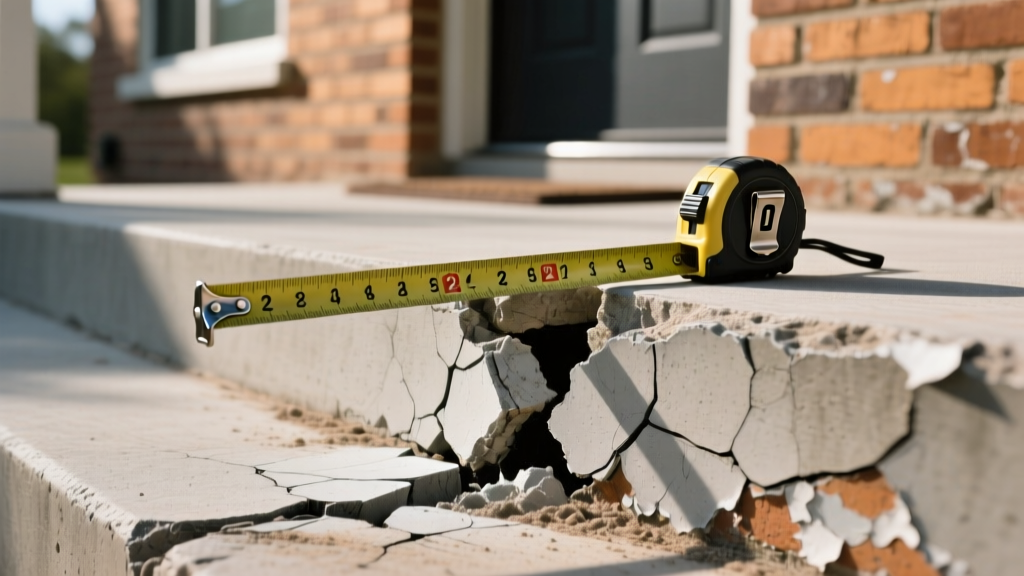
Diagnostic Matrix: Grading Your Porch Warning Signs
Before calling a contractor, conduct a systematic evaluation of the porch using a 4-foot spirit level, a laser level, and a set of feeler gauges. Categorize your findings using the diagnostic matrix below to determine the urgency of the intervention.
| Symptom | Measurement / Threshold | Underlying Cause | Urgency |
|---|---|---|---|
| Hairline gap at house junction | < 1/4 inch | Normal thermal expansion/contraction or minor initial backfill compaction. | Low (Monitor) |
| Visible slope away from house | > 1/4 inch per 10 feet | Subgrade erosion or expansive clay shrinkage (common in high-PI soils). | Medium (Plan Repair) |
| Staircase separation from landing | > 1/2 inch gap | Independent frost heave on stairs vs. main slab; shallow stair footings. | High (Trip Hazard) |
| Diagonal cracking at door frames | Cracks > 1/8 inch wide | Porch slab is physically pulling on the home's rim joist or brick veneer. | Critical (Immediate) |
For homeowners in regions with highly expansive soils, such as the American Southwest or parts of Texas, monitoring soil moisture is critical. The Texas A&M AgriLife Extension notes that soils with a high Plasticity Index (PI > 25) can exert thousands of pounds of uplift pressure during wet cycles, followed by severe withdrawal during droughts, directly causing the cyclical settling seen in porch slabs.
2026 Porch Foundation Repair Cost by Intervention Method
The porch foundation repair cost varies drastically based on the soil profile, the weight of the porch structure, and the chosen stabilization method. Below is a detailed breakdown of current market rates for the most common interventions.
1. Slabjacking (Mudjacking)
This traditional method involves pumping a slurry of cement, topsoil, and water beneath the sunken slab. While cost-effective, the slurry weighs approximately 100 lbs per cubic foot, which can exacerbate settling in weak, poorly draining soils over time.
- Average Cost: $8.00 to $12.00 per square foot.
- Typical Porch Total: $1,200 to $2,400 (for a 150 sq. ft. porch).
- Best Application: Heavy, thick concrete porches with minor settling and stable underlying clay.
2. Polyurethane Foam Jacking
A modern alternative utilizing a two-part, closed-cell polyurethane resin. The foam expands to 20-30 times its liquid volume, curing in under 15 minutes. High-density structural foam (2.5 to 4.0 lbs/cu ft density) offers compressive strengths exceeding 50 psi while weighing only 2-3 lbs per cubic foot, adding virtually no dead load to the subgrade.
- Average Cost: $10.00 to $18.00 per square foot.
- Typical Porch Total: $1,500 to $3,500.
- Best Application: Porches suffering from soil erosion, washouts, or areas where minimal drilling (5/8-inch holes) is preferred to preserve decorative stamped concrete.
3. Helical Push Piers
When the porch has structural columns, a heavy masonry skirt, or is built on highly unstable fill dirt that cannot support slabjacking, helical piers are required. These galvanized steel shafts (typically 2-7/8 inch OD) are mechanically torqued into the ground until they reach load-bearing strata or bedrock. The porch footing is then mechanically lifted and pinned to the pier bracket.
- Average Cost: $1,800 to $2,800 per pier installed.
- Typical Porch Total: $5,400 to $12,000+ (requires 3 to 6 piers depending on span).
- Best Application: Severe differential settling, porches supporting heavy roof loads, or regions with deep frost lines where shallow slabs continually heave.
4. Full Demolition and Repour
If the concrete exhibits severe map cracking (indicating alkali-silica reaction or freeze-thaw spalling) or if the rebar grid is heavily corroded, lifting the slab will only shatter it. Complete replacement involves jackhammering the existing slab, excavating 12-18 inches of subgrade, installing compacted aggregate base, and pouring a new 4-inch minimum slab with #4 rebar at 24-inch centers.
- Average Cost: $15.00 to $25.00+ per square foot (including demo and haul-away).
- Typical Porch Total: $3,000 to $6,000+.
- Best Application: Structurally compromised concrete where material integrity has failed, regardless of soil stability.
The 'Repair vs. Replace' Decision Framework
Homeowners often struggle to decide whether to invest in lifting an existing slab or tearing it out. Use this structural decision framework to guide your choice:
- The Coin Tap Test: Tap the concrete surface with a steel hammer. A solid, high-pitched ring indicates good structural integrity and a strong candidate for polyurethane lifting. A dull, hollow thud indicates delamination or severe sub-grade voids, leaning toward replacement.
- The Crack Width Rule: If structural cracks (those that penetrate the full depth of the slab and run edge-to-edge) exceed 3/8 of an inch in width, the tensile strength of the concrete is compromised. Lifting will likely cause secondary fracturing.
- The Rebar Corrosion Check: Inspect the edges of the slab or existing cracks for rust stains (spalling). If the internal steel reinforcement is oxidizing and expanding, it will blow out the concrete cover. Replacement is the only viable long-term option.
Hidden Variables That Inflate Your Final Invoice
The base porch foundation repair cost rarely tells the whole financial story. Several site-specific variables can introduce hidden expenses that must be accounted for during the budgeting phase:
- Geotechnical Soil Boring ($800 - $1,500): If helical piers are suspected, a structural engineer may require a soil boring report to determine the exact depth to load-bearing strata and the soil's friction angle. Skipping this can result in contractors underestimating pier lengths, leading to massive change orders on installation day.
- Utility Rerouting ($500 - $2,000): Porches frequently cover main water lines, gas shut-offs, or HVAC refrigerant lines. If polyurethane injection or pier excavation threatens these lines, they must be temporarily rerouted or sleeved.
- Masonry Veneer Repair ($1,000 - $3,500): If the settling porch has pulled away a section of the home's brick veneer or stone skirting, a mason will need to rebuild the wythe and install new corrugated wall ties to the home's framing after the porch is stabilized.
- Permitting and Engineering Stamps ($300 - $800): Most municipalities require a stamped engineering letter for any foundation repair involving deep piers or structural lifting exceeding 1 inch. Ensure your contractor factors local permit fees into the initial estimate.
By accurately diagnosing the specific failure mode of your porch and understanding the mechanical differences between slabjacking, foam lifting, and deep pier systems, you can negotiate from a position of knowledge. This prevents overpaying for unnecessary demolition or under-investing in a temporary patch that will fail by the next freeze-thaw cycle.
Written by
Marcus ChenMarcus Chen is a licensed structural engineer (PE) and building materials analyst with over 12 years of experience across residential, commercial, and industrial construction. He holds a Master of Science in Civil Engineering from UC Berkeley and spent six years at Thornton Tomasetti before transitioning to independent consulting and technical writing. Marcus specializes in material selection for seismic-prone regions, concrete reinforcement strategies, and lifecycle cost analysis. His work has been cited by the American Concrete Institute (ACI) and the Structural Engineers Association of California (SEAOC). When he is not on a job site or at his desk, you will find him hiking the Sierra Nevada or restoring a 1920s craftsman bungalow in Oakland, CA.
More from Marcus Chen
View all
Construction Cost
How Much Did the Eiffel Tower Cost to Build?
How much did the Eiffel Tower cost to build in 1889? We adjust for inflation and compare its budget to modern skyscraper construction.
Aug 4, 2026

Fire Resistance
What Is a Fire Resistant Material? Testing & Certification Guide
Discover what is a fire resistant material through ASTM and UL testing. Learn how fire ratings, certifications, and assemblies work in construction.
Aug 4, 2026

Construction Cost
How Much Did the Burj Khalifa Cost to Build?
How much did the Burj Khalifa cost to build? We break down the $1.5B project and extract 5 money-saving strategies for your next build.
Jul 30, 2026