Diagnosing Foundation Building Materials: Tucson Warning Signs & Soil Failures
Learn to diagnose failing foundation building materials in Tucson. Identify expansive clay damage, sulfate attack, and post-tension slab warning signs.
The Geologic Adversary: Caliche and Expansive Smectite
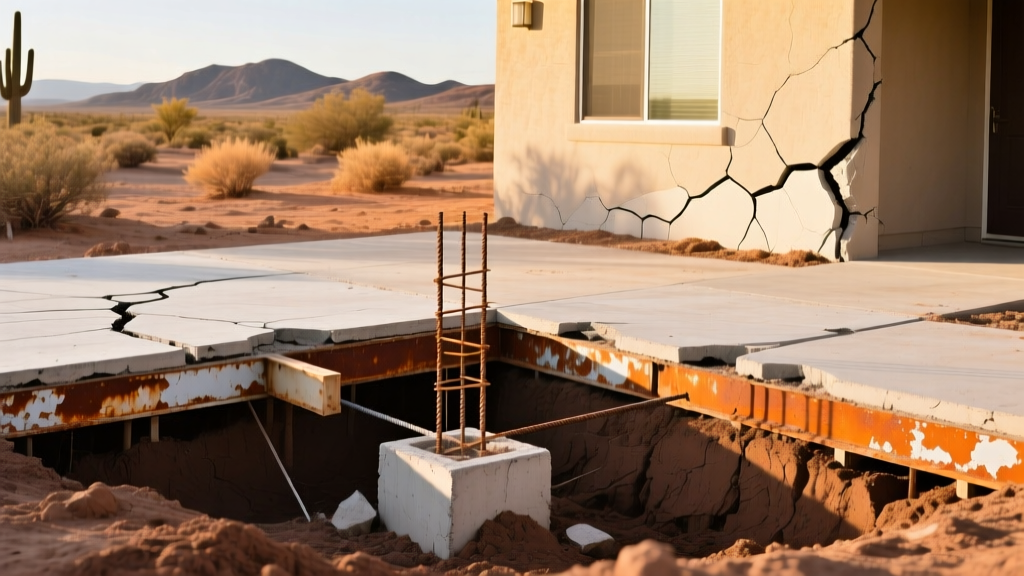
Evaluating foundation building materials in Tucson requires an understanding of the region's hostile subsurface geology. Southern Arizona is dominated by two distinct soil profiles that actively degrade structural concrete and steel. The first is caliche, a dense, cement-like layer of calcium carbonate that acts as an impermeable hardpan. During monsoon season, water cannot percolate downward through caliche, forcing it to pool laterally against foundation stem walls. The second threat is expansive smectite clay, which can swell up to 30% in volume when saturated and shrink drastically during drought cycles. According to the USDA NRCS Web Soil Survey, Pima County features extensive tracts of these highly reactive vertisols, generating uplift pressures exceeding 5,000 pounds per square foot against slab-on-grade materials.
Tucson's precipitation is heavily skewed. A foundation material that survives the dry spring may catastrophically fail when August monsoons introduce rapid moisture spikes. Never diagnose a foundation in May without accounting for the differential swelling that occurs in late summer.
Diagnostic Matrix: Material Symptoms vs. Soil Stressors
When foundation building materials in Tucson fail, the physical symptoms map directly to the underlying soil mechanics. Use this diagnostic matrix to identify the root cause of structural distress.
| Foundation Material | Primary Warning Sign | Root Soil Cause | Severity Level |
|---|---|---|---|
| Post-Tension Slab | Diagonal drywall tears at lintels; slab heaving | Expansive clay uplift exceeding 1.25 inches over 20 feet | High |
| Concrete Stem Wall | Horizontal spalling; white efflorescence streaks | Lateral water pooling against caliche hardpan | Medium |
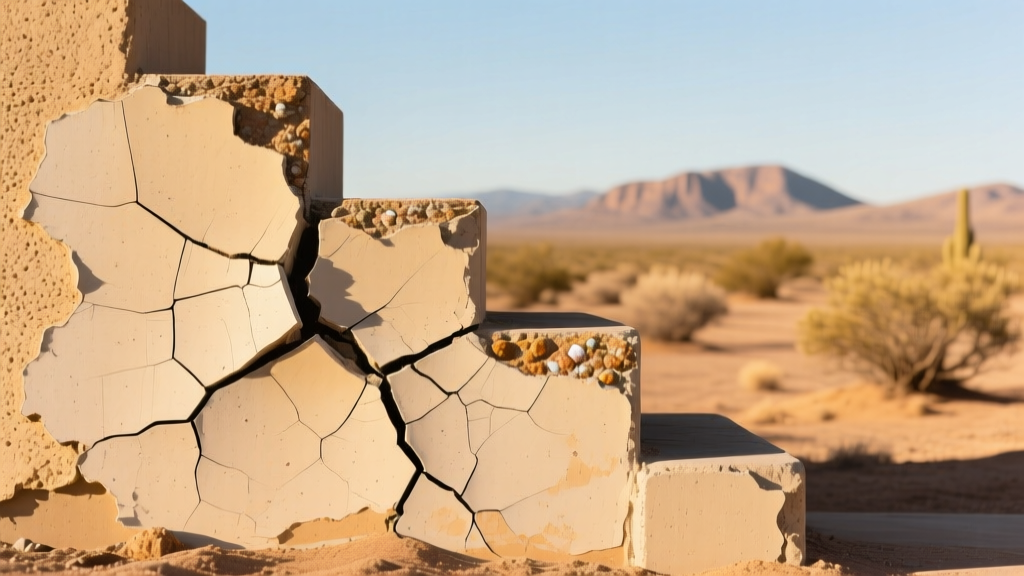
| CMU Block Foundation | Stair-step cracking at mortar joints | Differential settlement in uncompacted fill soils | Critical |
| Type I Portland Cement | Surface flaking; map cracking; soft concrete | Sulfate attack from alkaline desert soils | High |
Post-Tension Slab Failures: Reading the Tendons
Post-tensioned (PT) concrete slabs are the dominant foundation building material in Tucson's modern residential construction. By utilizing high-strength steel tendons encased in grease-filled plastic sheaths, PT slabs resist the tensile stresses caused by expansive clays. However, when these materials are compromised, the structural integrity of the entire home is at risk.
The most critical warning sign of PT slab failure is concrete spalling near the dead-end anchorages. If the concrete cover over the wedge anchors is less than the 1.5-inch minimum required by the Post-Tensioning Institute (PTI), moisture infiltrates the sheath. This causes the steel cable to corrode, expand, and blow out the surrounding concrete.
Step-by-Step PT Cable Inspection Protocol
- Locate the Stamp: Find the PT slab certification stamp, usually located on the garage floor or driveway. This confirms the slab is post-tensioned and warns against unapproved core drilling.
- Inspect Perimeter Edges: Walk the exterior perimeter with a flashlight. Look for rust stains bleeding through the stucco or concrete at 3-foot intervals (the standard tendon spacing).
- Sound the Slab: Use a steel hammer to tap the concrete near exposed anchorages. A hollow, dull thud indicates delamination beneath the surface, even if the surface appears intact.
- Measure Differential Movement: Use a laser level to measure slab elevation at the corners and center. In Tucson's reactive soils, a variance greater than 0.75 inches across a 30-foot span indicates the PT cables have yielded or snapped.
Sulfate Attack on Concrete Stem Walls
Many older neighborhoods in Tucson feature stem walls poured with standard Type I Portland cement. This is a critical material failure waiting to happen. Desert soils in the Sonoran region frequently contain high concentrations of water-soluble sulfates. When sulfates interact with the tricalcium aluminate (C3A) in standard cement, they form a crystalline compound called ettringite. Ettringite occupies more volume than the original cement compounds, creating immense internal expansive pressure that literally tears the concrete apart from the inside out.
According to ACI 318 building code standards, soil sulfate concentrations between 0.10% and 0.20% by weight require Type II (moderate sulfate resistant) cement. Concentrations exceeding 0.20% mandate the use of Type V (high sulfate resistant) cement. The University of Arizona Cooperative Extension notes that many Pima County soil profiles easily exceed the 0.20% threshold, making Type I cement a guaranteed failure point over a 15-to-20-year timeline.
Visual Diagnosis of Sulfate Attack: Unlike structural cracking, which follows straight lines or structural joints, sulfate attack presents as 'map cracking' (a network of fine, random fissures) accompanied by a white, powdery efflorescence. The concrete will feel soft and friable when scraped with a masonry nail.
2026 Intervention Costs and Material Replacements
Once foundation building materials in Tucson have been diagnosed as failing, remediation requires specialized materials engineered for high-alkaline, expansive environments. Standard DIY concrete patches will fail within months. Below are the current 2026 market rates and material specifications for professional interventions.
- High-Density Polyurethane Foam Jacking: For localized slab settlement caused by soil washout beneath caliche layers, structural polyurethane resin (e.g., two-part closed-cell foam with a compressive strength of 60+ psi) is injected through 5/8-inch ports. Cost: $180 to $250 per square foot of affected slab.
- Helical Pier Underpinning: When expansive clay heaving or deep settlement compromises continuous footings, galvanized steel helical piers must be driven past the active soil zone (typically 15 to 25 feet deep in Tucson) into load-bearing bedrock. Cost: $2,200 to $2,800 per pier installed.
- Epoxy vs. Polyurethane Crack Injection: For structural stem wall cracks, use a high-modulus, two-part epoxy (minimum 3,000 psi tensile strength) to weld the concrete back together. For non-structural, actively leaking cracks caused by lateral monsoon water pressure, use a hydrophobic polyurethane grout that expands upon contact with water to seal the void. Cost: $300 to $550 per linear foot.
Frequently Asked Diagnostic Questions
Can I use standard 6-mil polyethylene vapor barriers under Tucson slabs?
No. Standard 6-mil poly is easily punctured by sharp caliche fragments during the pouring process, rendering it useless against soil moisture migration. For Tucson foundations, specify a minimum 15-mil puncture-resistant, cross-laminated vapor barrier (such as Stego Wrap) with taped seams to prevent moisture vapor emission rates (MVER) from exceeding the 3.0 lbs/1000 sq ft/24hr limit required for modern floor coverings.
Why are my interior drywall cracks worse in August than in January?
This seasonal cyclical cracking is the hallmark of expansive smectite clay reacting to monsoon moisture. The soil swells, pushing the foundation upward. If the cracks close or narrow during the dry winter months, you are dealing with seasonal soil swell, not permanent structural failure. However, if the cracks remain wide open year-round and continue to widen, the foundation materials have permanently yielded.
Written by
David NakamuraDavid Nakamura is a licensed architect (AIA) and construction technology writer focused on sustainable building methods, mass timber engineering, and high-performance building envelopes. He holds a Master of Architecture from the University of Washington and is a certified Passive House Consultant (CPHC). David spent eight years at the Seattle firm Mithun, where he led the design of three LEED Platinum projects, before founding his own practice specializing in net-zero residential design. He serves on the editorial advisory board of GreenBuilder Magazine and has authored peer-reviewed papers on cross-laminated timber (CLT) connections for the Journal of Structural Engineering. In his spare time, David teaches woodworking at Pratt Fine Arts Center and kayaks the Puget Sound.
More from David Nakamura
View all
Construction Cost
Labor Cost to Build a Deck Per Sq Ft: 2026 Installation Guide
Discover the exact labor cost to build a deck per sq ft in 2026. This installation guide breaks down contractor rates, complexity factors, and hidden fees.
Aug 4, 2026

Construction Cost
How Much Does It Cost to Build a 3 Bedroom House? Financing Guide
Learn exactly how much it costs to build a 3 bedroom house and explore 2026 financing options, construction loan types, and budget frameworks for your build.
Aug 4, 2026

Construction Cost
Cost to Build a Tennis Court: 2026 Guide
How much does it cost to build a tennis court in 2026? Breakdowns for asphalt, concrete, and synthetic surfaces plus fencing and lighting.
Jul 30, 2026