Mudjacking vs Polyurethane: Comparing Foam Foundation Repair Cost
Compare polyurethane foam injection to mudjacking and piering. We break down the foam foundation repair cost, lifespan, and best use cases for 2026.
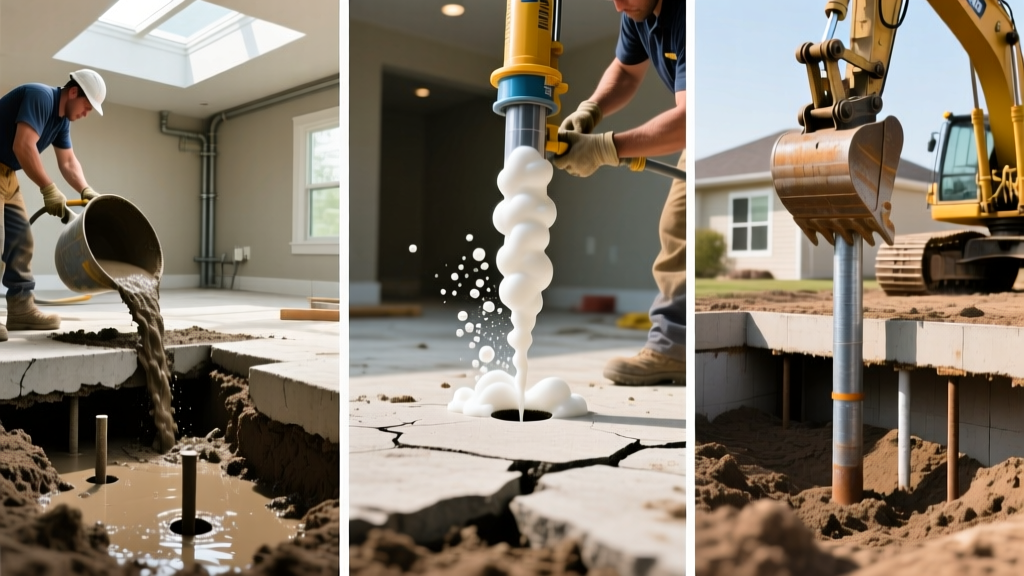
The Core Contenders: Polyurethane Injection vs. Cementitious Mudjacking
When a concrete slab or shallow footing settles, the structural remedy hinges on the soil mechanics beneath it. For decades, cementitious mudjacking (slab jacking) was the default solution. Today, two-part closed-cell polyurethane foam injection dominates the residential and light-commercial market. Understanding the true foam foundation repair cost requires looking past the initial quote and evaluating material density, equipment requirements, and long-term soil interaction.
Polyurethane foam jacking utilizes a two-component resin system (typically a polyol and an isocyanate) mixed at the injection wand under high pressure (1,500 to 2,000 PSI). As the liquid enters the subgrade void, it expands 20 to 30 times its original volume, curing into a rigid, water-resistant structural foam in under 15 seconds. Mudjacking, conversely, pumps a slurry of topsoil, sand, and Portland cement through much larger 1.5-inch holes, relying on sheer mass and hydraulic pressure to lift the slab.
Head-to-Head Comparison Matrix
| Feature | Polyurethane Foam Injection | Cementitious Mudjacking | Helical Piers (Deep Stabilization) |
|---|---|---|---|
| Material Density | 2.5 to 4.0 lbs/cu ft | 100 to 120 lbs/cu ft | Steel (varies by shaft thickness) |
| Injection Hole Size | 5/8 inch | 1.5 to 2 inches | Excavation required at footing |
| Cure / Use Time | 15 to 30 minutes | 24 to 48 hours | Immediate upon torque achievement |
| Water Resistance | Impervious (closed-cell) | Erodes over time | Impervious (galvanized steel) |
| Typical Lifespan | 20+ years | 5 to 10 years | 75+ years |
Deconstructing the Foam Foundation Repair Cost
As of 2026, raw polyol and isocyanate resin supply chains have stabilized, but the specialized proportioning equipment required (such as Graco Reactor E-30 or Gusmer GH-2 rigs) keeps the barrier to entry high for contractors. This equipment overhead is directly reflected in the foam foundation repair cost.
Base Pricing Tiers
- Per Square Foot (Slab Lifting): Polyurethane injection typically ranges from $12 to $25 per square foot. Mudjacking is cheaper upfront, averaging $4 to $9 per square foot.
- Project Minimums: Most reputable foam contractors enforce a mobilization minimum of $1,500 to $2,200 to cover resin purging, equipment setup, and transit. Mudjacking minimums are generally lower ($800 to $1,200).
- Void Filling (Deep Erosion): If the goal is not lifting, but rather filling a massive subterranean void (e.g., washed-out culverts or sinkholes), contractors charge by the board foot or cubic yard of expanded foam, typically $8 to $15 per board foot.
The 'Hidden' Variables That Inflate Your Quote
The square-footage metric is often misleading. The actual cost is driven by the volume of the void beneath the slab, not just the surface area. A driveway that has settled 4 inches requires roughly twice the resin volume of a driveway that has settled 2 inches. Furthermore, high-density structural foams (like NCFI TerraThane or Alchemy-Spetec AP Lift 4.3, which boast compressive strengths of 60 to 80 PSI) cost 20% to 30% more per gallon than standard 2.5 lb/ft³ lifting foams.
Hardware stores sell two-part spray foam kits (e.g., Touch 'n Foam) for window insulation and air sealing. These are not structural. They lack the compressive strength to lift concrete and will degrade under hydrostatic pressure. True structural slab lifting requires precise 1:1 chemical mixing at high temperatures and pressures. Attempting DIY foundation lifting with low-pressure kits will result in localized heaving, slab cracking, and wasted capital.
When Foam Fails: Deep Foundation Alternatives
Polyurethane foam is a shallow stabilization method. It compacts the immediate subgrade (the top 2 to 6 feet of soil) and lifts the slab. It is highly effective for slab-on-grade foundations, sidewalks, and warehouse floors suffering from surface erosion or poor initial compaction.
However, if the structural failure originates deeper in the soil column—such as expansive clay desiccation 15 feet below grade, or a shifting load-bearing footing—foam injection will fail. The foam will lift the slab, but the footing will remain behind, causing the slab to snap at the grade beam intersection. In these scenarios, the foam foundation repair cost becomes a sunk cost, and deep foundation systems are mandatory.
Push Piers and Helical Piers: The Heavy-Duty Contenders
When deep stabilization is required, contractors bypass the shallow soils entirely, driving steel piers down to load-bearing bedrock or stable strata.
- Push Piers (e.g., ECP or Chance systems): Hydraulically driven using the weight of the structure. Cost: $1,800 to $2,800 per pier.
- Helical Piers: Screwed into the ground using hydraulic torque motors, ideal for lighter structures or new construction. Cost: $1,500 to $2,500 per pier.
While a 10-pier job might cost $20,000 compared to a $4,000 foam job, the piers address the root structural failure, whereas foam only addresses the symptom (the slab).
The Decision Framework: Which Method Fits Your Failure Mode?
Use this diagnostic matrix to determine the correct repair methodology before soliciting quotes:
- IF the concrete is a non-structural slab (driveway, patio, garage floor) AND the settling is less than 6 inches AND the slab is intact: Choose Polyurethane Foam Injection.
- IF the slab is heavily fractured into multiple small pieces AND budget is the primary constraint: Choose Mudjacking (though replacement may be more cost-effective long-term).
- IF the structural footing itself is dropping AND interior drywall shows stair-step cracking AND doors are binding on their frames: Choose Helical or Push Piers.
- IF there is a known subterranean void (washed-out utility trench, abandoned septic tank) beneath a sinking slab: Choose Deep-Void Polyurethane Grouting.

Moisture Management: The Unspoken Prerequisite
No foundation repair method—foam, mud, or steel—will survive if the site's water management is ignored. The Building Science Corporation's research on groundwater management emphasizes that bulk water control is the primary defense against soil erosion and expansive clay swelling. If a downspout is discharging directly next to a settled driveway, the water will simply wash away the newly compacted subgrade surrounding the foam.
Furthermore, the American Concrete Institute's ACI 546R guidelines for concrete repair dictate that the underlying cause of deterioration must be mitigated before structural intervention. Polyurethane foam is hydrophobic and will not absorb water, but the soil holding it in place will. Before signing a contract for foam injection, invest $500 to $1,500 in extending downspouts, regrading the perimeter to a 5% slope, and installing French drains if necessary. For comprehensive site drainage standards, refer to FEMA's Building Science publications on residential retrofitting.
Expert Verdict: Calculating the True ROI
When evaluating the foam foundation repair cost, the premium over mudjacking (often 2x to 3x higher per square foot) is justified by the material's inert nature and minimal site disruption. Mudjacking slurry adds thousands of pounds of dead load to already failing soils and requires patching massive drill holes. Polyurethane adds negligible weight, cures in minutes, and leaves 5/8-inch holes that are virtually invisible once sealed. For residential slabs, warehouse floors, and municipal sidewalks, high-density polyurethane injection remains the most durable and cost-effective shallow stabilization method available in 2026.
Written by
Sarah WhitfieldSarah Whitfield is a chartered quantity surveyor (MRICS) and construction cost analyst with 15 years of experience in material pricing, procurement strategy, and project budgeting. She earned her degree in Construction Management from the University of Reading (UK) and has worked on projects ranging from $2M custom homes to $180M mixed-use developments across North America and Europe. Sarah currently leads cost estimating for BuildMat Insight, maintaining a proprietary database of 4,000+ material price points updated quarterly. She is a frequent contributor to RSMeans cost data panels and has presented at the International Cost Engineering Council (ICEC) congress. Based in Denver, CO, Sarah is an avid trail runner and volunteer mentor for Women in Construction.
More from Sarah Whitfield
View all
Wood & Lumber
What Are the Different Types of Wood? A Builder's Guide
Compare structural softwoods, finish hardwoods, and engineered lumber. Analyze Janka ratings, MOE values, and 2026 pricing for construction.
Aug 4, 2026

Walls & Panels
Steel Framing vs Wood Framing: Corrosion and Moisture Defense
Compare steel framing vs wood framing for moisture resistance. Learn about galvanized coatings, condensation risks, and corrosion protection strategies.
Jul 21, 2026

Stone & Masonry
How to Cut Stone Veneer: Wet Saw vs Grinder Comparison
Compare the best tools for cutting stone veneer. We review wet saws, angle grinders, and chop saws to help you achieve clean, chip-free cuts.
Jul 21, 2026