Warning Signs & Foundation Repair Cost San Antonio Breakdown
Diagnose structural damage early. Explore our foundation repair cost San Antonio guide, covering soil factors, warning signs, and pier pricing.

The San Antonio Soil Factor: Why Foundations Fail
San Antonio's geological profile is notoriously hostile to concrete slab foundations. The region is dominated by highly expansive soils, specifically the Eagle Ford Shale and Taylor Marl formations, alongside pockets of Beaumont clay. These soils possess a high plasticity index (PI), meaning they undergo drastic volumetric changes in response to moisture fluctuations. When the soil absorbs water, it swells (heave); when it dries out during the intense South Texas summers, it shrinks (settlement).
Understanding this soil behavior is the prerequisite to accurately diagnosing damage and estimating the foundation repair cost San Antonio homeowners face. You cannot price a repair without first identifying whether the structure is experiencing edge settlement, center heave, or a combination of both.
Diagnostic Triage: 5 Critical Warning Signs
Before calling a contractor for an estimate, perform a systematic diagnostic walkthrough. Foundation repair companies often sell piers; your goal is to identify if piers are actually necessary or if surface-level maintenance will suffice. Look for these specific thresholds:
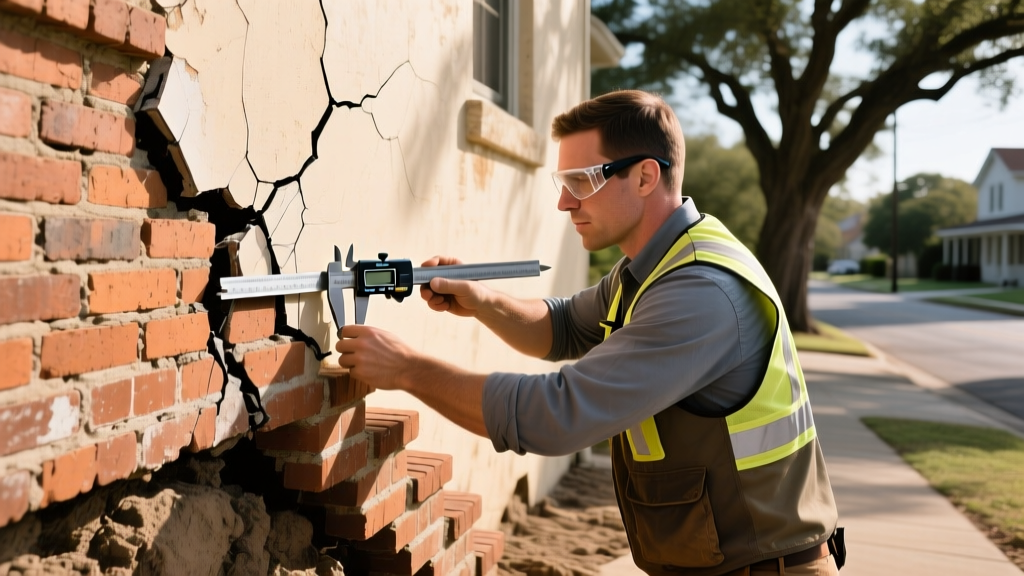
- Exterior Brick Stair-Step Cracks: Hairline cracks (under 1/16 inch) are normal thermal expansion. Cracks exceeding 1/4 inch in width, particularly those that are wider at the top than the bottom, indicate active differential settlement pulling the masonry apart.
- Interior Drywall Shearing: Look at the top corners of door frames and window lintels. Diagonal tears extending 6 to 12 inches outward from the corner at a 45-degree angle signify that the structural frame is racking out of square.
- Door Binding Diagnostics: A door that sticks at the top hinge side usually indicates the floor is settling away from the frame. A door that sticks at the top strike plate (latch side) often indicates center heave pushing the middle of the house upward.
- Slab Elevation Variance: Using a laser level or a water level (zip level), measure the floor elevation. A deflection ratio exceeding L/240 (e.g., more than 1 inch of drop over a 20-foot span) is the industry threshold where structural intervention is recommended over cosmetic patching.
- Frieze Board Separation: Check the exterior where the brick veneer meets the wood soffit/frieze board. A horizontal gap opening up here means the brick is settling downward while the wood frame remains stationary, or the frame is lifting.
Foundation Repair Cost San Antonio: 2026 Pricing Matrix
Once structural distress is confirmed, the repair method dictates the budget. San Antonio's market utilizes several underpinning and slab-lifting techniques. The foundation repair cost San Antonio residents encounter varies wildly based on soil depth to bedrock and the weight of the structure. Below is the current pricing matrix for residential applications.
| Repair Method | Best Application | Cost Per Unit (2026) | Average Total Job Cost |
|---|---|---|---|
| Bell-Bottom Concrete Piers | Standard slab-on-grade; stable bearing strata within 12-15 ft. | $600 - $850 per pier | $5,500 - $9,000 |
| Steel Push Piers | Heavy structures; requires driving 25-40 ft to bedrock or load-bearing strata. | $1,800 - $2,500 per pier | $12,000 - $22,000 |
| Helical Piers | Lightweight structures, new construction, or areas with high water tables. | $2,200 - $3,000 per pier | $14,000 - $25,000 |
| Polyurethane Foam Jacking | Filling voids under slabs, lifting sunken patios, or addressing minor slab dips. | $15 - $25 per sq. ft. | $2,500 - $6,000 |
Note: Total job costs assume an average of 10-15 piers for a standard 2,500 sq. ft. single-story home requiring perimeter stabilization. Interior pier installations require tunneling or breaking the slab, adding $1,500 to $3,000 in concrete demolition and restoration costs.
Action Matrix: When to Patch vs. When to Pier
Not every crack requires a $15,000 underpinning contract. Use this decision framework to determine your next step:
Scenario A: Cosmetic / Moisture Management
Symptoms: Cracks under 1/8 inch, seasonal door sticking, minor drywall tape peeling.
Action: Do not install piers. Implement a soaker hose foundation watering program to maintain consistent perimeter soil moisture. Install French drains to divert roof runoff away from the slab edge. Budget: $500 - $2,000.
Scenario B: Active Structural Failure
Symptoms: Cracks > 1/4 inch, L/240 floor deflection, binding doors, frieze board separation.
Action: Hire an independent Licensed Professional Engineer (PE) to conduct a manhole-to-manhole elevation survey and soil analysis. Proceed with steel push or bell-bottom piers based on the PE's depth-to-bedrock report. Budget: $8,000 - $20,000+.
Navigating San Antonio Permits and Engineering Reports
A critical, often overlooked component of the foundation repair cost San Antonio homeowners must budget for is the permitting and engineering phase. According to the City of San Antonio Development Services Department (DSD), structural foundation repairs that involve underpinning, piers, or altering the structural footprint require a building permit.
Furthermore, the City requires that foundation repair plans be stamped by a Professional Engineer (PE) licensed in the State of Texas. Beware of contractors who offer to 'skip the permit' to save time or money. Unpermitted structural work will flag during a future real estate transaction, potentially derailing a home sale or requiring expensive retroactive engineering certifications.
Budgeting for the Pre-Repair Phase
- Independent PE Structural Report: $750 - $1,200 (Never rely solely on the contractor's in-house 'free inspection' for structural validation).
- City of San Antonio Permit Fees: $250 - $600 (based on valuation of the repair).
- Plumbing Leak Test: $350 - $500. (Required by most reputable engineers before lifting a slab to ensure the sewer line isn't compromised, which could cause the soil to wash out immediately after repair).
By front-loading the diagnostic process with independent engineering and precise elevation measurements, you transition from a reactive homeowner to an informed project manager. This ensures the foundation repair cost you pay directly correlates to the specific soil mechanics and structural demands of your San Antonio property.
Written by
Marcus ChenMarcus Chen is a licensed structural engineer (PE) and building materials analyst with over 12 years of experience across residential, commercial, and industrial construction. He holds a Master of Science in Civil Engineering from UC Berkeley and spent six years at Thornton Tomasetti before transitioning to independent consulting and technical writing. Marcus specializes in material selection for seismic-prone regions, concrete reinforcement strategies, and lifecycle cost analysis. His work has been cited by the American Concrete Institute (ACI) and the Structural Engineers Association of California (SEAOC). When he is not on a job site or at his desk, you will find him hiking the Sierra Nevada or restoring a 1920s craftsman bungalow in Oakland, CA.
More from Marcus Chen
View all
Construction Cost
How Much Did the Eiffel Tower Cost to Build?
How much did the Eiffel Tower cost to build in 1889? We adjust for inflation and compare its budget to modern skyscraper construction.
Aug 4, 2026

Fire Resistance
What Is a Fire Resistant Material? Testing & Certification Guide
Discover what is a fire resistant material through ASTM and UL testing. Learn how fire ratings, certifications, and assemblies work in construction.
Aug 4, 2026

Construction Cost
How Much Did the Burj Khalifa Cost to Build?
How much did the Burj Khalifa cost to build? We break down the $1.5B project and extract 5 money-saving strategies for your next build.
Jul 30, 2026