Foundation Settlement Repair Cost Calculator & Estimation Guide
Calculate your foundation settlement repair costs with our estimator framework. Compare push pier, helical pier, and slabjacking pricing.
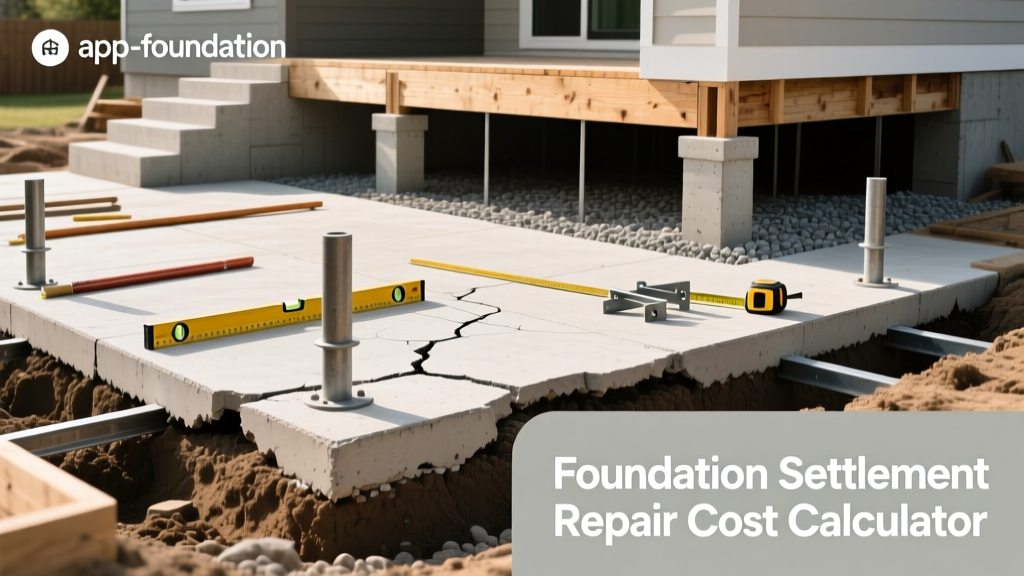
The True Cost of Foundation Settlement Repair: Beyond the Surface
Foundation settlement is not merely a cosmetic nuisance; it is a structural load-path failure. When the soil beneath a footing compresses, washes out, or shrinks due to moisture fluctuation, the foundation drops. Repairing this requires transferring the dead and live loads of the structure past the unstable soil into load-bearing strata or bedrock. Because every home has unique soil profiles and load requirements, flat-rate pricing is a myth. However, by understanding the unit economics of underpinning, you can accurately estimate your project scope before a contractor ever steps foot on your property.
Quick Cost Snapshot
- National Average Project Cost: $8,500 – $15,000
- Push Pier Installation: $1,500 – $2,500 per pier
- Helical Pier Installation: $1,800 – $3,200 per pier
- Structural Engineering Report: $800 – $1,500
The Foundation Settlement Repair Cost Calculator Framework
To build a realistic budget, you must calculate the linear footage of the affected perimeter and determine the required pier spacing. Contractors do not guess where piers go; they follow engineering standards based on the weight of the structure and the load capacity of the soil.
Step 1: Calculate Linear Footage of the Affected Perimeter
Measure the exterior walls that are exhibiting signs of settlement (e.g., stair-step cracking in brick veneer, drywall tears at door frames). If the entire 40-foot rear elevation of your home is dropping, your affected linear footage is 40 feet. Do not include walls that are plumb and level, as underpinning is only applied to the failing sections.
Step 2: Determine Pier Type and Spacing
Standard engineering guidelines, such as those referenced by the Foundation Performance Association, typically dictate pier spacing between 6 and 8 feet for residential wood-frame structures with brick veneer. Heavier loads (like multi-story masonry) may require 5-foot spacing. Divide your linear footage by the spacing requirement to find your total pier count.
Example Calculation:
40 linear feet ÷ 7-foot spacing = 5.71. Always round up to ensure continuous support. You will need 6 piers for this section.
2026 Material & Method Cost Matrix
The method your engineer specifies will dictate the bulk of your material and labor costs. Below is a breakdown of the primary underpinning technologies used in modern foundation settlement repair.
| Repair Method | Best Application | Industry Standard Brands | Cost Per Unit (2026) | Depth Limitations |
|---|---|---|---|---|
| Steel Push Piers | Heavy structures, deep bedrock, high load transfer | ECP Model 350, A.B. Chance Type SS | $1,500 – $2,500 / pier | Up to 100+ ft (requires bedrock refusal) |
| Helical Piers | Lighter loads, deep unstable soil, no bedrock nearby | A.B. Chance Helical Pulldown, MacLean-Dixie | $1,800 – $3,200 / pier | Typically 20 – 50 ft (torque-dependent) |
| Polyurethane Slabjacking | Slab-on-grade interior floors, non-structural settling | Alchemy-Spetec Deep Lift, NCFI | $10 – $20 / sq. ft. | Shallow (fills voids up to 12 inches deep) |
Hidden Variables That Spike Your Final Quote
A contractor's initial estimate is often based on "standard conditions." When site conditions deviate, change orders are issued. Understanding these variables protects you from budget shock.
The "Depth to Refusal" Multiplier
Push piers are driven hydraulically using the weight of the house until they hit "refusal"—meaning they strike bedrock or a soil stratum dense enough to resist 40,000+ PSI of driving force. Standard quotes assume bedrock is 20 to 30 feet down. If your soil profile requires driving piers to 60 feet, you will need double the steel pier sections. Each additional 3-foot steel section adds $150 to $250 to the cost of that specific pier.
Interior vs. Exterior Access
If the settlement is occurring under an interior load-bearing wall or a finished basement, contractors must break through the concrete slab or excavate inside the home. Interior slab removal, shoring, and concrete restoration typically add $2,500 to $5,000 to the project total compared to exterior-only excavation.
"Never allow a contractor to bypass a geotechnical soil report. According to Texas A&M AgriLife Extension, highly plastic clays can exert thousands of pounds of uplift pressure. Without knowing your soil's plasticity index (PI), an underpinning system may be severely under-designed."
How to Audit a Contractor's Line-Item Quote
When evaluating bids for foundation settlement repair, do not just look at the bottom line. A professional quote should be transparent and itemized. Use this checklist to audit your proposals:
- Engineering Stamp: Does the quote include the cost of a licensed Professional Engineer (PE) to design and stamp the repair plan? If not, budget an extra $1,000.
- Hydraulic Manifold System: Are they using a synchronized hydraulic manifold to lift the house evenly, or individual hand-pumps? Synchronized lifting prevents secondary drywall cracking during the lift.
- Load Testing: Does the contract specify a proof-load test on the first pier installed? (Standard practice is to load the first pier to 1.5 times the design working load to verify soil capacity).
- Landscaping Restoration: Excavation for piers requires removing shrubs, concrete walkways, or HVAC lines. Clarify if backfilling and basic landscaping restoration are included, or if you will be left with a trench of loose dirt.
- Warranty Terms: Look for a fully transferable lifetime warranty backed by a third-party insurer, not just a "company warranty" that vanishes if the contractor goes out of business.
Frequently Asked Questions on Settlement Pricing
Can I just use concrete mudjacking instead of steel piers?
Concrete mudjacking (slabjacking) is only viable for non-structural, slab-on-grade applications like driveway aprons or garage floors. It cannot stabilize a continuous perimeter footing supporting a two-story house. For structural settlement, deep foundation underpinning (piers) is the only code-compliant solution.
Does homeowner's insurance cover foundation settlement repair?
Standard HO-3 policies explicitly exclude earth movement, soil shrinkage, and gradual settlement. Insurance will only cover foundation damage if it is the direct, sudden result of a covered peril, such as a burst plumbing line washing out the subgrade. For gradual settlement, expect to pay out-of-pocket or utilize specialized foundation repair financing.
How long does a 10-pier installation take?
A standard 10-pier exterior installation typically takes 3 to 5 days. Day 1 is for excavation and bracket attachment. Days 2-3 involve driving the piers to refusal and performing the hydraulic lift. Days 4-5 are dedicated to backfilling, tamping the soil, and site cleanup. Interior installations or projects requiring extensive masonry shimming will extend this timeline.