Selecting Foundation Building Materials: 3rd Street Riverside CA
Expert selection framework for foundation building materials in 3rd Street Riverside CA. Navigate expansive soils, seismic codes, and local supply.

Geotechnical Profile: The 3rd Street Corridor
When specifying foundation building materials, 3rd Street Riverside CA properties present unique geotechnical challenges that demand a highly localized selection framework. The -5 feet below grade, or deploy drilled cast-in-drilled-hole (CIDH) concrete piers extending 20+ feet into stable bedrock.
Concrete Mix Designs for Inland Empire Alkalinity
Alluvial soils near the Santa Ana River basin frequently exhibit high sulfate concentrations and alkaline pH levels. Standard Type I/II Portland cement will degrade within a decade when exposed to these subsurface conditions, leading to concrete spalling and rebar corrosion.
Type V Cement vs. Slag Blends
To combat sulfate attack, structural engineers must specify high-sulfate-resistant concrete mixes. The two primary options available from local Inland Empire batch plants are:
- ASTM C150 Type V Portland Cement: Formulated with low tricalcium aluminate (C3A) content, typically under 5%. This is the baseline requirement for severe sulfate exposure zones mapped along the river corridor.
- Portland-Limestone Cement (Type IL) with Slag: Blending Type IL with 30-40% ground granulated blast-furnace slag (GGBFS) significantly reduces permeability and improves long-term chemical resistance. This mix also lowers the embodied carbon of the foundation, aligning with California's 2026 green building mandates.
Maintain a strict maximum water-to-cement (w/c) ratio of 0.40. Higher w/c ratios increase the capillary pore network, allowing sulfate-laden groundwater to penetrate the slab and attack the steel reinforcement.
Vapor Barriers and Hydrostatic Mitigation
The proximity to the Santa Ana River means the water table can fluctuate dramatically during atmospheric river events. A standard 6-mil polyethylene vapor retarder is entirely insufficient for commercial or high-end residential builds in this corridor.
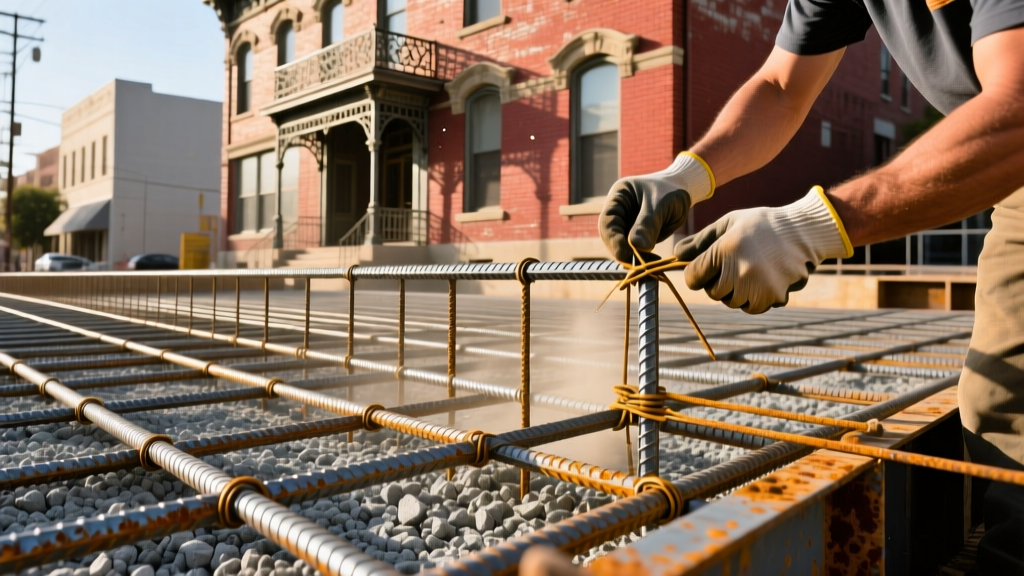
Specify a minimum 15-mil cross-laminated polyolefin vapor barrier (such as Stego Wrap or Fortifiber Moistop) with a permeance rating of less than 0.01 perms. All seams must be overlapped by 6 inches and sealed with manufacturer-approved acoustic mastic. Furthermore, install a 4-inch capillary break of 3/4-inch clean crushed aggregate directly beneath the vapor barrier to sever the capillary draw of groundwater into the slab.
Deep Foundation Alternatives for River-Adjacent Lots
For multi-story structures or heavy masonry builds on 3rd Street, shallow slabs may not satisfy the bearing capacity requirements outlined by the City of Riverside Building & Safety Division. In these scenarios, deep foundation materials must be selected based on load transfer mechanisms.
- Drilled Cast-in-Drilled-Hole (CIDH) Piers: Utilize 18 to 24-inch diameter auger-cast piers reinforced with Grade 60 epoxy-coated rebar cages. These bypass the expansive clay and socket directly into the underlying sedimentary bedrock.
- Helical Piers: For retrofitting historic foundations or supporting lighter commercial additions, galvanized steel helical piers (minimum 2.875-inch OD shaft) can be torqued to refusal. They offer immediate load-bearing capacity without the cure time or spoil removal required for CIDH piers.
Sourcing & Logistics in Downtown Riverside
Procuring the right materials is only half the battle; delivering them to the 3rd Street corridor requires strict logistical planning. Downtown Riverside enforces strict commercial vehicle routing and noise ordinances.
Concrete batch plants located in Jurupa Valley or Fontana are typically the most reliable sources for high-specification Type V and slag-blend mixes. However, transit times during peak I-215 and CA-91 congestion can push concrete past its 90-minute discharge limit. To mitigate this, specify hydration-stabilizing admixtures (HSA) at the batch plant to extend workability by 45-60 minutes without compromising the ultimate compressive strength. Ensure all ready-mix trucks are equipped with truck-mounted concrete line pumps, as standard boom pumps often lack the clearance or permitting to operate on narrow downtown lots adjacent to 3rd Street.
"Foundation integrity in Riverside's downtown corridor is not determined by the volume of concrete poured, but by the chemical compatibility of the mix design with the local alluvial soils and the precision of the moisture mitigation layers."
Summary Decision Checklist for 2026 Projects
Before finalizing your foundation material submittals for any 3rd Street project, verify the following parameters with your geotechnical and structural engineers:
- Has the soil Plasticity Index (PI) been tested, and does the slab stiffness (post-tensioning or rebar grid density) match the calculated swell potential?
- Is the concrete mix design utilizing Type V cement or adequate slag replacement to neutralize subsurface sulfates?
- Are all below-grade steel reinforcements epoxy-coated or galvanized to prevent chloride and alkalinitygation.
Written by
Sarah WhitfieldSarah Whitfield is a chartered quantity surveyor (MRICS) and construction cost analyst with 15 years of experience in material pricing, procurement strategy, and project budgeting. She earned her degree in Construction Management from the University of Reading (UK) and has worked on projects ranging from $2M custom homes to $180M mixed-use developments across North America and Europe. Sarah currently leads cost estimating for BuildMat Insight, maintaining a proprietary database of 4,000+ material price points updated quarterly. She is a frequent contributor to RSMeans cost data panels and has presented at the International Cost Engineering Council (ICEC) congress. Based in Denver, CO, Sarah is an avid trail runner and volunteer mentor for Women in Construction.
More from Sarah Whitfield
View all
Wood & Lumber
What Are the Different Types of Wood? A Builder's Guide
Compare structural softwoods, finish hardwoods, and engineered lumber. Analyze Janka ratings, MOE values, and 2026 pricing for construction.
Aug 4, 2026

Walls & Panels
Steel Framing vs Wood Framing: Corrosion and Moisture Defense
Compare steel framing vs wood framing for moisture resistance. Learn about galvanized coatings, condensation risks, and corrosion protection strategies.
Jul 21, 2026

Stone & Masonry
How to Cut Stone Veneer: Wet Saw vs Grinder Comparison
Compare the best tools for cutting stone veneer. We review wet saws, angle grinders, and chop saws to help you achieve clean, chip-free cuts.
Jul 21, 2026