Slab Foundation Repair Costs: A 2026 Selection Framework
Navigate slab foundation repair costs with our 2026 selection framework. Compare piering, foam jacking, and mudjacking prices based on settlement severity.

Evaluating slab foundation repair costs requires more than gathering three contractor quotes and picking the middle number. Slab-on-grade failures are driven by complex geotechnical variables—specifically differential settlement, soil shear strength, and hydrostatic pressure. A repair method that works for minor slab curling will catastrophically fail if applied to deep-seated active zone soil consolidation. To make an informed capital decision, homeowners and facility managers must align their repair strategy with the specific failure mode of the structure.
This selection framework categorizes slab foundation repair costs into four distinct tiers based on structural severity, providing exact 2026 pricing benchmarks, material specifications, and engineering thresholds to guide your investment.
The Cost-to-Severity Selection Matrix
The following matrix maps the physical symptoms of foundation failure to the appropriate engineering intervention and current market costs. Use this as a baseline to verify contractor proposals.
| Severity Tier | Differential Settlement | Primary Intervention | 2026 Unit Cost | Typical Total Project |
|---|---|---|---|---|
| Tier 1: Cosmetic | < 0.5 inches | Epoxy / Polyurethane Crack Injection | $15 - $25 per linear ft | $800 - $2,500 |
| Tier 2: Minor Structural | 0.5 - 2.0 inches | Polyurethane Foam Jacking / Mudjacking | $6 - $14 per sq ft | $3,500 - $9,000 |
| Tier 3: Moderate Structural | 2.0 - 4.0 inches | Steel Push Piers (Friction/End Bearing) | $1,800 - $2,600 per pier | $14,000 - $28,000 |
| Tier 4: Severe / Active Shear | > 4.0 inches | Helical Piers / Deep Bedrock Anchoring | $2,200 - $3,200 per pier | $25,000 - $50,000+ |
Tier 1 and 2: Void Filling and Slab Lifting
When a slab loses contact with the subgrade due to soil erosion, shrinkage, or poorly compacted fill, the resulting voids lead to cracking under live loads. The goal here is not to bypass the soil, but to restore the slab-to-soil interface.
Mudjacking vs. High-Density Polyurethane
Traditional mudjacking (slabjacking) involves pumping a slurry of cement, sand, and fly ash through 1.5-inch drilled holes. While the material cost is low ($3 to $6 per square foot), the slurry weighs roughly 100 to 120 lbs per cubic foot. In weak, expansive clay soils, this added dead load can accelerate secondary settlement.
High-density polyurethane foam jacking (using products like Prime Flex 210 or Alchemy-Spetec Deep Lift) has become the industry standard for Tier 2 repairs. The two-part closed-cell resin expands to 2.5 to 4.0 lbs per cubic foot, curing in under 15 minutes. Injection requires only 5/8-inch holes, minimizing structural weakening of the concrete. Expect to pay $8 to $14 per square foot for polyurethane lifting. While the upfront cost is double that of mudjacking, the elimination of added soil burden and the water-resistant nature of closed-cell foam provide a vastly superior long-term ROI.
Tier 3 and 4: Deep Underpinning via Piering
When differential settlement exceeds 2 inches, or when the American Society of Civil Engineers (ASCE) identifies that the active zone of the soil extends beyond 15 feet, surface lifting is inadequate. The foundation must be mechanically decoupled from the unstable topsoil and transferred to a load-bearing stratum or bedrock.
Steel Push Piers: The Compression Standard
Push pier systems (such as those manufactured by Foundation Supportworks or Earth Contact Products) utilize 2-7/8" or 3-1/2" outside diameter steel tubing. Hydraulic rams drive the steel sections through the unstable soil until they reach 'refusal'—typically defined as a hydraulic pressure exceeding 2,000 PSI or a rate of penetration of less than 1 inch per minute.
Cost Breakdown: The average cost per pier in 2026 is $1,800 to $2,600. This price includes saw-cutting the slab, excavating the footing, driving the pier, and lifting the structure. A standard 2,000 sq ft home experiencing corner settlement may require 8 to 12 piers, placing the total project between $14,400 and $31,200.
Helical Piers: Tension and Light-Load Applications
Helical piers feature steel shafts with welded helical bearing plates. Instead of being driven, they are torqued into the ground like a screw. The installation torque directly correlates to the soil's bearing capacity (e.g., achieving 5,000 ft-lbs of torque verifies a specific load capacity). Helical piers are mandatory when the structure is too light to provide the resistance needed to drive push piers, or when the foundation requires tension resistance against uplift forces. Due to the manufacturing complexity of the helical plates, expect a 15% to 25% cost premium over push piers.
Many foundation repair companies offer 'lifetime warranties' on piering systems. Read the fine print. These warranties are frequently prorated after year 10 and are often voided if the homeowner fails to maintain specific soil moisture levels using soaker hoses, or if they alter the site grading. Always require the contractor to define the exact soil moisture maintenance protocol in writing to keep the warranty valid.
The Soil Mechanics Multiplier
According to the Foundation Performance Association (FPA), the majority of slab failures in the American South and Midwest are driven by expansive clays with a Plasticity Index (PI) greater than 25. These soils swell when wet and shrink during droughts, creating a cyclical heaving and settling effect.
If your geotechnical report identifies high-plasticity clay, your selection framework must include root cause mitigation. Installing deep foundation piers without addressing surface water management is a temporary fix. Budget an additional $3,000 to $8,000 for peripheral French drains, downspout extensions, and high-density polyethylene (HDPE) root barriers to prevent large vegetation from extracting moisture from the soil beneath the slab.
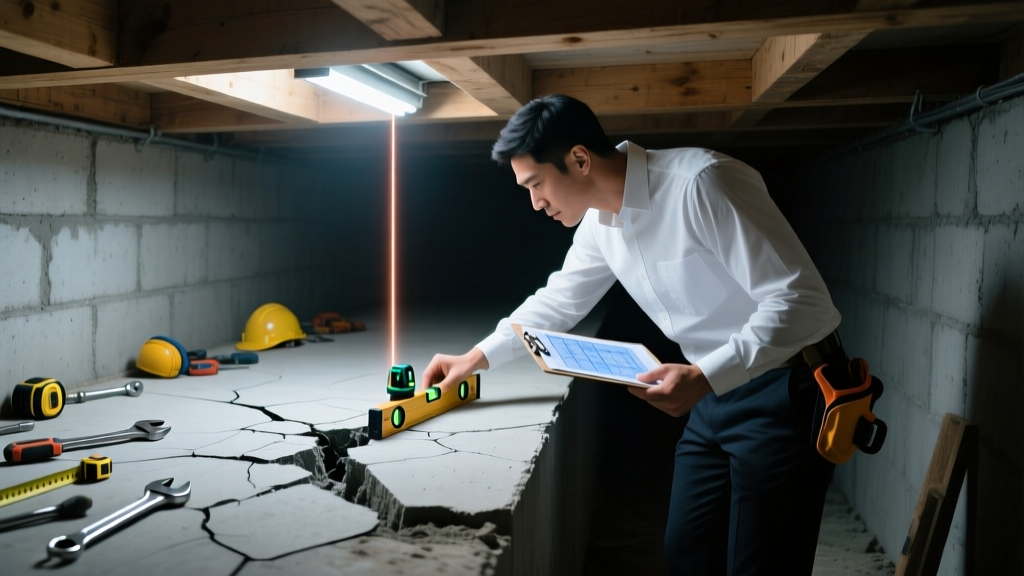
Decision Flowchart: Choosing Your Repair Path
Use this logical sequence to determine the correct engineering intervention before soliciting contractor bids:
- Step 1: Procure an Independent Evaluation. Hire a licensed Professional Engineer (PE) specializing in geotechnical or structural engineering ($500 - $1,200). Do not rely solely on a contractor's free inspection, as their compensation is tied to the sale of their specific repair product.
- Step 2: Measure the Deflection. If the PE's floor elevation survey shows less than 1 inch of differential settlement and no structural shear cracking (stair-step cracks in masonry), proceed to Tier 1 or 2 (Foam Jacking).
- Step 3: Assess the Load Path. If settlement exceeds 2 inches, or if interior load-bearing walls are experiencing drywall tearing and door frame racking, surface lifting is insufficient. Proceed to Tier 3 (Push Piers).
- Step 4: Evaluate the Strata. If the PE's soil borings indicate bedrock is deeper than 60 feet, or if the soil profile consists of loose, collapsible sandy loam rather than cohesive clay, push piers may fail to reach refusal. Pivot to Tier 4 (Helical Piers or Friction Collars).
Hidden Variables That Inflate Final Invoices
When budgeting for slab foundation repair costs, contractors typically quote only the structural stabilization. Homeowners must account for the secondary restoration costs that follow the lift:
- Flooring Destruction: Lifting a slab will almost certainly crack brittle floor coverings. Budget $4 to $9 per square foot to remove and replace ceramic tile or hardwood in the affected zones.
- Plumbing Realignment: Rigid cast-iron or older PVC drain lines embedded in the slab can snap when the foundation is hydraulically lifted. A post-lift hydrostatic pressure test ($350 - $500) is mandatory to ensure no sewage leaks are occurring beneath the newly stabilized slab.
- HVAC Ductwork: In homes with slab-embedded ductwork, lifting the foundation can separate duct joints, requiring specialized aerosol duct sealing (e.g., Aeroseal) costing $1,500 to $2,500.
By applying this selection framework, you transition from a reactive consumer to an informed project manager. Aligning the specific geotechnical failure mode with the correct mechanical intervention ensures that your capital investment permanently stabilizes the structure, rather than merely masking the symptoms for the next real estate transaction.
For further reading on slab-on-grade performance and soil-structure interaction, refer to the U.S. Department of Housing and Urban Development (HUD) Residential Foundation Systems guidelines.
Written by
James ThorntonJames Thornton is a construction industry veteran with 25 years of hands-on experience in wood framing, lumber grading, and residential building codes. He started as a framing carpenter in rural Oregon, earned his ICC Residential Building Inspector certification, and eventually became a senior plan reviewer for the City of Portland Bureau of Development Services. James holds a B.S. in Wood Science & Technology from Oregon State University and is a certified lumber grader through the West Coast Lumber Inspection Bureau (WCLIB). He has inspected over 3,000 residential construction sites and authored the city's internal guide on advanced framing techniques (2x6 at 24" O.C.). James lives in Bend, OR, where he builds custom timber-frame cabins and competes in lumberjack sports.
More from James Thornton
View all
Insulation
Best Home Insulation Materials: Complete 2026 Guide
Compare top home insulation materials for 2026. Find R-values, installed costs per square foot, and best uses for fiberglass, spray foam, and mineral wool.
Aug 4, 2026

Sustainable Building
Certify Your Green Building Material for LEED and WELL
Step-by-step guide to certifying a green building material for LEED v5 and WELL v2. Master EPDs, HPDs, and VOC limits for 2026 project specifications.
Aug 4, 2026

Stone & Masonry
Veneer Stacked Stone Panels: Interior Design & Style Showcase
Discover how veneer stacked stone panels transform interiors. Explore modern design profiles, material pairings, and technical installation specs.
Aug 4, 2026