Smart Crawl Space Vents: Top Brands and Models Compared
Compare top crawl space vent brands including Temp-Vent, SMART VENT, and Lomanco. Deep dive into specs, pricing, and failure modes for foundation builds.
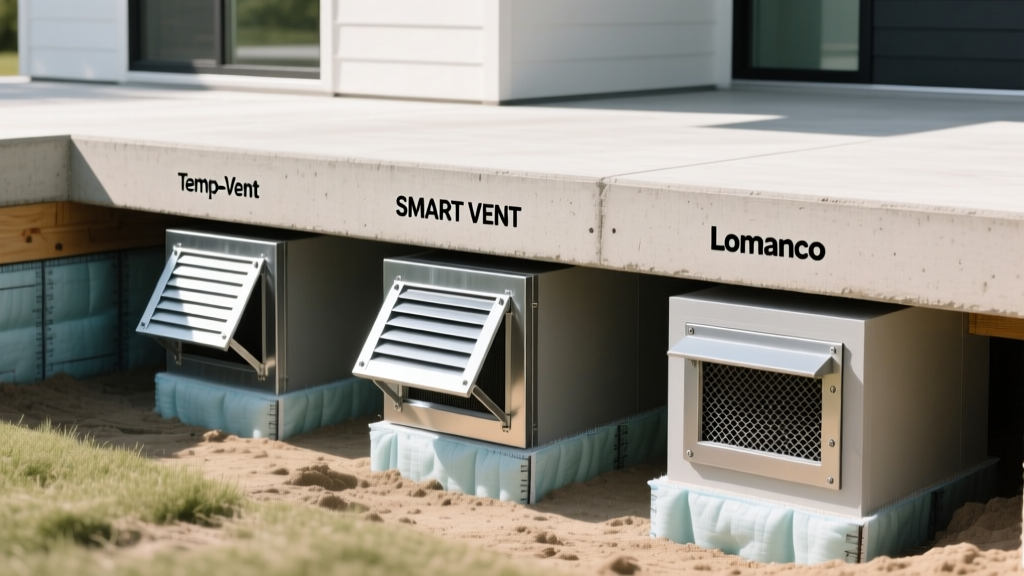
The Building Science Shift: Why Crawl Space Vent Codes are Changing
The debate over foundation ventilation has fundamentally shifted over the last decade. Historically, building codes mandated passive cross-ventilation to dry out crawl spaces. However, modern building science—documented extensively by the Pacific Northwest National Laboratory (PNNL)—proves that venting outside air into a crawl space often introduces more moisture than it removes, particularly in humid summer months. This leads to condensation on cold floor joists, mold growth, and accelerated structural decay.
Brand Deep-Dive: Temp-Vent (Active Power Exhaust Systems)
Temp-Vent, a flagship brand under the Crawl Space Depot umbrella, dominates the active mechanical ventilation market. Rather than relying on passive breeze, Temp-Vent systems use motorized fans to forcefully exhaust stagnant, moisture-laden air from the foundation enclosure.
Model Spotlight: Temp-Vent PV-110 Power Vent
The PV-110 is a 110-volt automated foundation vent designed to fit standard 16-inch by 8-inch masonry rough openings. It features an integrated humidistat and thermostat, programmed to trigger exhaust only when specific dew-point thresholds are met.
- Airflow Capacity: 130 CFM (Cubic Feet per Minute)
- Net Free Area (NFA): 65 sq. inches (when louvers are open)
- Power Draw: 18 Watts operating / 2 Watts standby
- Average 2026 Pricing: $165 - $195 per unit
Installing active exhaust vents like the PV-110 without sealing the crawl space floor and walls can create negative pressure. This vacuum effect will pull soil gases—including radon—and unconditioned air through micro-cracks in the foundation slab. In EPA Radon Zones 1 and 2, active exhaust must be paired with a sub-membrane depressurization system to prevent dangerous radon accumulation in the living space above.
Common Failure Mode: Sensor Drift and Housing Condensation
The most frequent field failure with the PV-110 occurs when the exterior housing is installed perfectly flush without a downward slope. During winter, the exhaust of warm, moist air hits the cold exterior louver grille, causing condensation to drip backward into the motor housing. Furthermore, if the foam weatherstripping seal degrades, the internal humidistat reads the exterior ambient humidity rather than the crawl space humidity, causing the fan to run continuously and spike energy bills.
Brand Deep-Dive: SMART VENT (Dual-Function Flood & Air Systems)
While Temp-Vent focuses on air quality, SMART VENT engineers products specifically for FEMA floodplain management compliance. In coastal and riverine flood zones, enclosed foundations must feature hydrostatic flood vents to prevent water pressure from collapsing masonry walls during storm surges.
Model Spotlight: Model 1540-510 Dual Function Vent
The 1540-510 is an ICC-ES certified dual-function vent. In normal conditions, it acts as a standard passive air vent with a decorative louver face. During a flood event, the internal engineered floats rise, unlatching the door to allow water to flow freely in and out, equalizing hydrostatic pressure.
- Material: Marine-grade 316 Stainless Steel (also available in ABS plastic)
- Flood Coverage: 1 unit covers 200 sq. ft. of enclosed area
- Air NFA: 144 sq. inches
- Average 2026 Pricing: $230 - $275 (Stainless), $140 - $160 (ABS)
Installation Gotcha: The Silt Clearance Rule
A critical installation error made by general contractors is mounting the 1540-510 at the very bottom of the foundation wall. When floodwaters recede, they leave behind heavy silt and debris. If the vent is installed without a minimum 3-inch clearance from the interior grade to the bottom of the vent opening, packed mud will jam the internal float mechanism. This leaves the vent permanently stuck in the 'open' position, compromising the thermal boundary and allowing pest intrusion long after the flood event.
Brand Deep-Dive: Lomanco (Traditional Passive Louvers)
For standard, non-flood-zone residential builds where budget constraints dictate traditional passive cross-ventilation, Lomanco remains the industry standard for stamped metal foundation vents.
Model Spotlight: Series 750 and 752 Foundation Vents
The Series 750 is a fixed, louvered galvanized steel vent. The upgraded Series 752 includes a manual slide damper, allowing homeowners to close the vents during winter months to prevent frozen plumbing pipes.
- Material: Galvanized Steel or Mill-Finish Aluminum
- Net Free Area (NFA): 50 sq. inches
- Rough Opening: 16" x 8" (Fits standard concrete block cores)
- Average 2026 Pricing: $14 - $22 per unit
Common Failure Mode: Mortar Droppings and Wasp Nests
Because the Series 750 relies on narrow, stamped louver blades, it is highly susceptible to blockage. During initial masonry construction, mortar droppings frequently harden on the interior tracks, preventing the 752 slide damper from ever closing. Additionally, the 1/4-inch gaps between louvers are the exact preferred dimension for mud daubers and paper wasps to build nests, effectively reducing the NFA to zero within a single summer season. Retrofitting a woven wire mesh screen on the interior side is highly recommended.
Head-to-Head Comparison Matrix
| Brand / Model | Type | Net Free Area | Power Req. | Avg. Cost | Best Application |
|---|---|---|---|---|---|
| Temp-Vent PV-110 | Active Exhaust | 65 sq. in. | 110V GFCI | $180 | Humid climates, legacy vented retrofits |
| SMART VENT 1540-510 | Dual (Air/Flood) | 144 sq. in. | None | $250 | FEMA flood zones, coastal builds |
| Lomanco Series 752 | Passive Louver | 50 sq. in. | None | $18 | Budget builds, dry/arid climate zones |
Troubleshooting Common Installation Failures
Even the most expensive foundation vent hardware will fail if the installation geometry is incorrect. Address these three critical field issues before signing off on foundation inspections:
- The Mortar Netting Blockage: Masons often leave wire mesh or brick ties protruding into the 16x8 rough opening. When plastic or metal vents are pushed into place, these wires pierce the vent housing or block the louver tracks. Fix: Mandate that masons chip back any protruding wire at least 1 inch from the interior edge of the block core before vent installation.
- Exterior Grade Slope Inversion: Landscapers frequently build mulch beds or soil grades up to the bottom edge of the foundation vents to hide the concrete stem wall. This traps water against the vent and blocks airflow. Fix: Maintain a strict 6-inch clearance between the bottom of the vent sill and the final exterior grade. Use a gravel French drain swale if site grading forces soil near the foundation.
- Thermal Bridging in Conditioned Spaces: If a builder accidentally installs passive vents in a space designed to be an unvented, conditioned crawl space, the R-value of the floor assembly plummets. Fix: Do not simply tape over the vents. Cut 2-inch rigid XPS foam board to friction-fit the interior opening, seal the perimeter with closed-cell spray foam, and secure it with masonry Tapcon screws to create a continuous thermal boundary.
Final Verdict: Aligning Hardware with Foundation Strategy
Selecting crawl space vents requires matching the hardware to the overarching foundation strategy. If local building codes or floodplain maps mandate hydrostatic relief, the SMART VENT 1540-510 is non-negotiable; its ICC-ES certification will prevent permitting delays and protect the structural integrity of the masonry during surge events. For existing vented crawl spaces in high-humidity regions where encapsulation is financially unfeasible, upgrading to Temp-Vent PV-110 active exhaust units provides a mechanical stopgap against summer condensation. However, for new construction in 2026, the most robust strategy remains eliminating vents entirely, sealing the foundation, and conditioning the space—reserving passive hardware like Lomanco strictly for detached, unconditioned outbuildings or arid climate zones.