Selection Framework: Choosing Roofing Materials for Flat Roof Designs
Master the selection framework for roofing materials for flat roof systems. Compare EPDM, TPO, PVC, and Mod-Bit costs, lifespans, and failure modes.

The Flat Roof Selection Matrix
Selecting the correct membrane for a low-slope or flat structure requires moving beyond basic cost-per-square-foot calculations. Flat roofs (defined as having a pitch of 3:12 or less) do not shed water via gravity as efficiently as pitched roofs. Consequently, the primary enemies of these systems are hydrostatic pressure (ponding water), thermal shock, and mechanical abuse from HVAC maintenance. To systematically evaluate roofing materials for flat roof applications, building envelope professionals use a three-axis selection framework: Hydrostatic Resistance, Thermal/UV Stability, and Mechanical Abuse Tolerance.
Material Performance & Cost Breakdown (2026 Data)
The commercial and residential flat roof market is dominated by four primary material categories. The pricing below reflects 2026 national averages for fully installed, mechanically attached or fully adhered systems over standard polyisocyanurate insulation, including labor, flashing, and basic edge metal.
| Material Type | Average Installed Cost (per sq. ft.) | Expected Lifespan | Ponding Water Resistance | Chemical/Grease Resistance |
|---|---|---|---|---|
| EPDM (Rubber) | $4.50 - $7.50 | 20 - 30 years | Excellent | Poor (Degrades with oils) |
| TPO (Thermoplastic Polyolefin) | $5.50 - $9.00 | 15 - 25 years | Good | Poor (Fails with animal fats) |
| PVC (Polyvinyl Chloride) | $7.00 - $11.50 | 20 - 30+ years | Excellent | Excellent |
| SBS Modified Bitumen (Torch/Cold) | $6.00 - $10.00 | 15 - 25 years | Excellent | Moderate |
Scenario-Based Decision Trees
Rather than asking 'which material is best,' apply these specific operational scenarios to your building profile to isolate the optimal membrane.
Scenario A: High Grease, Oil, or Chemical Exposure
Context: Restaurants, manufacturing plants, or facilities with rooftop exhaust vents expelling fats, oils, and greases (FOG).
Selection: PVC (Polyvinyl Chloride) or KEE (Ketone Ethylene Ester).
Technical Rationale: Standard TPO membranes undergo rapid plasticizer extraction and seam degradation when exposed to animal fats and vegetable oils. PVC's chemical structure inherently resists FOG. For extreme industrial chemical exposure, specify a KEE membrane (like FiberTite), which utilizes a solid polymer base rather than liquid plasticizers, preventing the membrane from becoming brittle over time.
Scenario B: Maximum Solar Reflectivity & Cool Roof Mandates
Context: Sunbelt climates (ASHRAE Zones 1-3), buildings with high cooling loads, or jurisdictions requiring Energy Star/CRRC compliance.
Selection: White TPO (60-mil or 80-mil).
Technical Rationale: According to the U.S. Department of Energy, highly reflective cool roofs can reduce peak cooling demand by 10-15%. TPO offers the highest initial solar reflectance index (SRI) at the lowest price point among single-plies. However, specify a minimum 60-mil thickness; 45-mil TPO is highly susceptible to wind scour and surface degradation from UV radiation over a 20-year lifecycle.
Scenario C: High Foot Traffic & Heavy Rooftop Equipment
Context: Buildings with multiple HVAC units, solar arrays requiring frequent servicing, or rooftop terraces.
Selection: SBS Modified Bitumen (Cap Sheet) with a granulated surface or a PVC system with a high-density cover board.
Technical Rationale: Single-ply membranes (TPO/EPDM) are easily punctured by dropped tools or heavy foot traffic. SBS Modified Bitumen features a thick, multi-ply asphaltic matrix reinforced with polyester or fiberglass, offering superior puncture resistance. If a single-ply must be used, mandate the installation of a 1/2-inch high-density fiberglass mat cover board (e.g., DensDeck) directly beneath the membrane to distribute point loads.
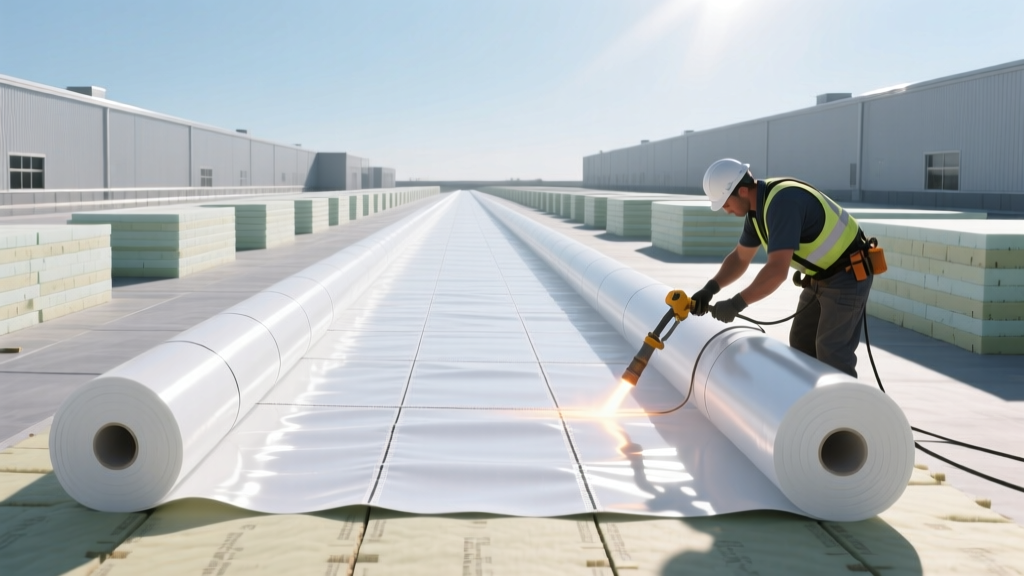
Hidden Variables: Insulation & Decking Compatibility
The membrane is only as effective as the substrate it adheres to. A common failure in flat roof design is ignoring the chemical and thermal interactions between the membrane and the insulation layer.
- Polyisocyanurate (Polyiso): The industry standard (R-5.6 to R-6.0 per inch). However, the asphaltic facers on some polyiso boards can bleed through and stain light-colored TPO and PVC membranes. Always specify a separation sheet or fleece-backed membrane when adhering directly to polyiso.
- EPS and XPS (Expanded/Extruded Polystyrene): Never fully adhere PVC or TPO directly to EPS/XPS using solvent-based adhesives or hot asphalt; the solvents will melt the polystyrene. Furthermore, the Environmental Protection Agency (EPA) notes that thermal shock on dark membranes can exceed 160°F, which approaches the softening point of EPS. If using EPS, a cover board is strictly required to dissipate heat.
- Concrete Decks: Newly poured concrete decks retain massive amounts of moisture. If a fully adhered, vapor-impermeable membrane (like EPDM or PVC) is installed over wet concrete, solar heating will vaporize the trapped moisture, causing catastrophic blistering. Use a vapor retarder or wait for the concrete to cure and dry to acceptable moisture levels (typically below 4-5% CM) before installation.
Critical Failure Modes to Design Against
Understanding how flat roofs actually fail allows you to specify details that prevent these outcomes.
- EPDM Seam Shrinkage: Unreinforced EPDM shrinks over time, pulling apart at the seams and flashing details. Framework Fix: Exclusively specify reinforced EPDM (with an internal polyester scrim) and mandate 3-inch wide seam tape with primer, rather than relying solely on liquid lap sealants which dry out and crack within 5-7 years.
- TPO Wind Uplift at Perimeters: TPO is highly susceptible to tearing at the perimeter and corners during high-wind events due to its relatively low tear strength. Framework Fix: Increase the fastener density in the perimeter and corner zones by 50% above the field requirement, and use fleece-backed TPO in these high-stress zones to distribute the mechanical pull-out forces.
- Modified Bitumen Blistering: Torch-applied Mod-Bit can trap moisture or air if the torching temperature is inconsistent, leading to blisters that eventually crack. Framework Fix: For temperature-sensitive projects or occupied buildings where open flames are a fire hazard, specify cold-process adhesives or self-adhering (peel-and-stick) SBS base sheets, which eliminate the variable of human torch-application error.
Pro-Tip for 2026 Specifications: When drafting your roofing bid documents, do not simply state 'Install TPO Roofing.' Specify the exact mil thickness, the attachment method (e.g., 'fully adhered using low-VOC water-based adhesive'), the required cover board type, and the exact seam welding parameters (minimum 1000°F hot air welder temperature with a 1.5-inch overlap). Ambiguity in the specification is the primary driver of premature flat roof failure.
Written by
Priya KapoorPriya Kapoor is a real estate market analyst and construction economics researcher with expertise in housing affordability, development feasibility, and infrastructure investment. She holds a Master of Regional Planning from Cornell University and previously worked as a senior analyst at CBRE's Investment Properties group, where she modeled returns for $4B in mixed-use development pipelines. Priya now runs an independent research practice advising developers, municipalities, and REITs on construction cost forecasting and market timing. She publishes the quarterly "BuildMat Market Pulse" report tracking material price indices across 12 commodity categories. Based in Austin, TX, Priya serves on the board of Habitat for Humanity Austin and is a marathon runner.
More from Priya Kapoor
View all
Construction Cost
Cost to Build a 1600 Sq Ft Home in 2026: Full Breakdown
Accurate 2026 cost to build a 1600 sq ft home—material, labor, and regional pricing breakdowns included. Plan your budget with real-time estimates.
Aug 11, 2026

Wood & Lumber
Name the Types of Wood for Pressure Treatment and Preservation
Learn how to name the types of wood best suited for pressure treatment. Compare species treatability, chemical retention levels, and 2026 preservation costs.
Aug 4, 2026

Stone & Masonry
Stone Veneer Suppliers Lindenhurst: 2026 Cost Analysis
Analyze 2026 stone veneer costs in Lindenhurst, NY. Compare local supplier pricing, delivery fees, and Suffolk County installation labor rates.
Aug 4, 2026