Top Roof Tile Materials Compared: Clay vs Concrete vs Slate
Compare top roof tile materials including clay, concrete, and slate. Explore 2026 costs, weight requirements, ASTM standards, and climate durability.

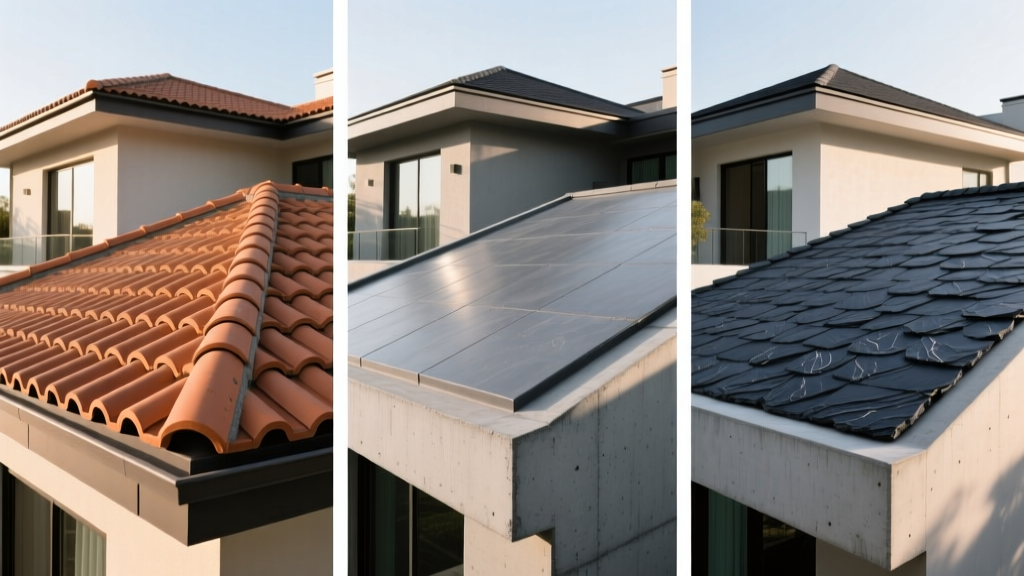
Selecting the correct roof tile materials requires looking past aesthetic preferences to evaluate structural load capacities, long-term weathering characteristics, and lifecycle costs. While asphalt shingles dominate the residential market by volume, high-end residential and commercial projects frequently specify tile for its 50-to-100-year service life and superior thermal mass. This analysis breaks down the three primary heavy-weight tile categories—clay, concrete, and natural slate—evaluating their material science, installation requirements, and 2026 market pricing.
The Structural Reality: Dead Loads and Framing Requirements
Before evaluating the aesthetic or durability differences between roof tile materials, structural engineers must verify the building's load-bearing capacity. Tile systems are classified as heavy-weight roofing, and the dead load they impose dictates the necessary truss spacing, sheathing thickness, and wall framing.
For new construction in 2026, specifying tile early in the architectural phase allows for 24-inch on-center (OC) truss spacing with heavier top chords, or 16-inch OC spacing for standard lumber, paired with minimum 5/8-inch CDX plywood or OSB sheathing to prevent deflection under the concentrated point-loads of the tiles.
Material Deep-Dive: Science and Performance
Clay Tiles (Terracotta): The Fired Standard
Manufactured by extruding or dry-pressing natural clay and firing it in kilns at temperatures exceeding 2,000°F, clay tiles are governed by ASTM C1167. The extreme heat vitrifies the clay, rendering it virtually impervious to water absorption (typically less than 2%).
- Color Retention: Unlike surface-coated materials, high-quality clay tiles feature 'through-body' color. The mineral composition (iron oxide for reds, manganese for browns) is baked into the matrix, meaning the tile will never fade, chalk, or require repainting over its 75+ year lifespan.
- Profiles: Available in Mission (S-curve), Spanish (barrel), and Flat profiles. Flat clay tiles are increasingly specified in modern architecture for their clean, slate-like sightlines.
- Failure Modes: Clay is brittle. Impact from large hail (2.5+ inches) or falling tree limbs will fracture the tiles. However, individual tile replacement is straightforward provided the original batch color is still available from the manufacturer.
Concrete Tiles: The Cost-Effective Heavyweight
Concrete tiles are formed from a mixture of Portland cement, sand, and water, extruded under high pressure and cured. They must meet ASTM C1492 standards. While they mimic the profiles of clay and slate at a lower price point, their material science introduces specific long-term maintenance requirements.
- The Efflorescence Factor: As concrete cures and weathers, calcium hydroxide migrates to the surface and reacts with atmospheric carbon dioxide, forming a white, powdery residue known as efflorescence. While primarily cosmetic, it requires periodic cleaning.
- Color Degradation: Most concrete tiles achieve their color through an acrylic or cementitious 'slurry coat' applied to the surface. UV exposure degrades this coating over 15 to 20 years, leading to chalking and fading. Budgeting for a professional acrylic roof coating at the 20-year mark is mandatory for concrete tile systems.
- Weight Variability: Concrete tiles absorb more moisture than clay (up to 5% by weight). In wet climates, a concrete roof will physically weigh more immediately after a heavy rainstorm than it does during a dry spell, a factor structural engineers must account for in peak load calculations.
Natural Slate: The Geological Benchmark
Quarried and split along its natural foliation planes, slate is the premium tier of roof tile materials, regulated by ASTM C406. It is a metamorphic rock composed primarily of quartz and illite, offering unmatched fire resistance and longevity.
- Grading is Critical: ASTM C406 classifies slate into three grades based on water absorption and modulus of rupture. S1 Grade (water absorption <0.25%) is guaranteed for 75+ years and is the only grade recommended for primary residences. S2 (40-75 years) and S3 (<40 years) are often sold cheaply by importers but will delaminate and spall prematurely in freeze-thaw climates.
- Fading vs. Unfading: 'Unfading' slates maintain their original mineral color indefinitely. 'Fading' or 'weathering' slates contain higher levels of calcium carbonate and iron sulfide, which oxidize over time, shifting the roof's color from dark gray to mottled browns and rusts. This is an aesthetic choice, not a structural defect, but must be specified intentionally.
2026 Cost and Performance Matrix
The following matrix reflects Q1 2026 national averages for material and specialized installation costs. Note that 'per square' refers to 100 square feet of roof area.
| Material | Installed Cost (Per Square) | Weight (lbs/sq) | Expected Lifespan | Maintenance Need |
|---|---|---|---|---|
| Clay (Terracotta) | $1,400 - $2,200 | 850 - 1,000 | 75 - 100+ Years | Low (Inspect flashings) |
| Concrete | $750 - $1,100 | 900 - 1,100 | 40 - 50 Years | Medium (Recoat at 20 yrs) |
| Natural Slate (S1) | $2,000 - $3,800 | 1,200 - 1,500 | 100+ Years | Very Low |
Underlayment and Fastening: The Hidden System
A common misconception among property owners is that the tile itself provides the waterproof barrier. According to guidelines published by the Tile Roofing Institute, tile systems are designed as water-shedding, weather-resistant claddings. The true waterproofing layer is the underlayment beneath it.
Underlayment Specifications
Because tiles are porous to wind-driven rain and capillary action, the underlayment must be robust. Standard 15-lb asphalt felt is obsolete for premium tile roofs. The 2026 best-practice specification involves a dual-layer approach:
- Ice and Water Shield: A self-adhering SBS-modified bitumen membrane applied to the eaves (minimum 24 inches past the interior wall line), all valleys, rakes, and around penetrations (chimneys, skylights, vents).
- Field Underlayment: A high-tensile, woven synthetic underlayment (e.g., GAF TigerPaw or equivalent) with a minimum tear strength of 35 lbf. Synthetic underlayments resist UV degradation for up to 6 months, providing crucial protection if tile installation is delayed by weather or supply chain issues.
Fastening Protocols
The National Roofing Contractors Association emphasizes that wind uplift is the primary mechanical threat to tile roofs. Fastening must be dictated by local wind-speed maps and the specific tile profile.
- Clay and Concrete: Typically secured using corrosion-resistant ring-shank roofing nails (minimum 11-gauge copper or stainless steel) driven into the decking. In high-velocity hurricane zones (HVHZ), every tile must be mechanically fastened, often supplemented by two-part polyurethane foam adhesives applied to the tile's cross-ribs to prevent rattling and uplift.
- Slate: Must never be nailed tight. Slate requires a 'hung' installation using solid copper or hot-dipped galvanized nails (stainless steel is acceptable but copper is preferred for its matching longevity). The nail head should rest just above the slate surface, allowing the tile to hang freely and expand/contract without cracking.
Climate-Specific Selection Framework
Choosing between these roof tile materials requires aligning the material's physical properties with the local microclimate.
Freeze-Thaw and Northern Climates
Specify S1 Grade Slate or High-Fire Clay. Avoid concrete tiles in regions with more than 30 freeze-thaw cycles annually. Concrete's higher porosity allows water ingress; when this water freezes and expands, it causes the face of the concrete tile to spall and delaminate. If concrete must be used, specify tiles treated with a factory-applied silane/siloxane water repellent.
Coastal and Salt-Spray Environments
Clay is the undisputed leader here. Salt air rapidly accelerates the corrosion of metal flashings and fasteners, but it has zero chemical effect on vitrified clay. Ensure all metal accessories (valleys, gutters, fasteners) are specified as 316-grade stainless steel or copper; standard galvanized steel will fail within a decade in marine environments.
Wildfire-Prone Zones (WUI)
All three materials (clay, concrete, slate) carry a Class A fire rating, the highest available. However, in Wildland-Urban Interface (WUI) zones, the vulnerability lies in wind-blown embers entering the gaps beneath the tile profiles. Installation must include 'bird stops' or eaves closures at the rake and eave lines, and the use of fire-resistant underlayment is often mandated by local building codes to prevent ember ignition of the decking.
Written by
Priya KapoorPriya Kapoor is a real estate market analyst and construction economics researcher with expertise in housing affordability, development feasibility, and infrastructure investment. She holds a Master of Regional Planning from Cornell University and previously worked as a senior analyst at CBRE's Investment Properties group, where she modeled returns for $4B in mixed-use development pipelines. Priya now runs an independent research practice advising developers, municipalities, and REITs on construction cost forecasting and market timing. She publishes the quarterly "BuildMat Market Pulse" report tracking material price indices across 12 commodity categories. Based in Austin, TX, Priya serves on the board of Habitat for Humanity Austin and is a marathon runner.
More from Priya Kapoor
View all
Construction Cost
Cost to Build a 1600 Sq Ft Home in 2026: Full Breakdown
Accurate 2026 cost to build a 1600 sq ft home—material, labor, and regional pricing breakdowns included. Plan your budget with real-time estimates.
Aug 11, 2026

Wood & Lumber
Name the Types of Wood for Pressure Treatment and Preservation
Learn how to name the types of wood best suited for pressure treatment. Compare species treatability, chemical retention levels, and 2026 preservation costs.
Aug 4, 2026

Stone & Masonry
Stone Veneer Suppliers Lindenhurst: 2026 Cost Analysis
Analyze 2026 stone veneer costs in Lindenhurst, NY. Compare local supplier pricing, delivery fees, and Suffolk County installation labor rates.
Aug 4, 2026