Choosing the Right Roof Repair Material for Asphalt, Metal, and Flat Systems
Discover the exact roof repair material needed for asphalt shingles, metal panels, and flat membranes. Includes product specs, costs, and tips.

Applying an incompatible roof repair material to a localized leak often accelerates degradation rather than stopping it. The chemical composition of your existing roof dictates which sealants, tapes, and patches will adhere properly and withstand thermal expansion. Using an asphalt-based cement on a synthetic rubber membrane, for example, will chemically dissolve the substrate and create a much larger failure point. This guide details the specific repair materials, product formulations, and application parameters required for asphalt, metal, and flat roofing systems.
The Diagnostic Framework: Matching Material to Failure Mode
Before purchasing any roof repair material, you must identify the exact failure mode. Water infiltration rarely occurs in the center of a shingle or panel; it occurs at transitions, penetrations, and fastener points. The diagnostic framework below dictates your material selection:
- Thermal Splitting (Asphalt/Mod-Bit): Requires elastomeric, mesh-reinforced compounds that stretch with temperature fluctuations.
- Fastener Back-Out (Metal): Requires mechanical upsizing and butyl-based compression seals, not surface-level caulking.
- Membrane Punctures/Shrinkage (EPDM/TPO): Requires chemical primers and vulcanized splice tapes or compatible liquid flashings.
Asphalt Shingle Repairs: Moving Beyond Standard Roofing Cement
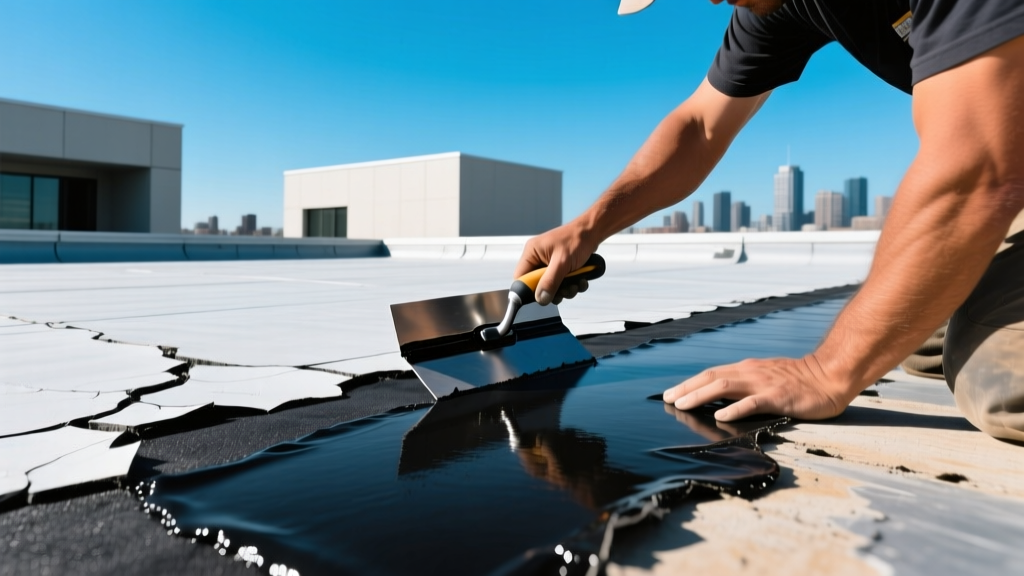
Standard black roofing cement (asphalt emulsion) is the most misused roof repair material on the market. While it provides an immediate watertight seal, it cures into a rigid, brittle mass. When the roof deck expands and contracts with seasonal temperature shifts, the rigid cement cracks, leading to secondary leaks within 12 to 18 months.
Heavy-Duty Rubberized Asphalt
For long-term asphalt shingle repairs, you must use a rubberized asphalt formulation. Products like Henry 208 Wet Patch or Karnak 19 Ultra contain synthetic rubber polymers that remain pliable down to 10°F (-12°C) and can be applied in active rain. For any crack, gap, or missing shingle tab wider than 1/4 inch, the sealant must be reinforced.
Application Protocol:
- Clean the area of granules and debris with a stiff wire brush.
- Apply a 1/8-inch base layer of rubberized cement.
- Embed a strip of fiberglass mesh (e.g., Henry 181 Repair Fabric) into the wet base layer.
- Trowel a second 1/8-inch layer of cement over the mesh, feathering the edges 2 inches past the repair zone.
Metal Roofing: Fasteners, Sealants, and Thermal Movement
Metal roofs fail primarily at the fasteners and the side-lap seams due to thermal cycling. The neoprene washers on standard roofing screws degrade under UV exposure and typically fail after 10 to 15 years. Simply smearing polyurethane caulk over a leaking screw is a temporary fix that will peel within a year.
Fastener Replacement and Upsizing
The correct roof repair material for a compromised metal fastener is a larger-diameter screw with a fresh EPDM or neoprene washer. If the original screw was a #10 diameter, remove it and install a #12 or #14 diameter screw of the same length to bite into fresh, un-compromised wood or metal substrate.
Seam and Transition Sealing
For metal side-laps, ridge caps, and flashing transitions, use a metal-backed butyl tape rather than liquid sealant. EternaBond MetalFlex or Tite-Seal butyl tapes feature a built-in aluminum or copper backing that reflects UV rays, while the butyl adhesive layer remains permanently pliable, accommodating the significant thermal expansion of metal panels.
| Failure Point | Correct Repair Material | Specific Product / Spec | Est. Cost (2026) |
|---|---|---|---|
| Leaking Screw | Upsized Metal Screw | #12 or #14 Hex Washer Head | $0.15 - $0.25 / ea |
| Side-Lap Seam | Metal-Backed Butyl Tape | EternaBond MetalFlex (4" wide) | $65 / 50ft roll |
| Pipe Penetration | Tripolymer Sealant | Geocel Pro Flex RV / 2300 | $12 / 10oz tube |
Expert Insight: Avoid standard silicone or polyurethane caulks on metal roofs. Silicone lacks adhesion to painted metal surfaces and peels under tension, while polyurethane skins over and cracks. Tripolymer sealants (like Geocel) cure to a flexible rubber that adheres aggressively to factory-painted metal finishes without a primer.
Flat Roof Systems: EPDM, TPO, and Modified Bitumen
Flat and low-slope roofs require highly specific repair protocols based on the membrane chemistry. According to technical guidelines from the National Roofing Contractors Association (NRCA), improper splice repairs are the leading cause of premature flat roof replacement.
EPDM (Ethylene Propylene Diene Monomer)
EPDM is a synthetic rubber. You cannot use standard adhesives to repair it. The correct roof repair material for an EPDM puncture or seam failure is a vulcanized EPDM splice tape (e.g., Carlisle or Firestone 6" Splice Tape). Crucially, the membrane must be prepped with a dedicated EPDM primer (a yellow, solvent-based liquid) applied with a scrub pad until the surface is completely clean and slightly tacky. Skipping the primer will result in tape delamination within weeks.
TPO (Thermoplastic Polyolefin)
TPO membranes cannot be repaired with tape or asphalt. TPO requires heat welding. For minor punctures, the correct repair material is a TPO-compatible liquid flashing or a TPO patch that is hot-air welded to the existing membrane using a specialized roofing heat gun set to 900°F - 1100°F. Products like GacoFlex TPO Liquid Flashing provide a chemical bond without requiring heavy welding equipment for small repairs.
Cost, Longevity, and Application Parameters
Investing in the correct, system-specific roof repair material yields a significantly higher return on investment than repeated applications of cheap, universal sealants. Below is a breakdown of expected longevity based on material selection:
- Universal Roof Cement (Asphalt Emulsion): 1 to 3 years. Low upfront cost ($10/gallon), but high labor cost due to frequent reapplication.
- Rubberized Asphalt + Mesh (Asphalt Shingles): 7 to 10 years. Moderate cost ($25/gallon + $15 mesh), matches the remaining lifespan of older shingle roofs.
- Butyl Tape with Metal Backing (Metal Roofs): 15 to 20+ years. High upfront cost ($1.30/linear foot), but effectively outlasts the metal panels themselves.
- Primed EPDM Splice Tape (Flat Roofs): 20+ years. Moderate cost ($0.90/linear foot + $30 primer), creates a permanent, vulcanized chemical bond.
For commercial buildings and large residential flat roofs considering broader maintenance, applying a reflective coating over repaired areas can significantly reduce thermal shock, which is the primary driver of seam degradation. The U.S. Department of Energy notes that cool roof coatings can lower roof surface temperatures by up to 50°F, drastically extending the life of underlying repair materials and membranes. Furthermore, following post-storm inspection protocols outlined by the Insurance Institute for Business & Home Safety (IBHS) ensures that micro-fractures and compromised fasteners are addressed with the correct materials before water infiltrates the roof deck.
Written by
Marcus ChenMarcus Chen is a licensed structural engineer (PE) and building materials analyst with over 12 years of experience across residential, commercial, and industrial construction. He holds a Master of Science in Civil Engineering from UC Berkeley and spent six years at Thornton Tomasetti before transitioning to independent consulting and technical writing. Marcus specializes in material selection for seismic-prone regions, concrete reinforcement strategies, and lifecycle cost analysis. His work has been cited by the American Concrete Institute (ACI) and the Structural Engineers Association of California (SEAOC). When he is not on a job site or at his desk, you will find him hiking the Sierra Nevada or restoring a 1920s craftsman bungalow in Oakland, CA.
More from Marcus Chen
View all
Construction Cost
How Much Did the Eiffel Tower Cost to Build?
How much did the Eiffel Tower cost to build in 1889? We adjust for inflation and compare its budget to modern skyscraper construction.
Aug 4, 2026

Fire Resistance
What Is a Fire Resistant Material? Testing & Certification Guide
Discover what is a fire resistant material through ASTM and UL testing. Learn how fire ratings, certifications, and assemblies work in construction.
Aug 4, 2026

Construction Cost
How Much Did the Burj Khalifa Cost to Build?
How much did the Burj Khalifa cost to build? We break down the $1.5B project and extract 5 money-saving strategies for your next build.
Jul 30, 2026