Top Storm-Tolerant Roofing Materials for Tampa Homes
Discover the best storm-tolerant roofing materials for Tampa homes. Compare wind ratings, impact resistance, and 2026 costs for hurricane-proof roofs.

Tampa's Unique Roofing Threat Profile and Code Requirements
Selecting storm-tolerant roofing materials for Tampa requires navigating a highly specific meteorological and regulatory landscape. Tampa and the broader Hillsborough County area sit squarely in a Wind-Borne Debris Region (WBDR), meaning roofs must withstand sustained winds of 130 to 150 mph and resist penetration from airborne projectiles during Category 3 and 4 hurricanes. Unlike the High-Velocity Hurricane Zone (HVHZ) in Miami-Dade, Tampa's building codes prioritize a balance of extreme wind uplift resistance and secondary water barrier performance.
According to the Florida Building Code Commission, any residential roof replacement in Tampa must incorporate a secondary water barrier. When high winds strip the primary roofing material, this barrier prevents catastrophic interior water damage. Furthermore, the NOAA National Hurricane Center notes that Tampa Bay's unique geography can amplify storm surge and microburst wind speeds, making localized wind uplift ratings more critical than generic national averages.
Decoding Wind Uplift and Impact Standards
Before evaluating specific materials, you must understand the testing standards that govern storm-tolerant roofing in Florida. Manufacturers use these metrics to validate their warranty coverage in high-wind zones.
Key Testing Protocols for Tampa Roofs
- ASTM D7158 (Class H): The benchmark for asphalt shingle wind resistance, certifying the material can withstand uplift forces equivalent to 150 mph sustained winds.
- UL 2218 (Class 4): The highest impact-resistance rating, achieved by dropping a 2-inch steel ball from 20 feet onto the material without causing fractures or tears. Essential for surviving hail and wind-blown debris.
- ASTM E1592 / UL 580: Standard test methods for structural performance of metal roof panels under uniform static air pressure differences, critical for standing seam systems.
Evaluating the Top Storm-Tolerant Roofing Materials for Tampa
1. Standing Seam Metal Roofing (Mechanical Lock)
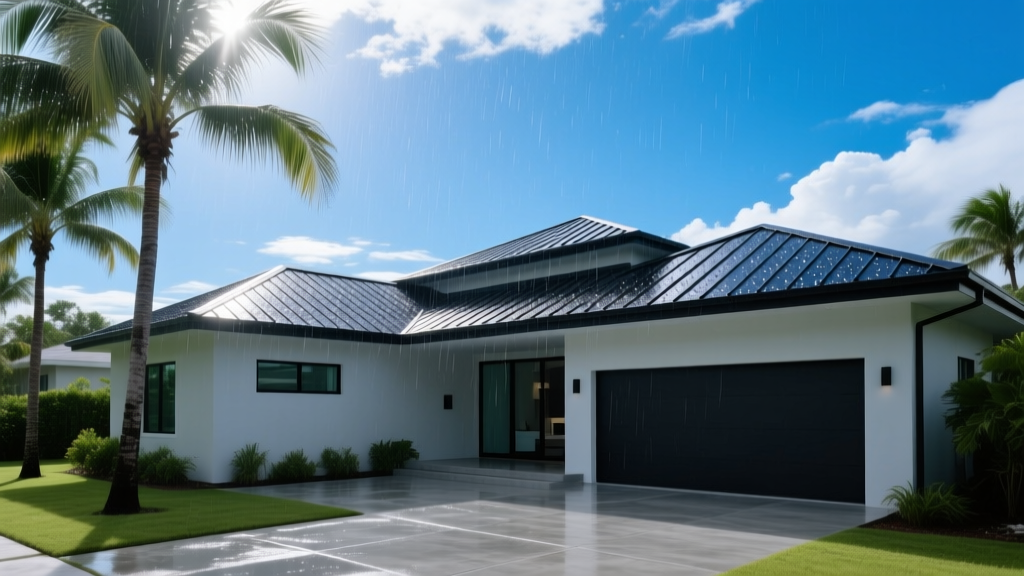
Mechanically seamed metal roofing is the apex of storm tolerance. Unlike exposed-fastener corrugated metal, a mechanical lock system (such as the Petersen PAC-CLAD Tite-Lok) features concealed clips and seams that are folded over each other on-site using a mechanical seamer. This creates a continuous, interlocking membrane that eliminates the primary failure point of traditional roofs: fastener back-out.
- Wind Rating: Up to 180 mph (exceeds Tampa WBDR requirements).
- Material Spec: 24-gauge galvalume steel or .032-inch aluminum (preferred within 1,500 feet of the coast to prevent salt-spray corrosion).
- Failure Mode to Avoid: Using snap-lock panels instead of mechanical locks. Snap-lock panels can unzip under the cyclical pressure loading of a hurricane.
2. Stone-Coated Steel Roofing
For homeowners who want the storm tolerance of metal without the industrial aesthetic, stone-coated steel (like DECRA Shake XD or Gerard MetroBond) offers a premium alternative. These systems feature a galvanized steel core stamped into traditional profiles (shingle, tile, or shake) and coated with acrylic-bonded stone granules.
- Wind Rating: 120 to 140 mph (Class H equivalent).
- Impact Rating: UL 2218 Class 4.
- Installation Advantage: Uses a hidden clip-and-screw fastening system that locks each panel to the deck and to the adjacent panel, creating a unified structural grid.
3. Class 4 Impact-Resistant Asphalt Shingles
Standard 3-tab and basic architectural shingles will fail in a Tampa hurricane. To achieve true storm tolerance with asphalt, you must specify SBS (Styrene-Butadiene-Styrene) modified shingles. Products like the GAF Timberline ArmorShield II or CertainTeed Landmark IR utilize a rubberized polymer matrix that allows the shingle to flex and absorb impact energy rather than shattering.
- Wind Rating: 130 mph (when installed with the mandatory 6-nail high-wind pattern).
- Impact Rating: UL 2218 Class 4.
- Cost Advantage: Significantly lower upfront material cost compared to metal, though the lifespan is reduced to 20-25 years in high-UV Florida climates.
2026 Tampa Market Pricing and Insurance ROI
Investing in storm-tolerant roofing materials for Tampa yields immediate returns through Florida's mandatory wind mitigation insurance discounts. Upgrading to a FORTIFIED-compliant roof can reduce the windstorm portion of your homeowners insurance premium by 20% to 40%. Below is the current 2026 pricing landscape for Hillsborough County.
| Material Type | Material Cost (Per Square) | Installed Cost (Per Square) | Est. Insurance Discount |
|---|---|---|---|
| Class 4 SBS Shingles | $160 - $220 | $350 - $480 | 15% - 25% |
| Stone-Coated Steel | $400 - $550 | $750 - $950 | 25% - 35% |
| Standing Seam Metal | $500 - $750 | $900 - $1,300 | 30% - 40% |
Note: Costs per square (100 sq. ft.) include tear-off of one existing layer and standard 5/8-inch OSB decking replacement up to 20%. Complex roof geometries with multiple valleys and dormers will increase labor costs by 15-25%.
Critical Installation Protocols for High-Velocity Winds
The most expensive storm-tolerant roofing material will fail if the underlying assembly is compromised. The IBHS FORTIFIED Home Roof Standards dictate specific installation protocols that go beyond the minimum Florida Building Code requirements. If your contractor skips these steps, your manufacturer warranty will be voided.
Warning: Common Contractor Shortcuts
- Skipping the Full Peel-and-Stick: Standard code requires a secondary water barrier only at the eaves and ridges. For true storm tolerance, specify a self-adhering polymer-modified bitumen membrane (like Grace Ice & Water Shield HT) applied to 100% of the roof deck.
- Using Smooth-Shank Nails: Decking must be secured using 11-gauge, 1.5-inch ring-shank nails. Smooth-shank nails can pull out under cyclical wind uplift, causing the entire plywood deck to detach from the trusses.
- 4-Nail Shingle Patterns: In Tampa's WBDR, asphalt shingles must be fastened with a 6-nail pattern per shingle, with the nails placed precisely on the manufacturer's designated nail line. High-nailing will cause shingles to slide off during a microburst.
Frequently Asked Questions
Do I need an HVHZ-rated roof in Tampa?
No. Tampa is classified as a Wind-Borne Debris Region (WBDR), not a High-Velocity Hurricane Zone (HVHZ). HVHZ designations are currently restricted primarily to Miami-Dade and Broward counties. However, purchasing materials that carry Miami-Dade Notice of Acceptance (NOA) certifications provides an extra margin of safety, as these products are tested to the most rigorous standards in the country.
Are concrete tile roofs good for Tampa hurricanes?
Concrete and clay tiles (like Boral or Eagle Roofing) are highly resistant to UV degradation and salt spray, but they present unique storm risks. Tiles are heavy and rely on a complex system of clips and adhesive to resist uplift. If the adhesive fails or the clips snap under extreme torsional wind loads, the tiles become massive, dangerous projectiles. If you choose tile, you must specify a fully adhered or mechanically fastened system that meets the stringent TAS 125 testing protocol, and budget for annual maintenance to check for cracked mortar and loose clips.
How do I verify my roof's wind mitigation status?
After installation, hire an independent, certified Florida wind mitigation inspector to complete the OIR-B1-1802 form. This document is legally required by your insurance provider to apply the storm-tolerant roofing discounts to your policy. Ensure the inspector verifies the nail size, nail spacing, and the presence of the full secondary water barrier.
Written by
Marcus ChenMarcus Chen is a licensed structural engineer (PE) and building materials analyst with over 12 years of experience across residential, commercial, and industrial construction. He holds a Master of Science in Civil Engineering from UC Berkeley and spent six years at Thornton Tomasetti before transitioning to independent consulting and technical writing. Marcus specializes in material selection for seismic-prone regions, concrete reinforcement strategies, and lifecycle cost analysis. His work has been cited by the American Concrete Institute (ACI) and the Structural Engineers Association of California (SEAOC). When he is not on a job site or at his desk, you will find him hiking the Sierra Nevada or restoring a 1920s craftsman bungalow in Oakland, CA.
More from Marcus Chen
View all
Construction Cost
How Much Did the Eiffel Tower Cost to Build?
How much did the Eiffel Tower cost to build in 1889? We adjust for inflation and compare its budget to modern skyscraper construction.
Aug 4, 2026

Fire Resistance
What Is a Fire Resistant Material? Testing & Certification Guide
Discover what is a fire resistant material through ASTM and UL testing. Learn how fire ratings, certifications, and assemblies work in construction.
Aug 4, 2026

Construction Cost
How Much Did the Burj Khalifa Cost to Build?
How much did the Burj Khalifa cost to build? We break down the $1.5B project and extract 5 money-saving strategies for your next build.
Jul 30, 2026