Climate-Specific Material List for Metal Roof Installations
Discover the exact material list for metal roof installations tailored to your climate zone, including panels, underlayment, fasteners, and sealants.

Why Climate Dictates Your Material List for Metal Roof Projects
A metal roof is not a monolithic product; it is a highly engineered assembly of panels, clips, underlayments, and fasteners. When contractors generate a material list for metal roof installations, the most critical variable is often ignored: the local microclimate. A standing seam system that performs flawlessly in the arid heat of Arizona will suffer catastrophic fastener back-out and thermal fatigue in the freeze-thaw cycles of upstate New York. Similarly, coastal environments demand entirely different metallurgical specifications to prevent galvanic corrosion.
This guide provides a comprehensive, climate-specific material list for metal roof projects, detailing exact gauges, alloy types, and accessory requirements to ensure a 50-year lifespan. All specifications and pricing reflect current 2026 building material standards.
The Baseline: Universal Metal Roofing Components
Before adjusting for climate, every structural metal roof requires a baseline assembly. According to the Metal Construction Association (MCA), the fundamental material list for metal roof systems must include:
- Roof Decking: Minimum 5/8-inch CDX plywood. Oriented Strand Board (OSB) is discouraged in high-humidity zones due to moisture retention and edge-swelling.
- Drip Edge & Trim: 24-gauge pre-finished galvalume or aluminum, custom-braked to match panel profiles.
- Closures: High-density polyurethane foam closure strips (top and bottom) to seal corrugations or ribs against wind-driven rain and pests.
- Ridge Cap: Vented or solid, depending on attic ventilation calculations, with a minimum 4-inch overlap on each side.
Cold & Snow-Dominated Climates (Zones 5-8)
In regions experiencing heavy snow loads, ice damming, and severe freeze-thaw cycles, the primary enemies are water infiltration under the panels and structural overloading from snow accumulation.
Panel Profile and Gauge
Exposed fastener panels are highly susceptible to neoprene washer degradation and screw back-out caused by extreme thermal expansion and contraction. For snow climates, the material list must specify a mechanical lock standing seam (1.5-inch or 2-inch leg height). Use 24-gauge steel minimum; 22-gauge is recommended for unheated structures or spans exceeding 4 feet between purlins.
Underlayment and Ice Protection
Standard synthetic underlayment is insufficient for the eaves. The National Roofing Contractors Association (NRCA) mandates self-adhered modified bitumen membranes in cold climates.
Snow Retention Systems
Snow guards are not optional on metal roofs over walkways, decks, or lower roof pitches. Specify pad-style snow guards (e.g., SnoBlox-SnoJax) adhered with 100% silicone sealant, or continuous snow rails clamped directly to the standing seam ribs to avoid penetrating the panel field.
High-Wind & Hurricane-Prone Coastal Climates
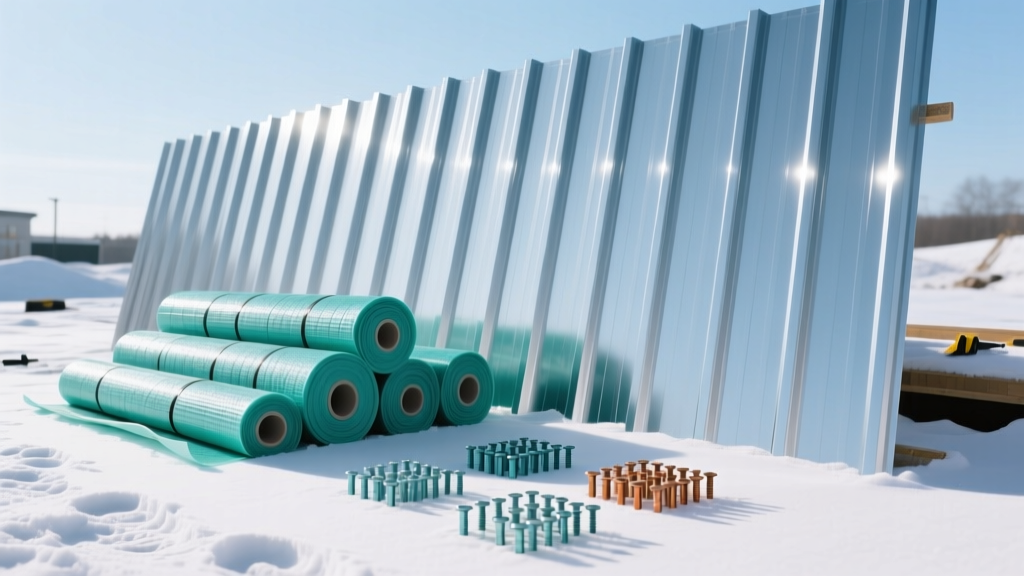
Coastal and hurricane-prone regions (Wind Zones 3 and 4) require a material list engineered for extreme uplift resistance and salt-spray corrosion.
Fastener Metallurgy
Standard carbon steel or even 304 stainless steel fasteners will suffer from tea-staining and eventual structural failure in salt-air environments within 5 to 7 years. Your material list must specify 316 marine-grade stainless steel fasteners for all trim, flashing, and clip attachments.
Panel and Clip Engineering
Opt for a 22-gauge structural standing seam with concealed, sliding clips. The clips must allow for thermal movement while resisting uplift forces exceeding 150 mph. For panel seams, a double-lock mechanical seam provides superior wind uplift resistance compared to a snap-lock profile. Refer to FEMA Building Science Publications for specific wind-mitigation fastening schedules, which often require reducing clip spacing from 36 inches on-center to 18 inches on-center in perimeter and corner zones.
Extreme Heat & High-UV Desert Climates
In desert environments, the material list must prioritize solar reflectance, thermal emittance, and UV degradation resistance.
Coatings and Finishes
Standard SMP (Silicone Modified Polyester) paint systems will chalk and fade rapidly under intense UV exposure. Specify panels coated with a 70% PVDF resin system (commonly known as Kynar 500 or Hylar 5000). These coatings maintain color retention and chalk resistance for decades. Furthermore, select "Cool Roof" certified colors (e.g., lighter tans, whites, or specialized cool-dark pigments) with a Solar Reflectance Index (SRI) of 32 or higher to reduce cooling loads.
Ventilation and Radiant Barriers
Heat transfer through the metal panels can superheat the attic space. Upgrade the underlayment on your material list to a radiant barrier synthetic underlayment (e.g., EcoFoil or similar foil-faced synthetic). Pair this with a ventilated ridge cap and continuous soffit vents to create a passive convection current that pulls hot air out from under the panels.
Comprehensive Material Matrix by Climate Zone
| Component | Cold / Snow (Zones 5-8) | High-Wind / Coastal (Zones 3-4) | Extreme Heat / Desert (Zones 1-2) |
|---|---|---|---|
| Panel Profile | Mechanical Lock Standing Seam | Double-Lock Structural Seam | Snap-Lock or Architectural Seam |
| Steel Gauge | 24-gauge (22 for long spans) | 22-gauge minimum | 26-gauge or 24-gauge |
| Paint System | SMP or PVDF | PVDF (Salt-spray tested) | 70% PVDF (High SRI Cool Roof) |
| Underlayment | Self-Adhered Mod-Bit (Eaves) + Synthetic | High-Temp Synthetic (300°F rated) | Radiant Barrier Foil Synthetic |
| Fasteners | Carbon Steel w/ EPDM (Zinc plated) | 316 Marine-Grade Stainless Steel | Carbon Steel w/ High-Heat EPDM |
| Critical Accessory | Snow Guards & Ice Dams | Perimeter Clip Reinforcement | Vented Ridge & Expansion Joints |
Deep Dive: Fasteners, Washers, and Sealants
The most common point of failure in any metal roof assembly is not the panel itself, but the fasteners and sealants. When finalizing your material list, pay strict attention to these micro-components.
Fastener Washers: EPDM vs. Neoprene vs. Silicone
Never use standard neoprene washers on a metal roof. Neoprene dries out, cracks, and fails under UV exposure within 10 years.
- EPDM (Ethylene Propylene Diene Monomer): The industry standard for most climates. It withstands temperatures from -40°F to 250°F and offers excellent UV resistance.
- Silicone: Required for extreme desert heat or specific high-temperature flashings. Silicone washers can withstand temperatures exceeding 350°F without degrading, though they are more expensive and prone to tearing if over-driven.
Sealants: The Hidden Lifeline
Sealants are used at end laps, ridge caps, and pipe boots. Avoid cheap acrylic or standard silicone caulks.
Instead, specify tripolymer sealants (e.g., Geocel 2300 or Titebond WeatherMaster). These sealants adhere aggressively to metal, remain permanently flexible across a -40°F to 180°F range, and can even be applied to damp surfaces or underwater in emergency repair scenarios.
2026 Sourcing and Cost Expectations
Material costs for metal roofing have stabilized following the supply chain disruptions of the early 2020s, but regional variations remain significant. When budgeting your material list for metal roof installations in 2026, expect the following baseline material costs (excluding labor):
- 26-Gauge Architectural Snap-Lock: $4.50 to $6.00 per square foot.
- 24-Gauge Mechanical Lock: $6.50 to $8.50 per square foot.
- 22-Gauge Structural (Coastal/Wind Rated): $8.00 to $11.00 per square foot.
- Premium Underlayments (Ice & Water / Radiant): $1.50 to $3.00 per square foot.
- Trim, Flashing, and Closures: Add 15% to 20% to the base panel cost.
Always source panels from regional roll-formers rather than national big-box retailers. Regional manufacturers use heavier, localized steel coils (often from Nucor or Steel Dynamics) and provide custom brake-work for trim, ensuring a precise fit that off-the-shelf box-store trim cannot achieve. Ensure your supplier provides a manufacturer's warranty that explicitly covers your specific climate zone, particularly regarding snow-load deflection and coastal salt-spray corrosion.
Written by
Elena RodriguezElena Rodriguez is a civil engineer and technical writer specializing in concrete technology, masonry systems, and ASTM/ACI compliance. She earned her B.S. in Civil Engineering from Texas A&M University and spent a decade at a materials testing laboratory, performing over 2,000 concrete compressive strength tests and masonry prism evaluations. Elena is an ACI-certified Field Testing Technician (Grade I) and a member of ASTM Committee C12 on Natural Building Stone. She currently consults on forensic engineering cases involving concrete failures and moisture intrusion. Based in San Antonio, TX, Elena is a proud member of the Society of Women Engineers (SWE) and coaches her daughter's FIRST Robotics team.
More from Elena Rodriguez
View all
Walls & Panels
Cost Analysis: Light Gauge Steel Framing Advantages and Disadvantages
Evaluate light gauge steel framing advantages and disadvantages through a strict cost analysis lens, comparing material, labor, and lifecycle expenses.
Aug 4, 2026

Walls & Panels
Gypsum Board Types: Exact Specifications, Thickness & Dimensions
Compare standard, Type X, and moisture-resistant gypsum board types. Get exact specifications, thicknesses, dimensions, and ASTM standards for your project.
Aug 4, 2026

Fire Resistance
Best Fire-Resistant Outdoor Decking Materials: 2026 Buyer Guide
Discover the best fire-resistant outdoor decking materials for 2026. Compare Class A PVC, aluminum, and hardwood options for WUI compliance and safety.
Aug 4, 2026