Understanding Roofing Material Lifespan and Durability Factors
Discover how climate, installation, and maintenance impact roofing material lifespan. Compare asphalt, metal, tile, and flat roof durability data.

The Reality of Manufacturer Warranties vs. Actual Lifespan
When evaluating roofing material lifespan, homeowners and commercial builders often conflate manufacturer warranties with functional longevity. A 'Lifetime' warranty on premium architectural shingles, such as the GAF Timberline HDZ or Owens Corning Duration, typically translates to a 50-year prorated coverage period. However, the actual functional lifespan—the time before the roof requires major intervention or replacement—is heavily dictated by microclimates, attic ventilation, and installation precision.
According to technical guidelines from the National Roofing Contractors Association (NRCA), a perfectly installed asphalt shingle roof in a temperate climate may reach 30 years, while the exact same product in a high-UV, high-humidity coastal environment may experience critical granule loss and mat degradation in 15 to 18 years. Understanding these variables is critical for accurate lifecycle cost analysis.
Comprehensive Roofing Material Lifespan Comparison Matrix
The table below synthesizes current market data, expected functional lifespans, and primary failure modes for the most common residential and commercial roofing systems.
| Roofing Material | Expected Lifespan | Avg. Installed Cost (per sq. ft.) | Primary Failure Mode |
|---|---|---|---|
| 3-Tab Asphalt Shingles | 15–20 Years | $3.50 – $5.00 | Wind uplift, thermal cracking, granule loss |
| Architectural Asphalt (e.g., OC Duration) | 25–30 Years | $5.50 – $8.50 | Algae staining, sealant strip failure |
| Standing Seam Metal (24-ga Galvalume) | 40–60 Years | $13.00 – $19.00 | Fastener back-out, coating fade, oil-canning |
| Concrete Tile | 40–50 Years | $16.00 – $24.00 | Underlayment rot, efflorescence, freeze spalling |
| EPDM Rubber (60-mil, fully adhered) | 25–35 Years | $7.00 – $11.00 | Seam separation, UV brittleness, punctures |
| Natural Slate (Hard-grade) | 75–100+ Years | $28.00 – $45.00 | Flashing failure, copper nail corrosion, delamination |
Environmental Stressors: How Climate Degrades Specific Materials
The baseline lifespan of any roofing material is immediately altered by its environmental exposure. The Environmental Protection Agency (EPA) notes that roof surface temperatures can reach 150°F to 190°F on a clear summer day, accelerating chemical degradation in polymer-based materials.
UV Radiation and Thermal Shock
Asphalt shingles rely on a petroleum-based binder that dries out and becomes brittle under sustained UV exposure. In high-sun regions like the Southwest US, specifying shingles with reflective 'cool roof' ceramic-coated granules (such as CertainTeed Landmark Solaris) can reduce surface temperatures by up to 20%, significantly extending the binder's elasticity. Conversely, metal roofing systems face thermal shock. A 24-gauge steel panel can expand and contract up to 1/8 inch per 10 linear feet between night and day. If standing seam panels are installed with fixed clips rather than floating/sliding clips, this thermal movement will cause 'oil-canning' (visible waviness) and eventually tear the panel at the fastener points.
Moisture, Freeze-Thaw Cycles, and Biological Growth
In northern climates, the freeze-thaw cycle is the primary enemy of porous materials. Concrete and clay tiles can absorb moisture; when that water freezes and expands, it causes micro-fractures and surface spalling. For flat commercial roofs, ponding water is a critical threat. TPO and EPDM membranes are designed to shed water, not sit in it. If water ponds for more than 48 hours, it accelerates the breakdown of plasticizers in the membrane and drastically increases the risk of seam failure.
Biological growth, specifically Gloeocapsa magma (the blue-green algae responsible for black streaks on asphalt roofs), feeds on the limestone filler used in modern fiberglass shingles. While primarily cosmetic, severe algae colonies can retain moisture against the shingle surface, accelerating granule loss and reducing the roof's functional lifespan by up to 15%.
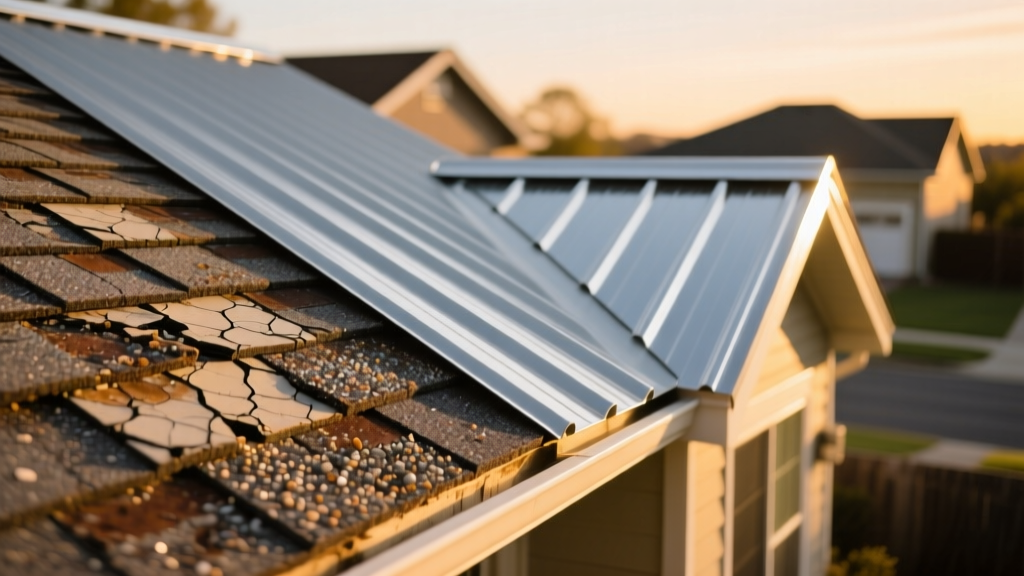
Installation Flaws That Cut Lifespan in Half
According to data aggregated by the DOE Building America Solution Center, improper installation is responsible for the majority of premature roof failures. Even the most expensive slate or metal roof will fail prematurely if the underlying deck and flashings are compromised.
- Over-driven Nails on Asphalt: Pneumatic nail guns set to too high a pressure will drive the nail head through the fiberglass mat of the shingle. This breaks the structural integrity of the shingle and leaves a micro-gap where wind can catch and tear the shingle off during a storm.
- Incompatible Underlayments: Using standard asphalt-saturated felt paper beneath a metal roof traps moisture against the metal's underside, leading to rapid galvanic corrosion. Metal roofs require a high-temp synthetic underlayment or a peel-and-stick ice and water shield in critical valleys and eaves.
- Galvanic Corrosion at Flashings: Mixing dissimilar metals is a fatal error. If a roofer uses copper step flashing against a Galvalume steel panel, the copper will act as a cathode and rapidly corrode the steel. Always use matching metals or separate them with a dielectric barrier or heavy-duty butyl tape.
- Inadequate Flat Roof Slope: Flat roofs (EPDM, TPO, PVC) require a minimum slope of 1/4 inch per foot to ensure positive drainage. Failing to install tapered insulation to create this slope guarantees ponding water, which will void almost all manufacturer warranties.
Maintenance Protocols to Maximize Longevity
Extending your roofing material lifespan requires proactive, scheduled maintenance rather than reactive repairs. Implement the following protocols based on your roof type:
- Bi-Annual Visual Inspections: Conduct inspections in late spring and late autumn. Look for lifted shingle tabs, exposed fastener heads on metal panels, and cracked pipe boots (neoprene pipe boots typically fail in 7-10 years; upgrade to lead or silicone-jacketed boots for a 30-year lifespan).
- Debris and Drainage Management: On flat and low-slope roofs, clear scuppers, gutters, and internal drains quarterly. Accumulated leaves and dirt hold moisture and create acidic environments that degrade membrane seams.
- Algae and Moss Mitigation: Install zinc or copper strips at the ridge line of asphalt roofs. When it rains, trace amounts of metal wash down the roof, creating an environment inhospitable to algae and moss. Avoid pressure washing asphalt shingles, as this strips the protective ceramic granules.
- Attic Ventilation Audits: Ensure soffit vents are not blocked by attic insulation. A super-heated attic in the summer will bake the shingles from underneath, while a humid attic in the winter will cause condensation that rots the OSB roof decking.
Edge Cases: When to Repair vs. Replace
Determining whether to patch a failing roof or invest in a full replacement depends on the percentage of compromised surface area and the age of the system. For asphalt shingles, if more than 25% of the roof shows significant granule loss in the gutters, or if multiple shingles exhibit horizontal creasing (a sign of severe wind fatigue), spot repairs are a waste of capital; full replacement is required. For single-ply commercial membranes (TPO/EPDM), if the membrane has become brittle and loses its elongation properties (tested via a simple field stretch test), patching leaks will only result in new leaks forming adjacent to the repair. In these edge cases, a complete tear-off and system upgrade is the only financially sound decision to restore the building envelope's integrity.
Written by
David NakamuraDavid Nakamura is a licensed architect (AIA) and construction technology writer focused on sustainable building methods, mass timber engineering, and high-performance building envelopes. He holds a Master of Architecture from the University of Washington and is a certified Passive House Consultant (CPHC). David spent eight years at the Seattle firm Mithun, where he led the design of three LEED Platinum projects, before founding his own practice specializing in net-zero residential design. He serves on the editorial advisory board of GreenBuilder Magazine and has authored peer-reviewed papers on cross-laminated timber (CLT) connections for the Journal of Structural Engineering. In his spare time, David teaches woodworking at Pratt Fine Arts Center and kayaks the Puget Sound.
More from David Nakamura
View all
Construction Cost
Labor Cost to Build a Deck Per Sq Ft: 2026 Installation Guide
Discover the exact labor cost to build a deck per sq ft in 2026. This installation guide breaks down contractor rates, complexity factors, and hidden fees.
Aug 4, 2026

Construction Cost
How Much Does It Cost to Build a 3 Bedroom House? Financing Guide
Learn exactly how much it costs to build a 3 bedroom house and explore 2026 financing options, construction loan types, and budget frameworks for your build.
Aug 4, 2026

Construction Cost
Cost to Build a Tennis Court: 2026 Guide
How much does it cost to build a tennis court in 2026? Breakdowns for asphalt, concrete, and synthetic surfaces plus fencing and lighting.
Jul 30, 2026