How to Repair and Maintain Popular Roofing Materials
Discover expert repair and maintenance techniques for popular roofing materials. Learn to fix leaks, replace shingles, and extend your roof's lifespan.

The Physics of Roof Degradation: Why Material Dictates Maintenance
Every roofing system is a continuous battle against thermal expansion, ultraviolet radiation, and hydrostatic pressure. However, the failure modes differ drastically across materials. A maintenance strategy that works for asphalt shingles will actively damage a metal panel system, and treating a flat EPDM membrane like a sloped tile roof guarantees premature water intrusion. Understanding the specific mechanical and chemical vulnerabilities of popular roofing materials is the first step in transitioning from reactive leak-chasing to proactive lifecycle management.
According to the National Roofing Contractors Association (NRCA), over 65% of premature roof replacements are directly tied to deferred maintenance and improper repair techniques rather than material failure. This guide details the exact diagnostic criteria, repair materials, and execution steps required to maintain the most common residential and commercial roofing systems.
Asphalt Shingles: Addressing Wind Creasing and Granule Loss
Asphalt shingles account for the vast majority of residential roofs, yet they are highly susceptible to thermal shock and wind uplift. The most common non-storm failure is 'wind creasing'—a condition where the factory-applied adhesive seal strip fails, allowing the shingle tab to flutter, creating a permanent crease just above the nail line.
Executing a Permanent Shingle Reseal
Do not use standard silicone caulk or roofing tar for shingle repairs; these materials lack the elastomeric properties required to handle the substrate's thermal movement. Instead, follow this protocol:
- Clean the Substrate: Lift the unsealed tab and use a wire brush to remove all remnants of the factory adhesive and accumulated dust from the underlying shingle.
- Apply Elastomeric Adhesive: Use a polyurethane-based roofing adhesive (such as Loctite PL Roof & Flashing or Henry 208R). Apply a continuous 1/4-inch bead, keeping the adhesive at least one inch away from the shingle edge to prevent squeeze-out.
- Weight and Cure: Press the tab down firmly. Place a standard clay brick wrapped in a plastic bag over the repair. Leave the weight in place for 24 hours to ensure a mechanical bond while the polyurethane off-gasses and cures.
Finding granules in your gutters is normal for the first two years. However, if you notice 'bald spots' on the shingle face or the asphalt mat is exposed, the shingle's UV protection is compromised. The Asphalt Roofing Manufacturers Association (ARMA) dictates that localized granule loss exposing the mat requires full shingle replacement, not just a coating of roof paint.
Standing Seam and Exposed Fastener Metal Roofs
Metal roofing is frequently marketed as 'maintenance-free,' which is a dangerous misconception. Exposed fastener metal roofs, in particular, suffer from a phenomenon known as 'fastener backing out.' As the metal panels expand and contract with daily temperature swings (thermal cycling), the screws slowly loosen. Once the neoprene or EPDM washer loses compression, water tracks directly down the screw shaft into the roof decking.
Fastener Replacement Protocol
When performing a maintenance sweep on an exposed fastener roof, inspect every screw head. If the washer is not compressed flush against the metal, or if the rubber is dry-rotted and cracking, it must be replaced.
- Remove the Old Screw: Back the screw out completely. Do not just tighten it, as the threads in the wood purlin or decking may already be stripped.
- Upsize the Fastener: Always step up one gauge in diameter. If the original was a #10 screw, use a #12 or #14 x 1-1/2' metal-to-wood screw with a fresh EPDM washer.
- Control the Torque: Use a variable-speed drill with a magnetic hex nut setter. Never use an impact driver. Impact drivers apply rotational force that will strip the wood substrate and instantly crush the EPDM washer, destroying its waterproofing capability.
Never mix fastener metals. If your roof panels are Galvalume steel, using standard zinc-plated screws will trigger galvanic corrosion, rusting the panel around the screw head within a single season. Always use fasteners with a zinc-aluminum alloy coating (e.g., Stalgard or Ceramic-coated carbon steel) matched to the panel manufacturer's specifications.
Clay and Concrete Tile: Navigating the Underlayment Reality
The most critical concept in tile roofing maintenance is understanding that the tiles themselves are not the primary waterproofing layer. They are a UV and impact shield for the underlying membrane (historically 90lb felt, now typically synthetic underlayments or self-adhering ice and water shields). If water is leaking inside a tile roof, the underlayment has failed, and surface-level tile repairs will not solve the issue.
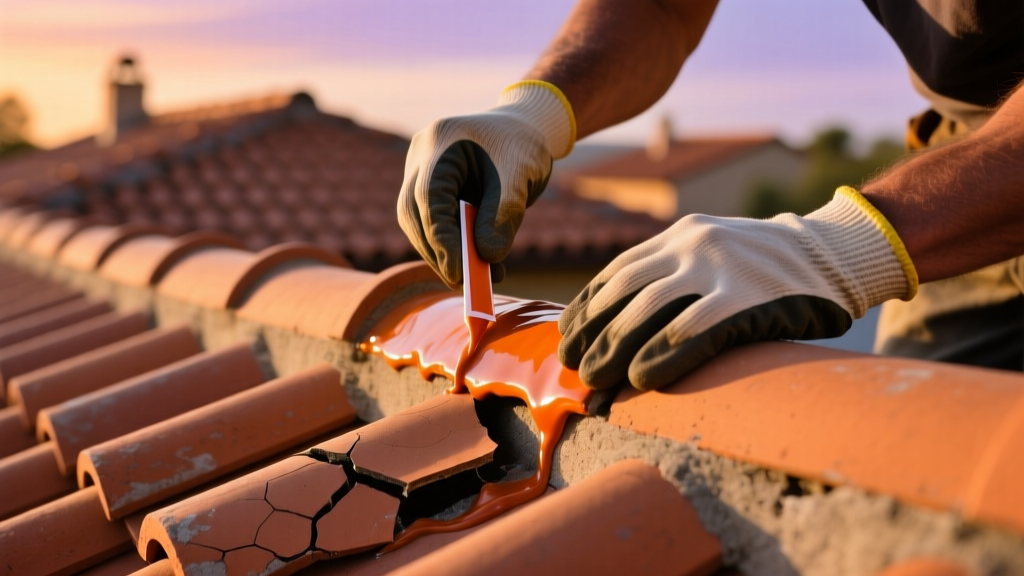
Replacing a Fractured Barrel Tile
Walking on a clay or concrete roof frequently causes micro-fractures that eventually split. When a single tile breaks, replace it without disturbing the surrounding field:
- Lift the Overlap: Carefully slide a flat pry bar under the overlapping tile in the course above to create clearance.
- Extract the Broken Tile: Use a tile ripper or a flat copper hook to grab the broken tile and slide it out. Copper is preferred because it will not mar the glaze of adjacent tiles.
- Install the Replacement: Slide the new tile into the channel. If the tile requires mechanical fastening, apply a 1/2-inch dab of polyurethane roof sealant (like Geocel 2300) to the nose of the tile and the top lug to bond it to the adjacent courses, preventing wind uplift.
EPDM and TPO Flat Roofs: Seam and Membrane Triage
Single-ply membranes dominate the commercial and modern residential flat roof market. While TPO (Thermoplastic Polyolefin) requires specialized hot-air welding equipment for repairs, EPDM (Ethylene Propylene Diene Monomer) can be effectively maintained using chemical primers and vulcanized tapes.
The most common EPDM failure occurs at the seams, manifesting as 'fishmouths'—small, wrinkled gaps where the seam tape failed to adhere flatly, allowing capillary action to draw water into the roof assembly.
Repairing EPDM Seam Fishmouths
- Diagnose the Void: Use a blunt probe (like a putty knife with taped edges) to gently press along the seam. If the probe slips under the tape, the seam is compromised.
- Clean and Prime: Cut an 'X' over the fishmouth. Clean the exposed rubber with a dedicated splice wash (not mineral spirits, which leave an oily residue). Apply a coat of EPDM primer and wait until it passes the 'touch test' (tacky, but no black residue transfers to your finger).
- Patch and Roll: Apply a 4-inch uncured EPDM target patch over the primed area. Use a silicone seam roller to apply a minimum of 100 lbs of pressure, working from the center outward to force out any trapped air.
Cross-Material Maintenance Comparison Matrix
Understanding the financial and temporal commitments of your specific roof type allows for accurate long-term capital planning. The table below outlines the maintenance realities of popular roofing materials in 2026.
| Material Type | Primary Failure Mode | DIY Repair Feasibility | Avg. Professional Repair Cost | Required Inspection Interval |
|---|---|---|---|---|
| Architectural Asphalt | Seal strip failure / Wind creasing | High (Adhesives & hand tools) | $350 - $550 per incident | Every 3 years |
| Exposed Fastener Metal | Fastener back-out / Washer dry-rot | Moderate (Requires torque control) | $600 - $900 per re-screw | Every 2 years |
| Standing Seam Metal | Clip fatigue / Panel oil-canning | Low (Requires seam-forming tools) | $800 - $1,500 per panel | Every 5 years |
| Concrete/Clay Tile | Underlayment degradation / Tile impact | Low (High breakage risk) | $1,200+ (Lift & relay required) | Every 5 years |
| EPDM Membrane | Seam tape delamination / Punctures | Moderate (Requires chemical primers) | $500 - $800 per seam repair | Bi-annually |
The 25% Rule: When to Patch vs. When to Replace
Knowing when a repair transitions into a required full replacement is critical for both structural integrity and insurance compliance. Most municipal building codes and the International Existing Building Code (IEBC) enforce the '25% Rule.' If more than 25% of a roof section is damaged or requires repair within a 12-month period, the code mandates a complete tear-off and replacement of that entire roof section.
Furthermore, repeatedly patching an aging asphalt roof alters the dead load on the roof trusses and traps moisture between layers, accelerating the rot of the OSB or plywood decking. If your roof is past 75% of its manufacturer-rated lifespan (e.g., year 20 of a 30-year shingle) and experiences multiple localized leaks, the return on investment for repairs drops below 15%. In these scenarios, capital should be redirected toward a full system replacement, upgrading to modern synthetic underlayments and high-wind rated materials to reset the maintenance clock.
Expert Insight: 'The most expensive roof repair is the one you have to do twice. Always match the repair material to the original manufacturer's chemical specifications. Applying an asphalt-based tar to an EPDM roof will cause the petroleum distillates to dissolve the synthetic rubber membrane, turning a $50 patch into a $5,000 replacement.' — Senior Forensic Roofing Consultant.
Written by
Priya KapoorPriya Kapoor is a real estate market analyst and construction economics researcher with expertise in housing affordability, development feasibility, and infrastructure investment. She holds a Master of Regional Planning from Cornell University and previously worked as a senior analyst at CBRE's Investment Properties group, where she modeled returns for $4B in mixed-use development pipelines. Priya now runs an independent research practice advising developers, municipalities, and REITs on construction cost forecasting and market timing. She publishes the quarterly "BuildMat Market Pulse" report tracking material price indices across 12 commodity categories. Based in Austin, TX, Priya serves on the board of Habitat for Humanity Austin and is a marathon runner.
More from Priya Kapoor
View all
Construction Cost
Cost to Build a 1600 Sq Ft Home in 2026: Full Breakdown
Accurate 2026 cost to build a 1600 sq ft home—material, labor, and regional pricing breakdowns included. Plan your budget with real-time estimates.
Aug 11, 2026

Wood & Lumber
Name the Types of Wood for Pressure Treatment and Preservation
Learn how to name the types of wood best suited for pressure treatment. Compare species treatability, chemical retention levels, and 2026 preservation costs.
Aug 4, 2026

Stone & Masonry
Stone Veneer Suppliers Lindenhurst: 2026 Cost Analysis
Analyze 2026 stone veneer costs in Lindenhurst, NY. Compare local supplier pricing, delivery fees, and Suffolk County installation labor rates.
Aug 4, 2026