EPDM Roof Systems: Top Brand Product Lines Compared 2026
Compare top EPDM roof brands for 2026. Deep dive into Holcim Elevate, Carlisle SynTec, and Mule-Hide product lines, pricing, and specs.
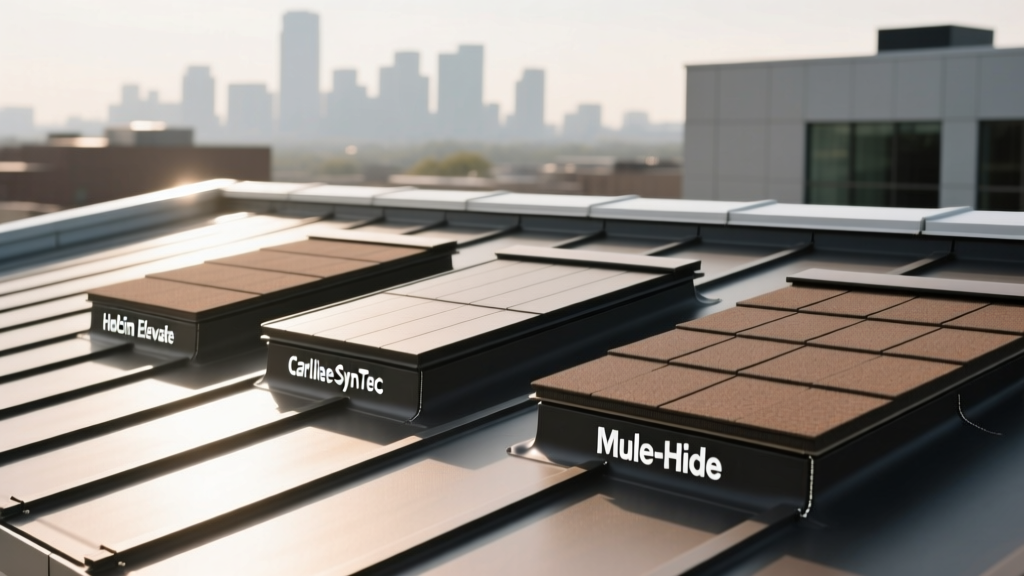
The State of Commercial EPDM Roofing in 2026
Ethylene Propylene Diene Monomer (EPDM) remains a dominant force in the low-slope commercial roofing sector, capturing roughly 35% of the market share. Known for its exceptional UV resistance, flexibility in extreme temperature fluctuations, and proven 30-plus-year lifespan, an EPDM roof is often the default specification for big-box retail, warehouses, and educational facilities. However, not all EPDM membranes are manufactured equally. The differences between top-tier brands lie in their polymer compounding, reinforcement scrims, seam tape technologies, and available sheet widths. According to the EPDM Roofing Association (ERA), advancements in pre-primed seam tapes and fleece-backed membranes have significantly reduced installation labor costs over the last five years. This deep dive examines the three leading EPDM roof product lines available in 2026: Holcim Elevate (RubberGard), Carlisle SynTec (Sure-Seal), and Mule-Hide.
Holcim Elevate (RubberGard): The Industry Workhorse
Holcim Elevate, which absorbed the legacy Firestone Building Products line, manufactures the RubberGard EPDM membrane. RubberGard is widely considered the industry benchmark for non-reinforced and reinforced EPDM. The product line is available in 45-mil, 60-mil, and 90-mil thicknesses. For most commercial applications requiring a 20-year or 30-year total system warranty, the 60-mil non-reinforced membrane is the standard specification.
Product Specs & Pricing
The 60-mil RubberGard membrane weighs approximately 0.34 pounds per square foot and offers a tensile strength of 1,300 psi. Material pricing in 2026 hovers between $0.65 and $0.82 per square foot for the 60-mil non-reinforced option, depending on distributor volume tiers. Holcim’s proprietary QuickSeam tape system, paired with QuickPrime Plus, remains a favorite among contractors for its aggressive initial tack and long-term vulcanization to the membrane.
Carlisle SynTec (Sure-Seal): Premium Reinforcement & Fleece Options
Carlisle SynTec’s Sure-Seal EPDM line is engineered for high-stress environments. While they offer standard non-reinforced sheets, Carlisle’s true market differentiator is its reinforced EPDM and FleeceBACK options. The Sure-Seal Reinforced membrane incorporates a tough, cross-woven polyester scrim that provides exceptional puncture resistance and dimensional stability, making it ideal for mechanically attached systems where wind uplift forces concentrate at the fasteners.
The FleeceBACK Advantage
Carlisle’s Sure-Seal FleeceBACK EPDM features a thick polyester fleece laminated to the back of the membrane. This allows contractors to adhere the EPDM directly to polyisocyanurate (polyiso) insulation using low-rise urethane adhesives, entirely bypassing the need for a separate gypsum or HDPE cover board. While the FleeceBACK membrane costs roughly 15% to 20% more upfront (around $0.95 to $1.15 per square foot for 60-mil), it saves $0.35 to $0.50 per square foot in cover board materials and significantly reduces labor time.
Mule-Hide Products: The High-Width, Contractor-Friendly Contender
Distributed primarily through ABC Supply locations, Mule-Hide EPDM is heavily favored by mid-sized commercial contractors and residential low-slope specialists. Mule-Hide’s primary advantage is its availability in massive 50-foot-wide rolls. While Holcim and Carlisle typically max out at 20-foot or 25-foot widths for standard logistics, Mule-Hide’s 50-foot sheets drastically reduce the number of field seams on large, open roof decks.
Fewer seams translate directly to lower labor costs and a reduced probability of future leaks, as the field membrane itself rarely fails. Mule-Hide’s 45-mil and 60-mil membranes are highly competitive in price, often undercutting the major manufacturers by $0.05 to $0.10 per square foot. However, Mule-Hide’s warranty infrastructure and technical support network are generally considered less robust than the enterprise-level support provided by Holcim or Carlisle, making it a better fit for projects where the contractor’s own workmanship warranty carries more weight than the manufacturer’s material warranty.
Head-to-Head EPDM Roof Brand Comparison Matrix
| Feature | Holcim Elevate (RubberGard) | Carlisle SynTec (Sure-Seal) | Mule-Hide EPDM |
|---|---|---|---|
| Standard Thicknesses | 45, 60, 90 mil | 45, 60, 90 mil | 45, 60 mil |
| Max Sheet Width | 20 ft (standard), 50 ft (special order) | 25 ft (standard) | 50 ft (readily available) |
| Fleece-Back Option | Yes (RubberGard Fleece) | Yes (FleeceBACK) | Limited availability |
| 60-Mil Material Cost | $0.65 - $0.82 / sq ft | $0.70 - $0.90 / sq ft | $0.58 - $0.75 / sq ft |
| Primary Seam Tech | QuickSeam Tape | SecuR Lap Tape | Standard Lap Tape / Liquid |
Critical Installation Nuances & Common Failure Modes
Even the highest-grade EPDM membrane will fail if installation protocols are ignored. Based on forensic roofing analyses and National Roofing Contractors Association (NRCA) guidelines, the most common EPDM roof failure modes include:
- Membrane Shrinkage at Penetrations: EPDM naturally shrinks over time (up to 1% to 2% over a 20-year period). If the membrane is pulled tight around HVAC curbs or pipe penetrations without leaving an adequate relaxation fold, the tension will eventually tear the membrane or pull it away from the flashing clamps. Always leave a 2-inch relaxation fold at the base of all penetrations.
- Adhesive Failure in Cold Weather: Water-based contact adhesives and primers will not cure properly if ambient temperatures drop below 40°F (4°C). Attempting to install fully adhered EPDM in late autumn without cold-weather adhesive formulations results in immediate seam delamination.
- Inadequate Seam Rolling: EPDM seam tape requires immense pressure to activate the chemical cross-linking. Using a standard 1.5-inch silicone roller is insufficient. Contractors must use a minimum 2-inch wide, heavy-duty steel roller, applying at least 100 pounds of pressure per linear inch to ensure a watertight vulcanization.
- Oil and Grease Exposure: EPDM is highly susceptible to degradation from animal fats, vegetable oils, and petroleum products. Restaurants with unfiltered exhaust vents will experience rapid membrane swelling and dissolution. In these scenarios, specify a TPO or PVC membrane instead.
System Attachment Methods: Making the Right Choice
The longevity of your EPDM roof is heavily dictated by how it is secured to the deck. Choose your attachment method based on the building's structural capacity and wind zone:
- Fully Adhered: The membrane is bonded directly to the insulation or cover board using a uniform layer of bonding adhesive. This provides the highest wind uplift resistance (ideal for coastal or high-wind zones) and prevents wind from getting underneath the membrane to cause billowing. It is the most labor-intensive and expensive method.
- Mechanically Attached: The membrane is secured using batten strips and fasteners driven into the structural deck, with the seams covering the fasteners. This is the fastest and most cost-effective method for large, open warehouses, but it requires a reinforced EPDM membrane to prevent the fasteners from tearing through the material under high wind loads.
- Ballasted: The membrane is laid loose over the insulation and held in place by smooth river stone or concrete pavers (typically 10 to 12 pounds per square foot). This method is incredibly fast to install and protects the membrane from UV degradation, but the building’s structural deck must be engineered to support the massive dead load of the stone.
Final Procurement Framework
When specifying an EPDM roof system for your next project, use this decision framework to select the right brand:
Specify Holcim Elevate (RubberGard) if: You are managing a large corporate portfolio, require the most robust 30-year total system warranty, and your contractor network is already deeply trained on the QuickSeam system.
Specify Carlisle SynTec (Sure-Seal) if: You are installing over polyiso insulation and want to eliminate the cover board via the FleeceBACK product, or if you are in a severe hurricane zone requiring reinforced, mechanically attached membranes.
Specify Mule-Hide if: You are a mid-sized contractor tackling a sprawling, low-complexity roof deck where 50-foot sheets will drastically reduce your seam labor, and you are relying on your own firm's workmanship warranty rather than a manufacturer's premium guarantee.
By aligning the specific product line advantages with your project's structural, financial, and logistical constraints, you ensure your EPDM roof delivers decades of watertight performance.