Which Roof Material for Flat Roof Offers Maximum Durability?
Compare the top roof material for flat roof systems based on durability, lifespan, and weather resistance to find the best membrane for your building.

The Reality of Flat Roof Degradation
Selecting the correct roof material for flat roof applications requires understanding that low-slope systems do not shed water; they manage it. Unlike pitched roofs that rely on gravity to rapidly clear precipitation, flat roofs are subjected to ponding water, extreme thermal shock, and concentrated UV radiation. According to the National Institute of Building Sciences, the primary cause of premature flat roof failure is not the membrane itself, but the degradation of seams, flashings, and substrate adhesion caused by continuous thermal expansion and contraction.
To maximize lifespan, building owners must move beyond basic material selection and evaluate specific membrane thicknesses, attachment methods, and chemical formulations. The following analysis breaks down the leading commercial and residential flat roof membranes through the lens of long-term durability and real-world failure modes.
Durability and Lifespan Matrix
The table below outlines the performance characteristics of the four dominant low-slope roofing systems. Costs reflect 2026 national averages for fully adhered or mechanically attached commercial installations, including insulation and labor.
| Membrane Type | Optimal Thickness | Expected Lifespan | Puncture Resistance | Ponding Water Tolerance | Installed Cost (per sq ft) |
|---|---|---|---|---|---|
| EPDM (Black) | 60-mil | 25 - 35+ years | Moderate | Excellent | $5.50 - $9.00 |
| TPO (White) | 80-mil | 20 - 25 years | High | Good | $6.00 - $10.50 |
| PVC (White) | 60-mil | 25 - 30 years | High | Excellent | $7.50 - $12.00 |
| SBS Mod-Bit | 2-Ply (180-mil) | 15 - 22 years | Very High | Good | $5.00 - $8.50 |
EPDM Rubber: The 40-Year Workhorse
Ethylene Propylene Diene Monomer (EPDM) is a synthetic rubber membrane renowned for its exceptional resistance to UV radiation and ozone. While 45-mil EPDM is common in budget residential applications, 60-mil is the absolute minimum for commercial durability. Thicker membranes resist hail impact and foot traffic damage significantly better.
Critical Failure Mode: Membrane Shrinkage
The most common failure point for EPDM is not the field of the membrane, but the perimeter. Over a 20-year period, EPDM can shrink up to 5%. In mechanically attached or ballasted systems, this shrinkage pulls the membrane taut, eventually tearing it away from parapet walls, HVAC curbs, and pipe penetrations.
TPO and PVC: Heat-Welded Thermoplastics
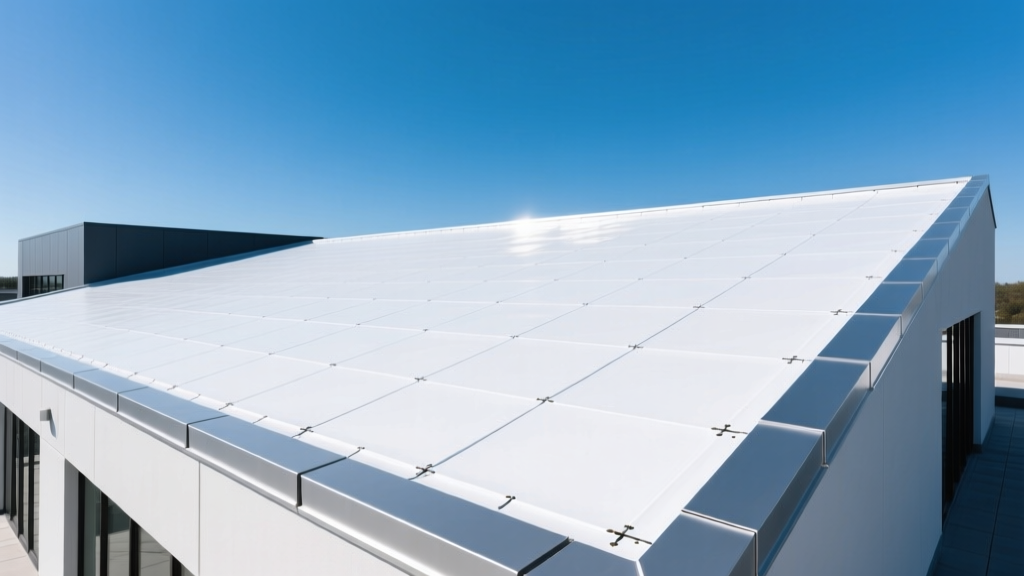
Thermoplastic membranes dominate the modern commercial market due to their reflective properties and monolithic seams. The U.S. Department of Energy notes that highly reflective white roofs can reduce peak cooling demand by 10% to 15%, significantly lowering the thermal shock burden on the membrane itself.
TPO: Overcoming Early Formulation Flaws
Thermoplastic Polyolefin (TPO) suffered a reputation crisis in the early 2000s due to severe cracking and premature seam failure caused by inadequate UV stabilizers. Modern TPO formulations (manufactured post-2018) utilize advanced Hindered Amine Light Stabilizers (HALS) and reinforced polyester scrim. For maximum durability in hail-prone regions, specify 80-mil TPO. The heat-welded seams (typically fused at 950°F to 1100°F) create a bond that is physically stronger than the membrane itself, eliminating the primary vulnerability of taped or glued systems.
PVC: The Chemical and Grease Resistant Option
Polyvinyl Chloride (PVC) shares TPO's heat-welded seam advantage but offers superior chemical resistance. If your flat roof houses commercial kitchen exhaust fans, HVAC units that may leak oil, or industrial chemical vents, PVC is the mandatory choice. Oils and greases will rapidly dissolve TPO and degrade EPDM, but PVC's molecular structure resists hydrocarbon breakdown. Furthermore, PVC handles chronic ponding water slightly better than TPO due to its inherent plasticizer flexibility.
Modified Bitumen: The Puncture-Resistant Option
Styrene-Butadiene-Styrene (SBS) modified bitumen is an asphalt-based system fortified with synthetic rubber. It is installed in multiple plies, typically resulting in a roof system that is 180 to 250 mils thick. This massive thickness grants SBS the highest puncture resistance of any single-ply or built-up alternative.
SBS is the ideal roof material for flat roof environments that require frequent foot traffic for maintenance, or buildings located in severe hail corridors. The primary aging indicator for SBS is granule loss. Once the protective ceramic granules wear away, the underlying asphalt becomes vulnerable to UV degradation. Specifying a heavily granulated cap sheet or applying a reflective silicone roof coating after year 10 will effectively double the system's functional lifespan.
Decision Framework: Matching Material to Climate
Durability is highly dependent on environmental context. Use this framework to align your membrane choice with local weather patterns:
- High Heat & Sunbelt Climates: White TPO or PVC. The reflectivity prevents the membrane from reaching the 160°F+ surface temperatures that accelerate plasticizer loss and thermal fatigue.
- Heavy Ponding & Northern Climates: EPDM or PVC. EPDM's vulcanized rubber remains flexible at sub-zero temperatures, while PVC's welded seams prevent water infiltration during freeze-thaw cycles.
- High Wind & Coastal Zones: Fully adhered PVC or Mod-Bit. Mechanical fasteners are prone to back-out under extreme wind uplift. Fully adhered systems distribute wind loads across the entire substrate.
Installation Variables That Void Lifespan Warranties
Even the most premium roof material for flat roof applications will fail within five years if installation protocols are violated. According to the Environmental Protection Agency, proper installation and maintenance are critical to realizing the energy and longevity benefits of low-slope systems. Ensure your contractor strictly adheres to these parameters:
Substrate Moisture Verification
Trapping moisture beneath a new single-ply membrane guarantees premature failure. Moisture turns to vapor under solar heat, creating blisters that break the adhesive bond. Contractors must perform nuclear moisture scans or infrared thermography on the existing roof deck before applying new polyiso insulation.
Heat-Weld Calibration
For TPO and PVC, robotic welders must be calibrated daily. Ambient temperature, wind speed, and humidity dictate the exact welding temperature and speed. A weld that is too cool results in a "cold seam" that will peel open during winter contraction; a weld that is too hot burns the polymer, creating a brittle fracture point.
Fastener Back-Out Prevention
In mechanically attached systems, fasteners must penetrate the structural deck by a minimum of 3/4 inch into steel or 1 inch into wood. Using screws that are too short, or driving them into degraded concrete decks, will result in fastener back-out during thermal cycling, ultimately tearing the membrane from the inside out.
Written by
David NakamuraDavid Nakamura is a licensed architect (AIA) and construction technology writer focused on sustainable building methods, mass timber engineering, and high-performance building envelopes. He holds a Master of Architecture from the University of Washington and is a certified Passive House Consultant (CPHC). David spent eight years at the Seattle firm Mithun, where he led the design of three LEED Platinum projects, before founding his own practice specializing in net-zero residential design. He serves on the editorial advisory board of GreenBuilder Magazine and has authored peer-reviewed papers on cross-laminated timber (CLT) connections for the Journal of Structural Engineering. In his spare time, David teaches woodworking at Pratt Fine Arts Center and kayaks the Puget Sound.
More from David Nakamura
View all
Construction Cost
Labor Cost to Build a Deck Per Sq Ft: 2026 Installation Guide
Discover the exact labor cost to build a deck per sq ft in 2026. This installation guide breaks down contractor rates, complexity factors, and hidden fees.
Aug 4, 2026

Construction Cost
How Much Does It Cost to Build a 3 Bedroom House? Financing Guide
Learn exactly how much it costs to build a 3 bedroom house and explore 2026 financing options, construction loan types, and budget frameworks for your build.
Aug 4, 2026

Construction Cost
Cost to Build a Tennis Court: 2026 Guide
How much does it cost to build a tennis court in 2026? Breakdowns for asphalt, concrete, and synthetic surfaces plus fencing and lighting.
Jul 30, 2026